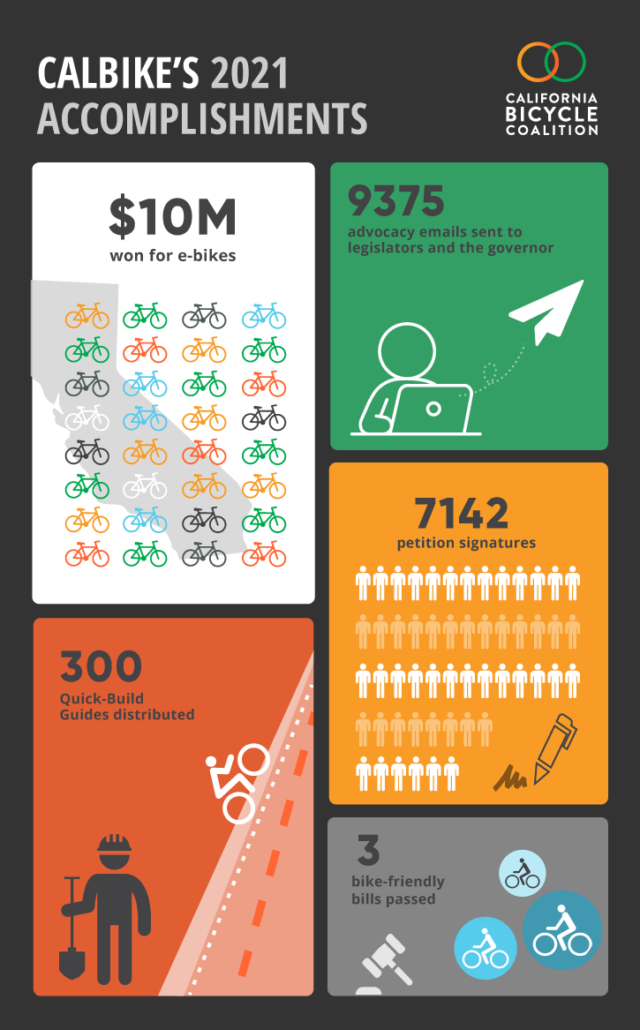
Thanks to support from our members, CalBike won a $10 million appropriation in this year’s budget to help Californians purchase electric bikes. The California Air Resources Board will administer the program, which must be operating by July of 2022.
The program will distribute vouchers to people who meet income eligibility requirements. The CARB will release a Request for Proposals to implement the program in the next couple of months, detailing important goals and specifications to shape voucher distribution.
CalBike is working with CARB to help ensure that the implementation meets CalBike’s objectives for this program. Here’s what we know so far.
Which types of e-bikes are eligible for the voucher program?
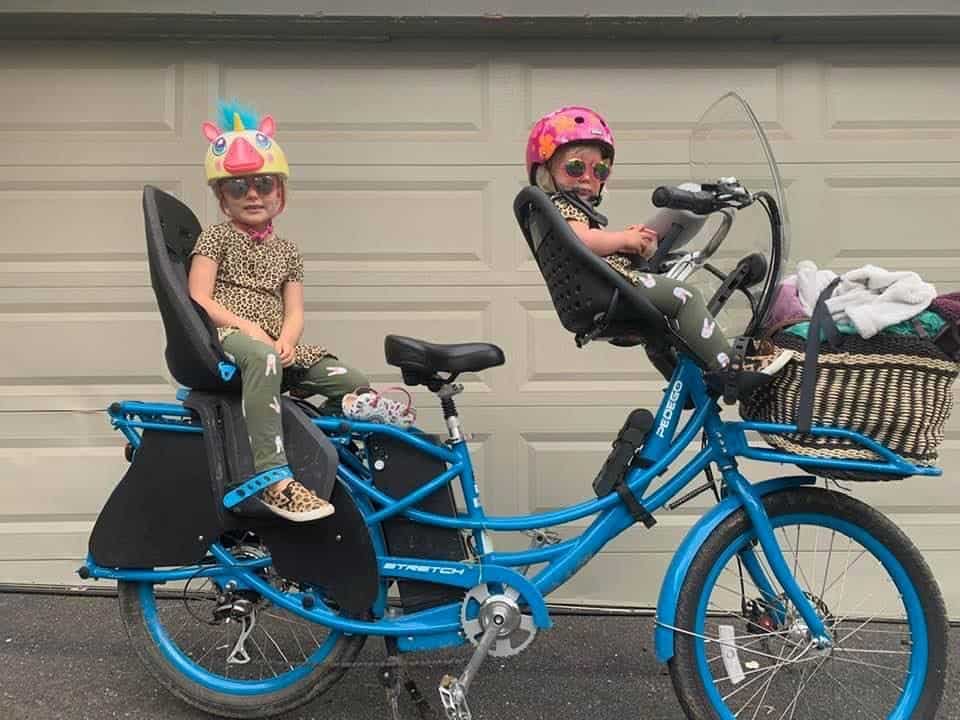
“Electric bicycles eligible for the incentives include, but are not limited to, those designed for people with disabilities; utility bicycles for carrying equipment or passengers, including children; and folding bicycles.”
Who will be eligible for e-bike purchase incentives?
The Air Resources Board has signaled its intent to restrict eligibility to low-income households (defined as households with income less than four times the federal poverty level, or $51,520 for an individual, or $106,000 for a family of four). The income restriction is not required by law, and CARB’s electric vehicle incentive program doesn’t include any income requirements.
CalBike and the more than 50 organizations that supported the program advocated for at least 80% of the funds to go to low-income households. We wanted 20% of the vouchers available to middle-income families to allow for broader funding distribution. Plus, it would have recognized that, like EVs, e-bikes are a civic good, and the state wants to encourage people to choose this form of transportation.
CalBike supports this initial round of funding going exclusively to disadvantaged people. However, it will take more than a grant to make the program successful. The upfront cost of a quality e-bike will be out of reach for most low-income people, even with a hefty subsidy. To ensure that everyone can access this incentive, we want the program to include an arrangement with a lender to will provide low- or zero-interest loans to buyers so that they can pay for an e-bike in installments.
The role of community-based organizations
A bike purchase incentive program differs from an electric vehicle incentive program because many potential recipients don’t already recognize how a bike could improve their lives. Everyone (almost) wants a car and would welcome a purchase subsidy, but the same is not true for bikes.
That’s why CalBike sees an essential role for nonprofits in distributing the funds. If community organizations serving low-income people are able to make extremely low-cost e-bikes available to their constituencies, they can engage and educate about howto use the bike to replace car trips. A nonprofit can also provide bike safety information and classes, so grant recipients are confident to ride their e-bikes for transportation. With this support, the e-bike suddenly becomes a viable transportation choice and the subsidy a critical lifeline.
Community-based organizations can also help identify the people who would benefit most from a low-cost e-bike and help spread the word among their constituencies. Plus, they can assist with the paperwork to apply for the grants, and they might be able to combine this subsidy with other funding sources to make bikes truly affordable. These groups can also provide feedback to evaluate the impact of the e-bike affordability program.
The impact of $10M for e-bikes
If designed and administered well, California’s new e-bike affordability program could have an impact far beyond the lives of the people who will be able to buy e-bikes.
First, if CARB successfully markets the program, it will increase awareness of biking as a viable and green transportation option. That, we hope, will create demand to expand the program and increase the funding available to help people buy bikes. And the incentives will put thousands more bicycles on our streets, which will raise the visibility of biking, increase the pressure to build safe bikeways, and encourage more people to hop on a bike. Plus, up to 10% of the funding in this program may be used for bicycle education, so it’s a great opportunity to build skills and confidence for more riders.
We’ll keep you informed when there’s more to know about the e-bike affordability program. Sign up below to be the first to know when the e-bike vouchers become available.
https://www.calbike.org/wp-content/uploads/2021/03/Yuba-e-bike-POC-e1616451276226.jpeg10562400Kevin Claxtonhttps://www.calbike.org/wp-content/uploads/2018/07/calbike-logo.pngKevin Claxton2022-02-09 19:34:332024-08-06 13:31:15Making California’s E-Bike Affordability Program Successful
Each year, CalBike sponsors legislation to make our streets safer and help more Californians choose active transportation. The bills sponsored by state Senators and Assemblymembers are the focus of significant discussion and advocacy, and we ask our supporters to email their representatives and the governor to build support.
Legislative initiatives are essential for advancing the cause, and we will certainly ask you to send emails in support of active transportation and safety legislation this year. But legislation is the tip of the iceberg for CalBike’s advocacy. The work we do out of the spotlight and without a lot of fanfare often has the biggest impact. We meet with officials at Caltrans and other agencies to change regulations and help craft new programs to support biking. We advocate for more funding for active transportation. This effort has led to a doubling of the Active Transportation Program budget and, this year, we might see that figure triple (though perhaps a temporary increase).
In 2022, CalBike plans to pursue several exciting initiatives to increase funding and access for people on bikes. Here’s a preview.
But first, some facts about advocating for change in California
California is one of only 10 states with full-time legislatures. Our state is the most populous of the 50 states, and our economy would be the fifth-largest in the world if we were a country, ranking just above the UK. All of which is to say that doing advocacy in Sacramento is more like pulling the levers of a national government than a state legislature.
CalBike is California’s only statewide nonprofit bicycle advocacy organization, and we are the little engine that could. With a handful of full-time and part-time staffers and help from our members and supporters, we stand for the interests of people who bike to make active transportation a safe choice for all Californians.
Each year, we build on our accomplishments to increase momentum for bicycling, and we expect 2022 to be a big year for progress toward a safer, more joyful, and more equitable California.
The enormous impact of the budget for better biking
Funding for biking and walking infrastructure is crucial to creating safe neighborhoods where active transportation is an easy choice. You may have experienced this when your community was able to build a new bike route or protected bikeway thanks to state funds.
Each funding cycle, the ATP receives hundreds of project proposals. There were so many excellent projects in the latest round that the funding ran out before all of the higher-scoring proposals were funded. CalBike advocated for more funding to build those shovel-ready projects in the 2021/22 budget. Although $500 million was approved initially, the money was pulled back because of a budget impasse between the governor and the legislature.
But budget discussions are back on, and CalBike is now advocating for $2 billion for bikes. So far, the governor’s budget proposal includes an additional $600 million: $500 million for the ATP, on top of about $230 in regular funding, plus $100 million dedicated to active transportation improvements in the Highway Safety Improvement Program.
We’re not giving up on the additional $1.4 billion we want for walking and biking in this year’s budget. CalBike has proposed $500 million for 15-minute neighborhoods, as promised by the governor in his veto statement for AB 1147. We’d also like to see funding for connected bikeway networks and separated bicycle highways.
If California is serious about mitigating climate change, its budget priorities need to reflect that. CalBike is working hard to move the needle on active transportation funding.
Creating an equitable e-bike affordability program
In 2021, with help from our supporters and allies, CalBike won $10 million in funding for an e-bike affordability program. Electric bikes open bicycling as everyday transportation to a broader group of people, but the steep price tag can be a barrier. The program, which will start in July 2022, will offer vouchers to low-income Californians to help them purchase e-bikes. CalBike is working with CARB, which will administer the program the ensure that the model is equitable and accessible. We hope for a successful launch to demonstrate that e-bike subsidies are just as popular as electric vehicle rebates so that the program will get ongoing funding.
Advocating for a better way to use safety funding
In addition to pushing for more money for biking, CalBike also works with agencies to better use the funding they already have.
For example, the California Office of Traffic Safety gives money to local police departments to support Vision Zero. Unfortunately, police departments often use that money to target and ticket people who ride bikes. CalBike is working with OTS to revise its policies, so Vision Zero funding goes to projects that genuinely make streets safer for people biking and walking, rather than harassing bicyclists.
We are also working with HSIP to define the safety elements of highway projects more clearly.
Continuing to push toward decriminalization of commonsense biking and walking
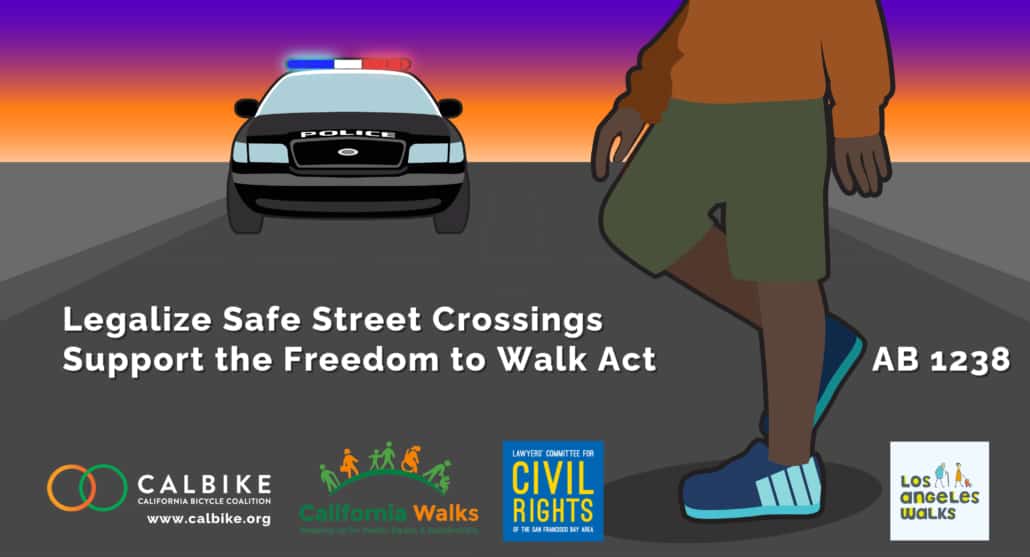
The governor vetoed CalBike’s bills to legalize the bicycle safety stop and end penalties for safe street crossings, but our campaigns for those bills built a groundswell of support for decriminalization. We’ll be building on that momentum in 2022 (and beyond) and continue to work with our allies on critical issues of traffic safety and police overenforcement. We hope to have more to share with you about those efforts later this year.
Working toward bike-share equity
Bike and scooter sharing systems are a terrific solution for last-mile (and often longer) transit and filling gaps in our public transportation systems. However, the costs for some private systems have become unaffordable for many users due to price hikes. And, if cities concentrate micromobility options in wealthier neighborhoods, they miss out on an excellent opportunity to increase transit equity.
CalBike will work toward equity in micromobility in 2022 by advocating for public transit agencies to add bike-share to their offerings, allowing passengers to use transfers and pay fares comparable to other forms of transit. We are also working with a researcher from UC Davis on a study of equity in micromobility. We think that will help move California toward more equitable and sustainable bike and scooter sharing.
A planning change that will make biking more practical
One critical thing to make biking a practical transportation choice is a secure place to park your bike. CalBike is working with other advocates and the California Department of Community Services and Development to develop guidelines for new housing that will require new apartment buildings to include bike parking.
We might not ask you to sign a petition or send an email about these initiatives but look for updates on these vital advocacy projects that could have big effects in communities across California.
Bringing advocates and decision-makers together at the California Bicycle Summit
Every two years, CalBike hosts the California Bicycle Summit. The event brings together people who care about better biking from around the state to share ideas, network, learn, and have a little fun, too. We’ll have 32 breakout sessions, plus bike rides, a bicycle movie festival, and more. The Summit will be held in beautiful Uptown Oakland on April 6-9, 2022. Registration is open. We hope to see you there!
https://www.calbike.org/wp-content/uploads/2022/01/pulling-the-levers-in-Sacramento-scaled.jpeg17072560Kevin Claxtonhttps://www.calbike.org/wp-content/uploads/2018/07/calbike-logo.pngKevin Claxton2022-01-26 15:13:392022-01-26 15:13:40How CalBike Quietly Pulls the Levers of Power in Sacramento
On April 6-9, 2022, we hope you will join us in Oakland to strengthen and grow the movement for sustainable transportation. The California Bicycle Summit, held every two years, always feels like a momentous occasion, but gathering in person after the past two years is even more compelling. The theme for this year’s Summit is CONNECTING.
We didn’t pick the theme just because we are thrilled to get together with all of you (though we are!). CONNECTING is about many different types of connections:
Creating connected neighborhoods where people of all ages can get to school, to work, or to the store without being forced to get in a car
Connecting to our bodies through the joyful movement of riding a bike
Connecting to the planet and creating a transportation system that aligns with the needs of Earth’s natural systems
Connecting the varied issues that we must address together: racism, lack of housing, and streets that are unsafe for many reasons, to name just a few
Connecting across communities and cultures to better understand and support each other
Connecting to create equitable communities where the joy of bicycling is an easy choice
The 2022 California Bicycle Summit is a can’t-miss event for people who care about biking
Speakers at the 2022 California Bicycle Summit will include community activists, California decision-makers, bicycle advocates, industry leaders, and planners designing the next generation of safer streets. They will present 32 exciting breakout sessions on a wide range of topics, including:
The promise and reality of Caltrans shift to support active transportation
Success stories of intersectional bike advocacy
Access to biking for people with disabilities
Two design symposia where engineers and planners will share cutting edge street designs
Accounts from the leaders of ride-outs, the grassroots biking events spreading across the country
The importance of community bike shops: how to make them excellent, how to support them
Black and POC-rooted solutions for mobility and empowerment
The still-growing impact of e-bikes
The intersections of active transportation with housing policy and climate action
Reports from Finland, Latin America, and across California about how to improve bicycle mode share
And much more
The event will also host fun and informational bike rides and social events:
Tours of infrastructure in the East Bay and San Francisco, including visiting the state’s only edge lane road
Visits to outstanding community bike shops
Recreational rides on the Bay Area’s beautiful backroads
A chance to join the famous and fabulous East Bay Bike Party, a rolling celebration of biking, music, and dancing that takes place every second Friday
A movie night featuring California’s best bike-themed short films
We’re delighted to bring the Summit to beautiful Uptown Oakland. Plenary sessions will be in the gorgeous 1926 art deco California Ballroom; breakout sessions will be held at the OakStop, a top-notch locally- and Black-owned event center. Telegraph Avenue in front of the venue will be closed to cars and open for socializing during the Summit.
Oakland, home of the Original Scraper Bike Team, enjoys a vibrant, diverse culture where powerful bike advocates collaborate with bike-friendly leadership in city government. We are proud to showcase The Town’s active and creative bike scene and fabulous art and architecture.
We invite anyone passionate about bicycling to join us—whether you’re a bike advocate, city official, planner, or a CalBike member who simply cares about making the world healthier, more just, and more sustainable and wants to learn more. See you in April!
https://www.calbike.org/wp-content/uploads/2022/01/Oakstop-overview.jpg360640Kevin Claxtonhttps://www.calbike.org/wp-content/uploads/2018/07/calbike-logo.pngKevin Claxton2022-01-26 15:10:032023-11-28 12:11:14Announcing the Theme of the 2022 California Bicycle Summit: CONNECTING
A completely unscientific look at the best and worst of California biking in 2021.
Let’s be honest: the competition for the worst in 2021 was fierce. We started the year with such high hopes. It had to be better than 2020, right? Nope. But there were many bright spots for biking in California, even in a crazy year like 2021. And, anyway, 2022 is bound to be a better year. Right? Right???
A bikeway grows in California
Whether fueled by the conversion of pandemic Slow Streets into permanent civic spaces or the fruit of many years of advocacy and local pressure, 2021 had a bumper crop of new bikeways. Here are some of the best, plus a couple of instances where planners let cars roll over their better judgment.
Best quick-build demo that should become permanent: Glendora Ave Complete Streets Demo
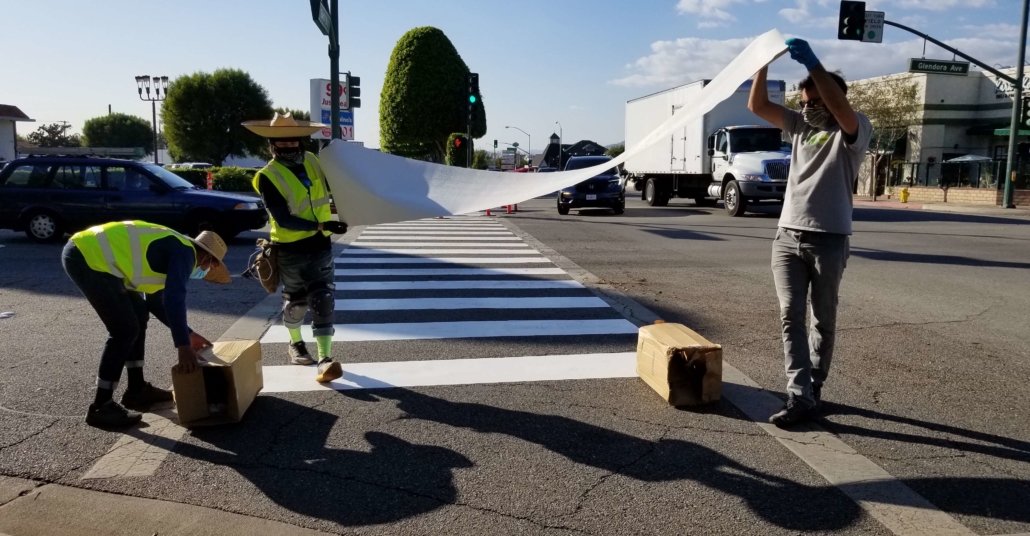
For most infrastructure projects, $46,000 would barely make a dent in the budget. But the city of Glendora and the San Gabriel Council of Governments used that amount to install quick-build improvements, including crosswalk striping and planters to create a buffer for separated bike lanes. Glendora plans to expand the project and make it permanent to improve access to a planned rail line extension, but the quick-build demo is helping people bike more safely right now. More of this, please. Read more in Streetsblog LA.
Best Slow Street that became permanent, thanks to quick-build: Doyle Street, Emeryville
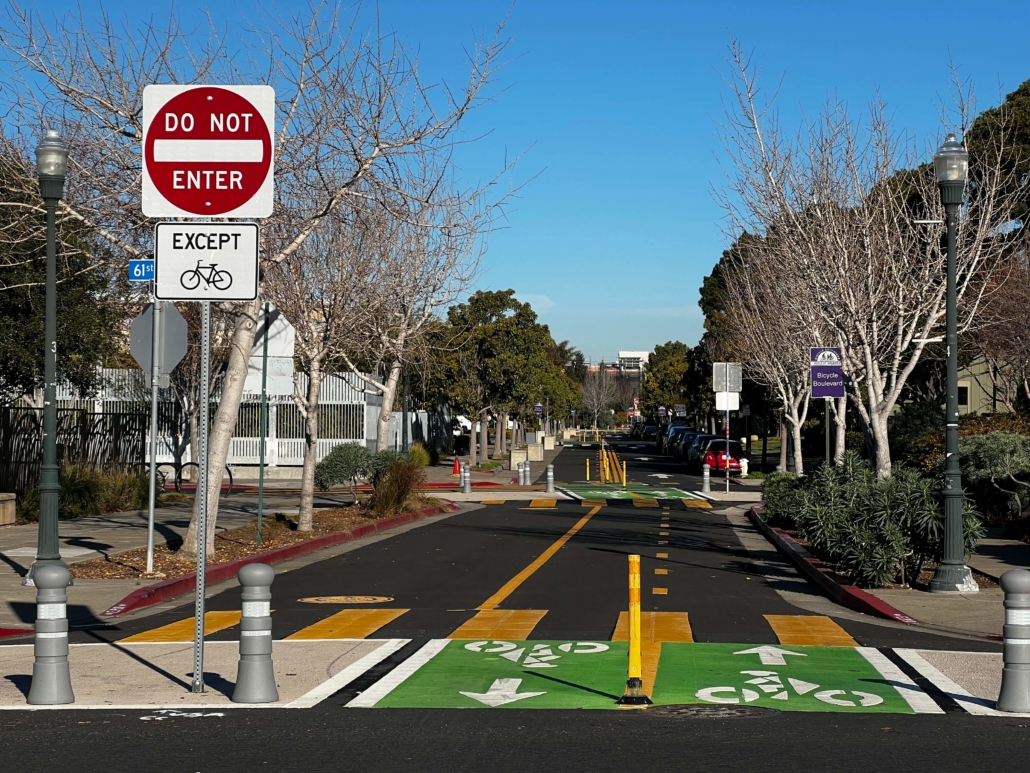
Emeryville took advantage of pandemic Slow Streets and the availability of quick-build funding to exclude or restrict traffic on several blocks of Doyle Street. Quick-build allowed the city to quickly make changes to create a joyful, safe space, connecting playgrounds and an off-road bike path, where kids can zoom around on bikes and scooters and neighbors walk and ride. And they got design help from Mr. Barricade.
Best examples of persistence paying dividends—a 2-way tie!
Photo from City Heights CDC
Orange Avenue Family Bikeway
The Orange Avenue Family Bikeway is a grassroots project in an environmental justice community that will implement the San Diego region’s first Bike Boulevard network with traffic diverters. SANDAG leadership halted the project in 2016 to get a freeway-centric funding measure approved, but fortunately, it was saved by community leaders in 2017, approved in 2019, and fast-tracked in 2021.
Photo from Randy Torres-Van Vleck
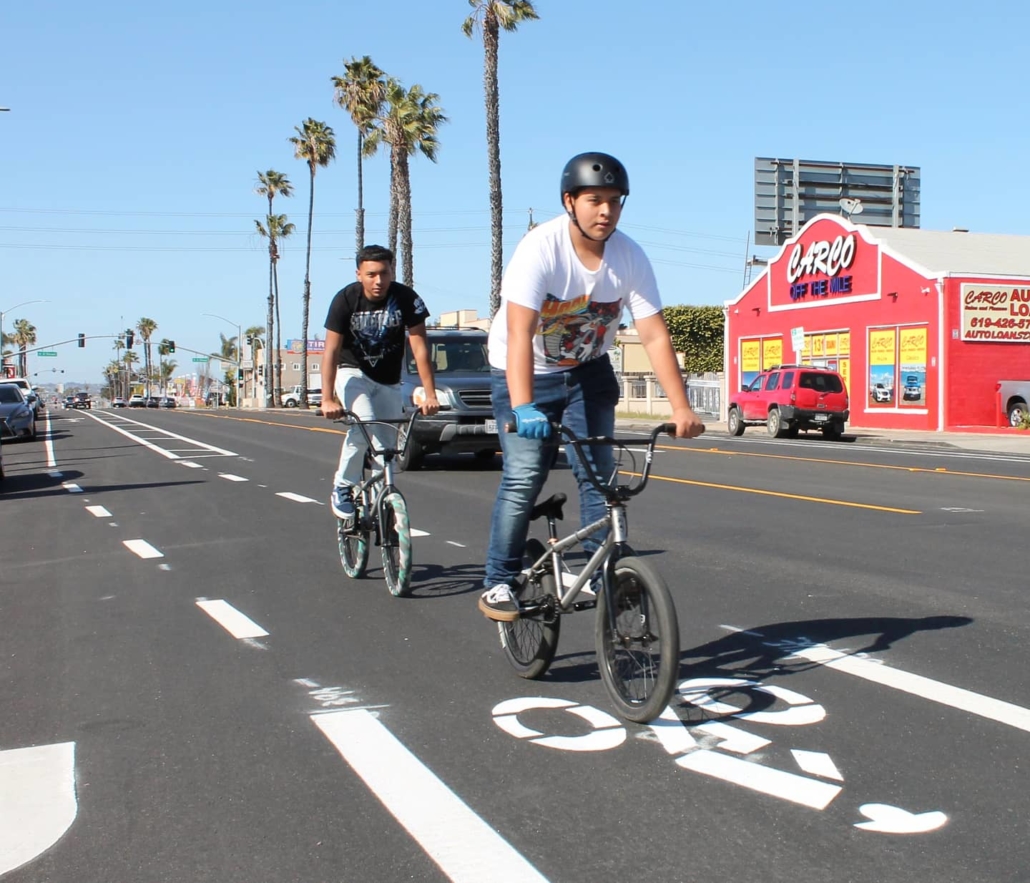
Bike lanes on Broadway Avenue in Chula Vista
At four miles long in each direction, the bike lane on Broadway in Chula Vista is the longest continuous bike lane ever installed as a single project on a commercial corridor in San Diego County. It took more than eight years to get this project approved and completed. Shout out to City Heights Community Development Corporation for keeping the pressure on for Orange Avenue and Broadway.
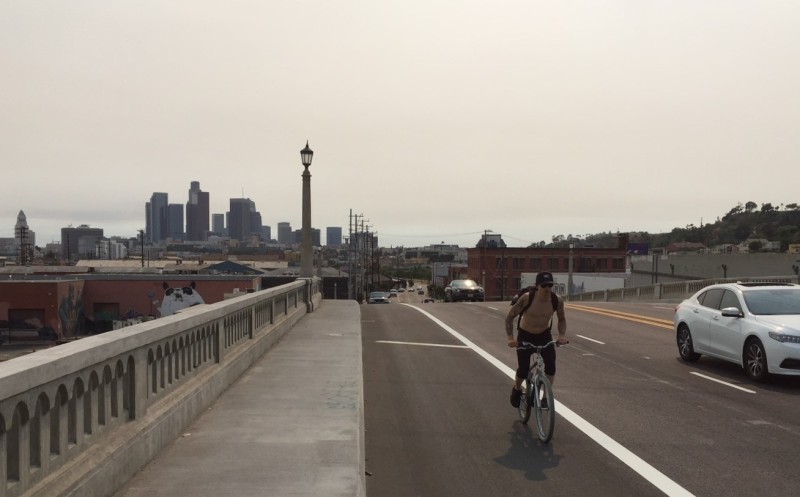
Worst abuse of political power to cancel bike infrastructure: North Spring Street Bridge bike lanes, Los Angeles
Photo by Joe Linton, StreetsblogLA
Los Angeles City Council Members wield a lot of power, including, apparently, the ability to kill safety projects they don’t like. The villain in this story is Gil Cedillo, whose jurisdiction includes the mostly complete North Spring Street Bridge widening. The project should have included bike lanes, but those lanes were delayed, and it now appears that Cedillo has unilaterally canceled them. That change in project scope could affect the validity of the project’s CEQA review and force Los Angeles to return some of the funding that paid for it. Thanks to terrific advocacy from Streets for All and excellent reporting from Streetsblog LA shining a spotlight on Cedillo’s attempt to undermine safe streets.
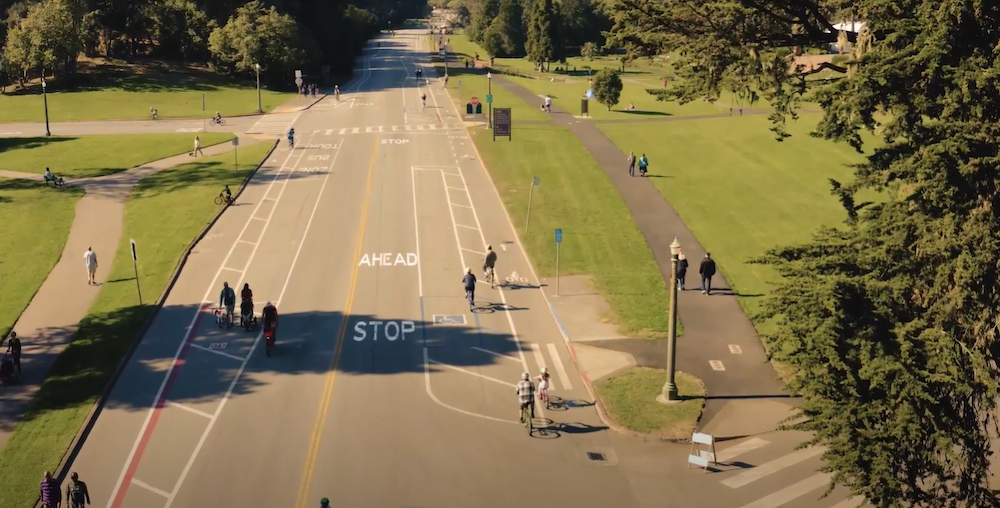
Best Slow Street that should continue after the pandemic: JFK Drive, Golden Gate Park, San Francisco
Photo from San Francisco Bicycle Coalition
Many of the Slow Streets programs created in 2020 continue as our pandemic life slogs on, but one of the best pandemic Open Streets is on the endangered list: JFK Drive, which cuts through the heart of San Francisco’s Golden Gate Park. The road had been closed to cars on weekends (a result of years of advocacy from the San Francisco Bicycle Coalition) and, thanks to pressure from advocates, the city made it car-free 24/7 during the pandemic. Since then, 36% more people have accessed the park, and there have been no accidents or injuries—a Vision Zero success. More than 70% of respondents supported keeping the roadway car-free in a city survey, and the San Francisco Chronicle Editorial Board came out in favor. Still, with powerful interests at museums in the park opposed, the future of this fantastic amenity is far from certain.
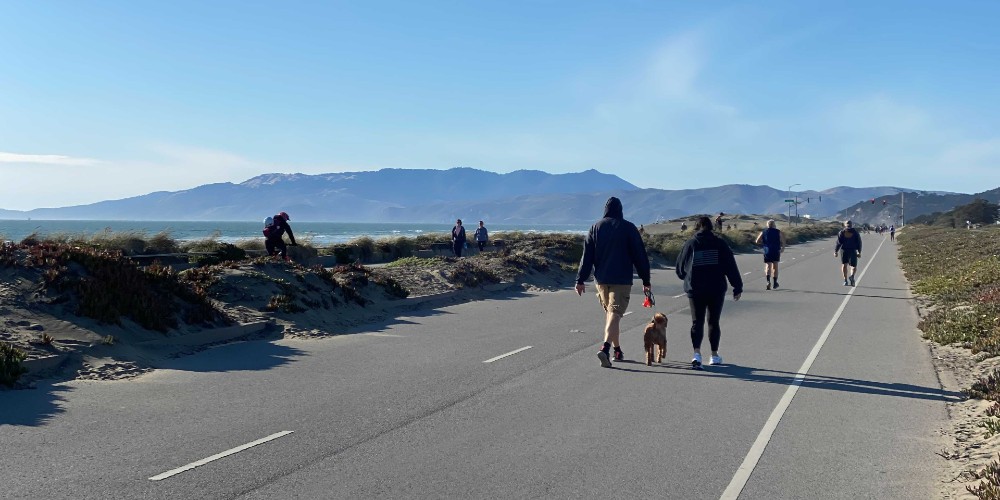
Worst concession to impatient car drivers: Great Highway, San Francisco
Photo from San Francisco Bicycle Coalition
While San Francisco has preserved car-free JFK Drive (so far), the city bowed to drivers who couldn’t tolerate the inconvenience of taking a longer route and allowed car traffic back on the Great Highway along Ocean Beach, despite fierceresistance from biking and walking advocates. The road remains car-free on weekends, and the New York Times recently named it one of its 52 Places for a Changed World. The theme of the annual travel feature is climate adaptation this year, and the Times described the Great Highway as “pointing the way for post-pandemic urbanism.” We hope San Francisco will think better of its decision to trade a locus of recreation, car-free transportation, and joy for the convenience of the people who are literally driving climate change.
The best and worst of everything else
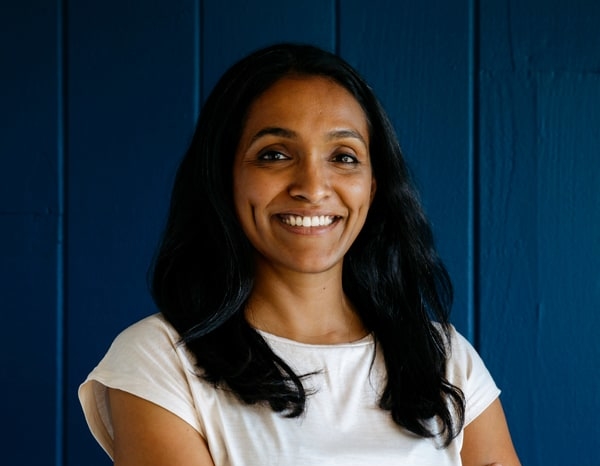
Worst attempt to thwart progress on bikeways through an electoral recall: Nithya Raman
Unfortunately, there was a lot to choose from with a wave of recalls initiated against elected officials in California. The only one that got enough signatures to make it to the voters was the unsuccessful attempt to topple Gavin Newsom from the governor’s seat. But we’d like to highlight the recall attempt against Los Angeles City Council Member Nithya Raman. CalBike heartily endorsed Raman, a transportation justice champion and bike-friendly leader. Her leadership promised to shake things up in the second-largest city in the U.S., so of course, she faced a campaign for her recall. Fortunately, the recall bid crashed and burned shortly after Newsom defeated his recall in September, showing the strong popular support for politicians who support bold changes in traffic safety as part of a progressive package.
Best investigation of biased policing against bicyclists: LA Times investigation of bike stops by sheriff’s deputies
The Los Angeles Times deserves major kudos for its in-depth look at data on bicycle stops and arrests by the Los Angeles Sheriff’s department. The Times analysis showed that police disproportionately stopped Latinos and targeted cyclists in poorer neighborhoods. Riders were stopped for minor infractions, largely as a pretext to search them for guns and drugs, but only a tiny percentage of stops turned up illegal items. The investigation has had results: the LA County Board of Supervisors is looking at decriminalizing minor bicycle infractions as a way to end biased policing. The Time’s reporting is another reminder that local newspapers are vital to our communities. Make a New Year’s resolution to subscribe to yours.
Best national conversation about safety: the national discussion of the insanity of jaywalking laws
The governor’s veto of the Freedom to Walk Act wasn’t a complete defeat for the cause. The campaign run by CalBike and our allies at California Walks and Los Angeles Walks, plus stellar efforts by Assemblymember Phil Ting, amplified and advanced a national conversation about the underhanded origins of jaywalking laws, which were designed to make city streets safe for cars, not people. Today, these laws are often used as a pretext for over-policing Black and brown people. The anticipated repeal of jaywalking laws even made it into one of the limericks on NPR’s Wait Wait Don’t Tell Me quiz show. The movement to reform how we police the use of our streets is just getting started, and the campaign to repeal this jaywalking law made great advances in the national conversation toward that goal.
Worst Charlie Brown kicking a football moment for active transportation: transportation budget delay
The e-bike affordability program shouldn’t have been the only positive budget development for biking in Sacramento in 2021. Faced with a historic budget surplus, legislators and the governor were poised to allocate an additional $500 million to the Active Transportation Program. This funding would have allowed about 80 excellent, shovel-ready bike and pedestrian projects to get the green light. But then, like Lucy pulling the football away from Charlie Brown, the promised ATP funding was snatched away when the governor and the legislature couldn’t agree on High-Speed Rail funding, which was to be part of the same funding package. However, the parties have resumed negotiations, and CalBike is asking for $2 billion for bikes. We’re counting on you, 2022, to give Charlie Brown the chance to finally kick the football out of the park and build more bikeways!
Best funding win to fight climate change: California’s e-bike subsidy program
Sacramento did come through for better biking in the budget, with $10 million for electric bicycle affordability. The program, which launches in July 2022, will offer vouchers to help people buy e-bikes. E-bikes make biking accessible to a broader range of people, and the voucher program will make e-bikes affordable for more Californians. We applaud the governor and legislature for funding this vital program (and a little pat on the back for ourselves, too, for advocacy that helped get it passed).
Best foot forward on regional planning: Hasan Ikhrata and SANDAG
The San Diego Association of Governments (SANDAG) has not historically been known for bike-friendly planning. But, with support from the association’s political leadership, Executive Director Hasan Ikhrata has been staking out a different path. In the face of possible funding shortfalls, Ikhrata committed to complete the regional bike plan’s Early Action Program, which includes the projects identified as a high priority. And SANDAG’s latest regional transportation plan represents a significant departure from past planning in the area. It has more emphasis on public transit and adopts the 10 Transit Lifelines developed by San Diego Transportation Equity Working Group. If implemented, the plan might even bring the region into compliance with its state-mandated greenhouse gas reduction goals.
Worst way to prove that traffic jams are a safety measure: bike/ped crashes went up despite traffic going down during the pandemic
In 2021, the data came in: while most of us holed up in our houses in 2020, the smaller number of cars on the roadways managed to kill more pedestrians than the year before. Remember this the next time a traffic engineer or planner tries to justify a road widening by saying it will make it safer. Driving went up in 2021 but traffic was still 22% below pre-pandemic levels. And, while the final crash data for 2021 isn’t in, it’s likely that car crash fatalities for people outside cars will be high once again.
Worst global pandemic that Will. Not. Go. Away!
You know the answer to this one. Mask up, get boosted, stay safe, and let’s hope for better days in 2022!
Did we miss one of your best or worst? Tweet your 2021 California bicycle advocacy hits and misses @calbike.
https://www.calbike.org/wp-content/uploads/2022/01/Doyle-Street-at-64th-scaled.jpeg13402560Kevin Claxtonhttps://www.calbike.org/wp-content/uploads/2018/07/calbike-logo.pngKevin Claxton2022-01-14 15:54:412022-01-15 09:59:04CalBike’s Best and Worst of 2021
Erin Shannon’s work as a project administrator for a general contractor takes her to project sites or to the main office, which means a commute from Oakland to San Francisco or South San Francisco. “I had to drive to and from. That was an hour or hour and a half to get there and up to three hours to get home,” she says. “It was not okay.” Taking transit wasn’t any better, particularly since part of the commute would involve tricky timing to catch a shuttle. Her health suffered. “I was absolutely miserable,” she recalls.
Three things happened to change Shannon’s life. “I had one of my best friends pass away and it made me want to change my life, to live,” she says. “Then I met someone.” Her new friend was a “heavy-duty bicyclist.” So, when her car got totaled, her friend helped her use the insurance money to buy an e-bike. He set up her bike so it is really comfortable to ride.
With the e-bike, Shannon was able to change her commute from being stuck in traffic to riding to and from public transit. “I had been really depressed before I started moving so much,” she says. “I feel healthier, mentally as well as physically.”
CalBike’s long campaign for e-bike purchase incentives
CalBike’s goal is to create a healthier and more equitable California by making biking accessible to more people. We do that by advocating for state funding for bikeways and changes to laws and regulations to create safer streets. E-bikes, because they make the life-changing joy of bicycling accessible to a wider range of people, are a vital part of that strategy.
“Electric bikes make biking a viable transportation choice for a broader range of people,” says Dave Snyder, CalBike’s executive director. “But, with the price of an average e-bike at $1,500 or more, many people need help to make that purchase. California gives incentives to help people buy EVs; it should do the same for e-bikes.”
In 2019, CalBike helped pass SB 400 (Umberg), which added e-bike vouchers to the Clean Cars 4 All program. The program, administered by the California Air Resources Board, allows lower-income Californians to trade in polluting automobiles and receive vouchers toward an EV purchase. And now, thanks to SB 400, you can get a voucher for an e-bike purchase. Check out the program on your local Air Quality Control Board website to get the specifics for your area.
However, the SB 400 roll-out was delayed by the pandemic in 2020. In addition, unlike the electric car vouchers, the bike program is restricted to low-income people, and you have to have a qualifying car to turn in. We knew we needed to do more.
Monica delaCruz loves her e-bike!
E-bike subsidies work
Monica delaCruz used to get around San Diego on a bike she bought off craigslist or by arranging rides with friends. “I’m the type of person, I like to go out a lot, do arts things, political things,” she says. But she felt dependent on rides when she wanted to go further, so she ended up staying home more because it was too much effort to go out.
Buying an e-bike was not part of the plan for delaCruz because she assumed it was out of her price range. “I was not going to pay that much for a bike,” she says. But when she heard about a county program in San Diego that would give her an e-bike if she agreed to log her miles and share her trips, she jumped at the chance.
“I just feel like my radius around my house where I’m comfortable going for picking up dinner or meeting friends is bigger,” she says. “Weather doesn’t matter as much, terrain doesn’t matter as much.” She adds, “I feel like I’m way more connected to any place that I need to go in San Diego.”
One of the biggest changes was her commute to National City, which can take up to an hour with multiple transit connections. “Now, I can get to the more convenient transit station because I’m not worrying about going up and down the hill,” delaCruz says. She can take her e-bike on the trolley and ride to her office, cutting her commute down to 20 minutes.
She has also found solace on her bike. “Sometimes, in the middle of the day, if it’s not too hot, I’ll take a ride. For me it’s really relaxing,” she says. Some of her friends have e-bikes through the same program and they sometimes meet up and ride. “Now it’s more social and relaxed to go on a bike ride together when you’re not worried about being out of breath talking.”
Now, delaCruz would like to get another e-bike and a purchase incentive would make that much more possible for her.
With an electric boost, people ride more often and go farther by bike
As we ramped up our 2021 E-bike purchase incentive campaign, we asked CalBike members and supporters for their e-bike stories. Dozens of people wrote to tell us how an e-bike purchase had changed the way they get around.
Brian Cox uses his e-bike for a 20-mile commute from Placentia to Irvine. “I am not a recreational cyclist,” he says. “I ride my bike because it’s a reason to get to work. It’s a total transportation alternative for me.” He started bike commuting in 2007 as a way to get outside and get more exercise. But the e-bike reduced his commute time each way by a third and enables him to ride five days a week instead of two.
Brian Cox on his e-bike
He monitors his heart rate while he rides and finds it’s only 10 bpm less on the e-bike than on his classic bike. And studies have shown that riding e-bikes keep riders fit because they tend to ride longer distances and more often than they would have on a manual bike.
Cox rides a Class 3 e-bike with a top speed of 28 mph, which helps him feel safe sharing the road with cars. “They have a lot more opportunity to see me than if I’m going 10 and they’re going 40,” he says. “With people’s distractions, that little bit of time can be a lifesaver.”
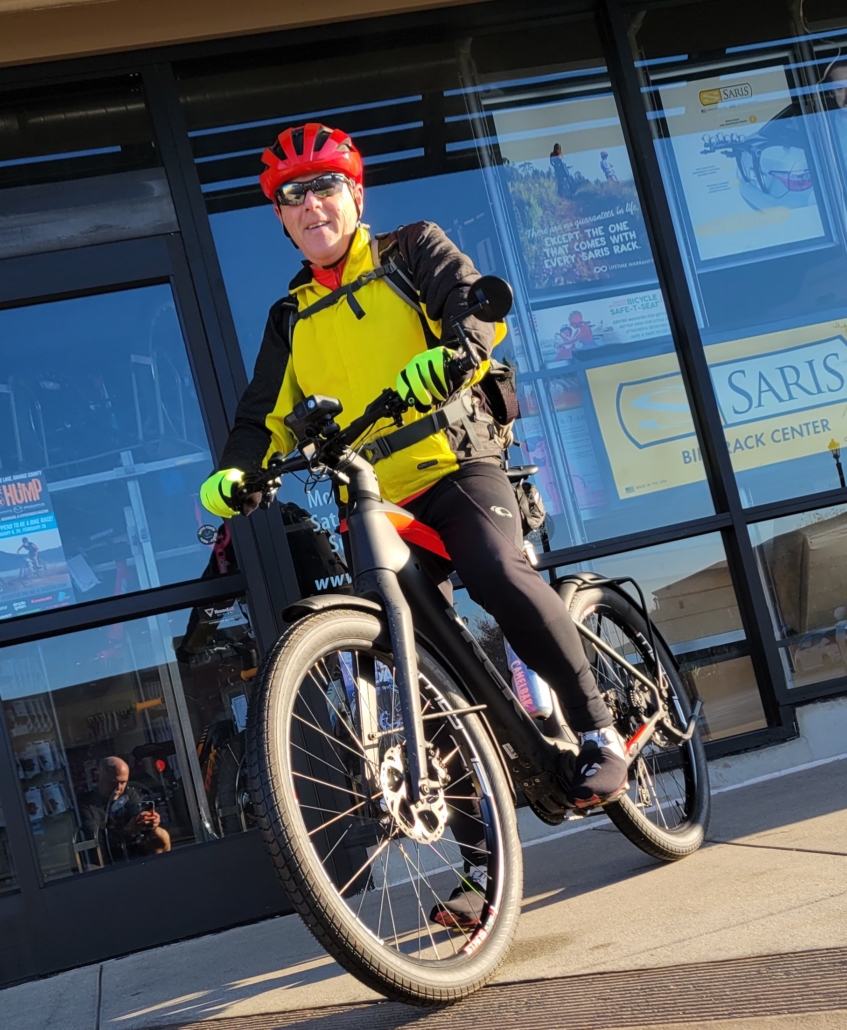
As VP of Operations for Jax Bicycles, Cox didn’t have to buy his e-bike. It is his “company car,” owned by his employer, which also pays employees $3 a day for commuting to work by bike.
He has seen e-bike sales shoot up in the last five years at his stores. “My hope and dream is that people will start to recognize that they have an option to maybe ride their bicycle to work now that they’ve got an e-bike,” he says. He hopes that e-bike rebates will raise awareness about what’s possible.
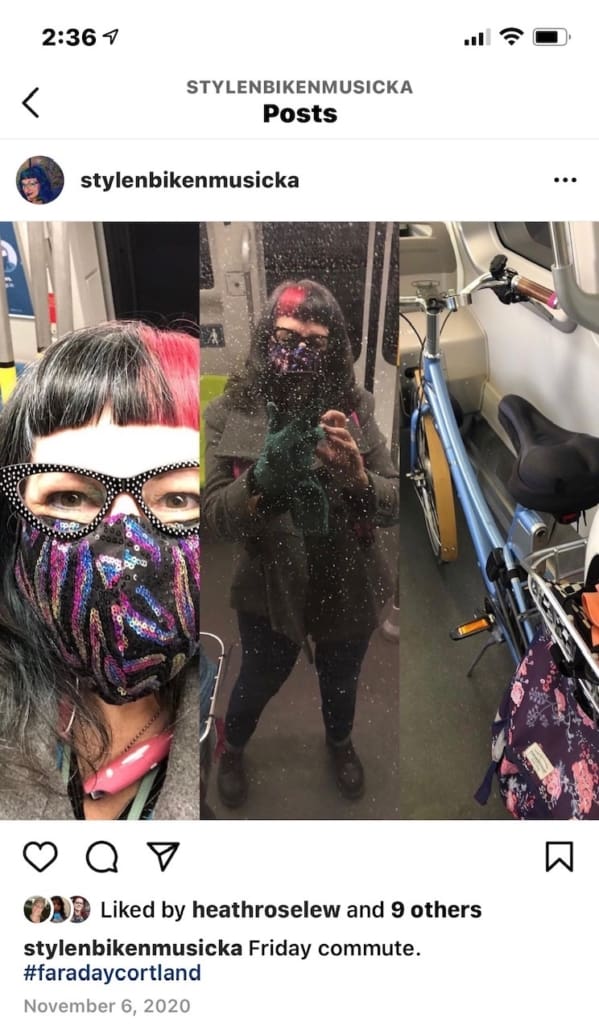
Shannon encourages others to bike by posting her bike joy on Instagram.
Radical joy
In a huge victory for low-carbon transportation in California, CalBike secured $10 million in funding for e-bike purchase incentives. Unlike rebates or tax breaks, which require people to front the money for a purchase and get it back later, the program will give people credits that they can use to buy an e-bike. That makes the program useful and accessible to people who wouldn’t otherwise have the money to buy an e-bike.
When CARB launches the program in July 2022, it will put 10,000 or more new e-bikes on the road across California. Shannon and delaCruz give us a window into the impact that will have on people’s lives and their happiness.
“I think we need to change our idea about how we get from point a to point B,” delaCruz says. “This is how I get places. This is my form of transit.” She definitely rides more miles now that she has an e-bike.
She also thinks the e-bike revolution can change how we think about who bikes. “Everybody thinks of the bike commuter being the 2% body fat guy with lycra,” delaCruz says. “I’m fat, my friends are fat, and I’m seeing more people out with larger bodies. It’s beautiful. I love seeing it around town. And I love being seen too.” E-bikes take away the barrier of worrying about not being able to keep up on a bike or worrying about your fitness level.
Shannon uses her daily commute as a stress-reducer: “I’m outside, the wind is blowing through my hair, I can see birds. It’s pretty beautiful. I feel like Snow White or Mary Poppins,” she says. “I feel powerful when I’m on my bike. And free. And I hadn’t felt that in a long time. That’s pretty amazing.”
“It’s like you’re directly involved in life, instead of being in a little tube. It’s freedom, bottom line.”
– Erin Shannon
And she sees her e-bike as a wise investment. “This bike, when I got it, was the most expensive thing I’ve ever owned outright,” Shannon says. “It was terrifying. But then I thought about it and about how much less I would spend on gas in the car.” She adds, “And I feel like I’m contributing to the environment, not being one of those cars stuck in traffic.”
The benefits of CalBike’s e-bike program will extend beyond the people who will be able to afford new e-bikes. “More people experiencing their roads outside of their car can experience road safety in a different way,” delaCruz says. “I hope it brings safer roads for everybody.”
CalBike’s Snyder sees safety as a major benefit of the new e-bike affordability program. “We’ve seen data this year that shows there is safety in numbers for bike riders on the streets,” he says. “And we know that, when people see more e-bikes and see how much fun people are having, they’re going to want one too.” He’s also looking to the future. “Some European countries have recognized the importance of adding biking to the transportation mix with cash incentives for all types of bikes, or repairs or gear. We’d love to see California offer subsidies on every bike purchase, electric or classic.”
On December 7, 2021, CalBike held its second Advance Symposium for the California Bicycle Summit: Lessons from Latin America. It was a powerful and fascinating deep dive into both success stories and challenges for biking in Latin American cities, with a deep dive into the home of the Cicolvia, Bogotá, Columbia. Scroll to the bottom to watch the full session.
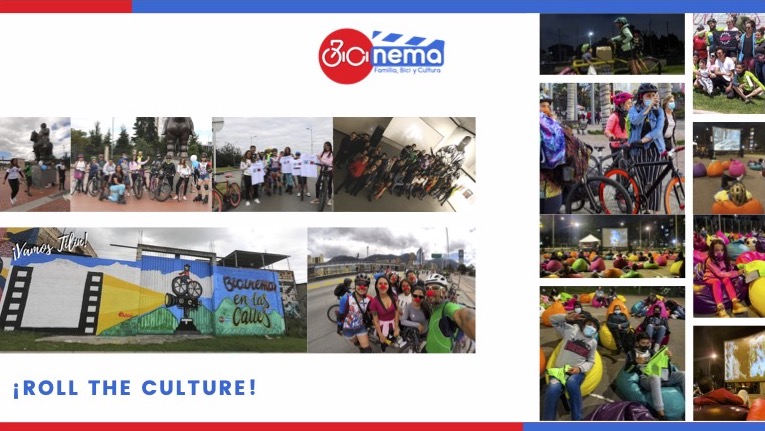
The presenters included the coauthors of the chapter on Latin American in Cycling for Sustainable Cities. Daniel Rodriguez is a professor of city and regional planning and the interim director of the Institute for Transportation Studies at UC Berkeley. Carlos Felipe Pardo is a senior advisor to the New Urban Mobility Alliance and also founded Despacio, a Bogota-based sustainable transportation organization. We were also joined by two advocates from BiciActiva, a Bogotá-based organization that sponsors BiciActiva Radio, which runs a station for and by bicyclists. Lorena Romero is the BiciActiva Foundation director and project manager who created the Bicinema project to bring movies to public places in disadvantaged neighborhoods. Raphael Navarro joined us from the Netherlands, where he is reporting on the Dutch cycling experience for BiciActiva Radio.
Ciclovias make cities more bike-friendly
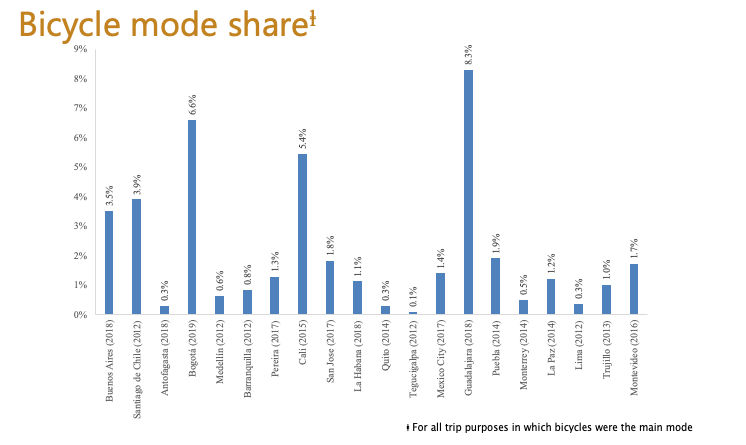
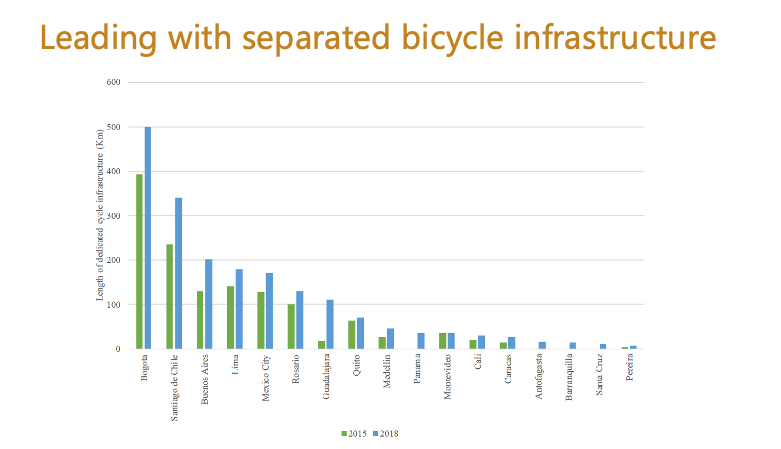
Bogotá is famous in bicycling circles as the home of the first Open Streets, the Ciclovia, founded in 1974, and it has the second-highest bicycle mode share. The highest is in Guadalajara, another city with a robust, weekly Ciclovia—and Rodriguez doesn’t think that’s a coincidence. He presented figures on miles of bike lanes built in recent years and, though Guadalajara has many fewer miles than Bogotá and some other cities, the percentage increase in bikeways in that city has been huge.
Photo of new Bogotá bike lanes courtesy of Carlos F Pardo
Pardo pointed out Bogotá’s long experience with quickly transforming streets for Ciclovias was useful during the pandemic. The city quickly created many miles of temporary bike routes and has begun to make some of those permanent with quick-build infrastructure.
Building community on two wheels
Romero and Navarro spoke about the power of shared information to improve safety and win better bikeways. They invited bike advocates from anywhere in the world to contribute to BiciActiva Radio, which has the mission of sharing information to support the bike riding community. One of Romero’s inspiring recent projects is Bicinema, which projected outdoor movies that people could bike to watch, creating community even during COVID.
These are just a few of the highlights from Lessons from Latin America. Watch the full session to get ideas and inspiration from these fantastic bicycle advocates. But, before you do, register for our next free, online Symposium: California Advocacy Success Stories. The session will be held on February 22, 2022. And don’t forget to reserve your spot for the in-person California Bicycle Summit, held in Oakland April 6-9, 2022.
Watch the full Symposium: Lessons from Latin America:
https://www.calbike.org/wp-content/uploads/2021/12/Rodriguez-image1-scaled.jpg14402560Laura McCamyhttps://www.calbike.org/wp-content/uploads/2018/07/calbike-logo.pngLaura McCamy2021-12-15 18:44:492022-02-10 16:18:21What California Can Learn from Latin American Bike Advocates
For bicycling at the state level in California, 2021 was a mixed year. However, at CalBike, with the help of our dedicated and fabulous members and supporters (we’re looking at you!), we accomplished a lot.
We won $10M in e-bike subsidies, so more Californians will get the chance to adopt this clean, green, form of transportation. We finished five bike plans that will make Fresno, Bakersfield, and Merced more bike-friendly, as part of the High-Speed Rail project. And we drafted five dramatic proposals to promote bicycle tourism by creating safe bike routes in five more Central California counties. And CalBike contributed to advocacy that is almost certain to lead to a change to Caltrans street design regulations that will allow vehicle lanes as narrow as 10’.
We broadened our coalition, adding new partners. In 2021, CalBike worked on campaigns alongside human rights, civil rights, social justice, immigrant rights, racial justice, environmental justice, women’s rights and health, economic justice, and housing justice & homeless advocacy organizations.
With help from our donors, we continued to promote quick-build design to transform our streets at speed. We distributed 300 copies of the quick-build brochure that we created with our partners at Alta Planning + Design to local planners and public works professionals, and we continue to work to get information about quick-build techniques into the hands of planners and decision-makers.
In 2021, CalBike members and supporters sent 9,375 emails urging their elected representatives to take action to support better bicycling in California. You added 7,142 signatures to petitions demanding bicycle-friendly reforms. And we supported three bicycle-friendly bills that became law in 2021, allowing lower speed limits, advancing Slow Streets, supporting the Great Redwood Bike Trail.
https://www.calbike.org/wp-content/uploads/2021/12/1207_CB_Blog_Header_v2.jpg10442071Kevin Claxtonhttps://www.calbike.org/wp-content/uploads/2018/07/calbike-logo.pngKevin Claxton2021-12-08 15:41:492021-12-10 12:05:59What CalBike Accomplished: 2021 by the Numbers
California has a current budget surplus of $31 billion. CalBike is advocating for the governor and legislature to put $2 billion of that surplus toward infrastructure projects that will make our communities safer and more inviting for biking and walking. We’re joined by our allies at Safe Routes Partnership, Transform, California Walks, Move LA, Planning and Conservation League, and Active SGV. That $2B would represent a one-time tenfold increase in funding for active transportation projects, but it will only touch the beginning of California’s need for infrastructure improvements.
The Active Transportation Program was created in 2013 by combining several state and federal funding sources into one account to support bike and pedestrian safety. Total funding was $134 million in 2013 ($160 million in today’s dollars), and the ATP had $238 million in 2020 (a 49% increase). Still, that amount does not come close to meeting the exploding demand for safer streets. The most recent round of ATP funding, for example, drew 453 applications requesting a total of $2.3 billion.
At a funding level of about $220 million each year, the Active Transportation Program is the largest single dedicated source of funding for bike and pedestrian safety in the country. Yet, for a state the size of California, with a transportation budget of $32 billion, it’s nowhere near enough to meet the need.
That’s why the $2 billion boost to active transportation is critical. Only 40 submitted proposals were funded in Cycle 5, representing less than 10% of potential projects. In the last cycle, projects had to score at least 92 points out of a possible 100 in the evaluation process to receive ATP money. Our recommendation for a $500 million augmentation to Cycle 5 ATP projects will allow the state to fund approximately 80 shovel-ready projects immediately. That would make almost all the proposals with applications scoring 86 points or above. CalBike has created a spreadsheet showing all 453 applications, sorted by their score, so you can see where a project from your community fits and if it might get funding.
Of course, this one-time boost is just the beginning. With our allies, we are demanding a doubling of the Active Transportation Program to $500 million annually and a new program to build connected bikeway networks to create 15-minute neighborhoods where everyone’s typical daily needs are just a safe and comfortable 15-minute bike ride away. We’ll need your support to get it done. Please sign the petition.
https://www.calbike.org/wp-content/uploads/2021/05/CalBike-Insider-Image4.png7201280Kevin Claxtonhttps://www.calbike.org/wp-content/uploads/2018/07/calbike-logo.pngKevin Claxton2021-12-01 18:48:402021-12-02 13:03:03CalBike Insider: $2 billion for bikes in 2022
An LA Times investigation of bicycle traffic stops since 2017 has put a spotlight, once again, on the need to remove armed officers from traffic enforcement. The two bills CalBike sponsored in 2021 to decriminalize common and safe walking and biking would have represented a step in that direction. However, although the Bicycle Safety Stop Bill and the Freedom to Walk Act got support from both houses of the legislature, the governor vetoed both bills, citing inaccurate safety statistics.
Disproportionate stops of Latino riders highlights the need to remove police from traffic enforcement
In addition to racism, the Times reporting uncovered bias against people who use bikes for transportation. Officers in Los Angeles perform searches four times more often during bike stops than when they stop someone driving a car or walking, even though bike stops are half as likely to end in an arrest.
The LA Times story makes clear that police officers were using bike stops as a pretext for a stop-and-frisk type of enforcement. Some key takeaways from the article:
The data paint a clear picture of a police force acting on prejudice against Latino and Black residents who ride bikes, particularly in areas where most residents are people of color. As the article highlights, these communities have little safe bicycle infrastructure, so decades of systemic racism and neglect become a weapon to doubly punish people in disadvantaged neighborhoods.
Discrimination against Latinos and people who bike for transportation or work
Although more than two-thirds of the bike traffic stops were of Latinos, that group had the lowest rate of illegal items—just 7.1%, compared to 10.5% among white bike riders. And these traffic stops have the potential to turn deadly, like the stop of Dijon Kizzee in 2020, a Black bike rider shot and killed by the police.
The quote from the police spokesperson reveals the underlying prejudice: people, primarily Latino or BIPOC people, riding without spandex or fancy kits, are probably criminals.
A 2019 study of attitudes about bicyclists among the general public found that 49% of people who drive view people on bikes as non-human and that dehumanization led them to act more aggressively toward cyclists. In other words, stereotyping and “othering” people on bikes make riders less safe. The LA Times reporting puts that in stark relief. For people of color, and their long history of “otherness,” riding a bike can be even more dangerous.
Barriers to changing traffic enforcement in California
The bike stops in LA did nothing to improve traffic safety, but they did target people of color for harassment. This latest information has added momentum to the movement to transfer traffic enforcement from the police to unarmed DOT personnel or automated cameras.
While CalBike supports these initiatives (with caveats), it’s worth noting that these reformist strategies are certainly not without concern and complexity. For instance, these de-policing approaches have the potential to simply relocate or exacerbate policing and surveillance by other means, whether by deputizing ordinary bureaucrats or through technological devices.
In response to the LA Times investigation, the Los Angeles County Board of Supervisors has made a welcome move to decriminalize biking on the sidewalk in areas with no bike lanes. Riding on the sidewalk was the pretext for 25% of the stops in East LA, which has few bike lanes. The supervisors have also asked the Sheriff’s Department to create a diversion program for people biking and walking to avoid fines and jail time. But state laws limit how far LA County can go to decriminalize safe biking and protect residents from racially-biased policing.
Berkeley was one of the first to reimagine traffic enforcement, voting in 2020 to create a new Department of Transportation to take over from the police. However, that change is illegal under current California law, as is speed detection by cameras. Advocates tried and failed to legalize camera speed detection in California this year. Still, there is growing momentum behind a potential 2022 bill to allow cities to take police out of traffic stops.
It’s clear that biased policing is a fact and that traffic stops are hazardous, especially for Black and Latino Californians. CalBike is asking Governor Newsom and CalSTA to listen to advocates and support concrete measures to de-police and decriminalize biking and walking in California.
https://www.calbike.org/wp-content/uploads/2023/05/crops_0001_police-car-lights.jpg18681644Jared Sanchezhttps://www.calbike.org/wp-content/uploads/2018/07/calbike-logo.pngJared Sanchez2021-11-17 14:07:002025-02-19 14:09:37Blockbuster LA Times Investigation Shows Police Bias in Bike Stops