
Tag Archive for: featured
Jeanie Ward-Waller Joins CalBike as Consultant
FOR IMMEDIATE RELEASE
January 12, 2024
Leading Transportation Expert and Advocate Jeanie Ward-Waller Joins Fearless Advocacy
Contacts:
Jeanie Ward-Waller (jeanie@fearlessadvocacy.com)
Jennifer Fearing (jennifer@fearlessadvocacy.com)
Kendra Ramsey (kendra@calbike.org)
SACRAMENTO – Fearless Advocacy, a Sacramento-based consulting firm specializing in advancing the policy agendas of mission-based and cause-oriented organizations, is pleased to announce that Jeanie Ward-Waller starts today as the firm’s first Director of Transportation Advocacy. Ward-Waller comes to Fearless Advocacy with nearly two decades of experience as a licensed professional engineer, advocate, and government executive. A former deputy director for planning and modal programs at Caltrans, Jeanie has been a vocal leader in advancing equitable and sustainable transportation in California from both inside and outside of government.
“It’s a time of critical change in transportation, and bold leadership is needed to tackle the challenge of reimagining our car-dependent system. I couldn’t be more excited to join the highly influential Fearless Advocacy team and strengthen transportation advocacy in support of clients committed to this mission. I’m particularly honored to launch this work in partnership with CalBike, TransForm, and ClimatePlan, organizations that I know well and deeply respect, and invite anyone interested in collaborating to reach out,” said Ward-Waller.
In her new role, Jeanie today launches a lobbying and consulting practice focused on advancing transportation public policy and investment objectives aligned with California’s ambitious goals to rapidly improve sustainable travel options and reduce the harmful impacts from driving on our most vulnerable communities and the global climate. Jeanie’s expertise is expected to bring elevated value to Fearless Advocacy’s existing work to accelerate state support and development of wildlife crossings and corridors.
“It’s thrilling to take this next step with Jeanie to build Fearless Advocacy’s capacity and scope. Her experience, values, and fearlessness are unparalleled in California’s transportation policy realm and she will bring immediate and immense value to her clients,” said Jennifer Fearing, founder and president of Fearless Advocacy. “I look forward to the synergies we will generate, and the good we will do together for people and the planet.”
“We’re beyond excited to have Jeanie working with CalBike again,” says Kendra Ramsey, CalBike executive director. “Her skills as a mobility advocate and her deep understanding of Caltrans from the inside will be invaluable assets in our campaign to make state-controlled roadways safer for people biking, walking, and taking transit.”
“I’m thrilled that Jeanie will be working with TransForm to hold state agencies accountable on how they spend transportation dollars. I’ve seen Jeanie in action, and she’s the strategic coalition builder we need to make real change happen so that we can meet California’s climate and equity goals.” – Jenn Guitart, Executive Director of TransForm.
Fearless Advocacy is in its tenth year producing policy and budget successes for nonprofits in California. Fearing has been named to the Capitol Weekly’s annual “Top 100” list five times and in 2019 was voted by her peers as public interest lobbyist of the year. She authored the chapter on nonprofit lobbying in the Kendall-Hunt textbook A Practitioner’s Guide to Lobbying and Advocacy in California.
##
There Is No Deficit in California’s Transportation Budget
As California begins negotiations for its 2024-2025 budget, much of the talk will center on a projected $38 billion shortfall. In past years, Governor Gavin Newsom has used budget deficits as reasons to veto active transportation bills. In 2023, the governor initially took back half of the extra $1.05 billion allocated to the Active Transportation Program (ATP) in a surplus year, though that money was later returned. And, to be clear, the “extra” funding still wasn’t enough to greenlight all the worthy projects in the chronically underfunded and urgently needed program.
The governor’s proposed 2024-2025 budget once again takes money from the ATP while leaving freeway spending untouched.
We need to spend more, not less, on active transportation and, although California will need to make some hard choices due to the budget shortfall this year, there is no deficit in the transportation budget. There is more money in the transportation coffers than there has ever been.
State revenue for transportation has soared with the passage of SB 1 in 2017. SB 1 expanded funding for California’s transportation system by an average of $5.4 billion annually. Now, the Infrastructure Investment and Jobs Act (IIJA), passed in 2021, is sending federal cash to California. The IIJA will bring California an estimated $41.9 billion over five years from Federal Fiscal Year (FFY) 2022 through FFY 2026. If you compare the 2017-2018 transportation budget with that of 2023-2024, the additional money available for transportation infrastructure is clear:
- $13 billion in state funds (2017-18)
- $21 billion in state funds (2023-24)
- $6 billion in federal funds (2017-18)
- $12 billion in federal funds (2023-24)
Totals:
- $19 billion in state & federal funds (2017-18)
- $33 billion in state & federal funds (2023-24)
State Transportation Budget Demystified
Given how transportation funds are raised, the transportation budget is self-generating (user taxes and fees) and generally immune from the stark deficits found in the whole of California’s budget, which is significantly dependent on income taxes and facing a $68 billion deficit this coming year.
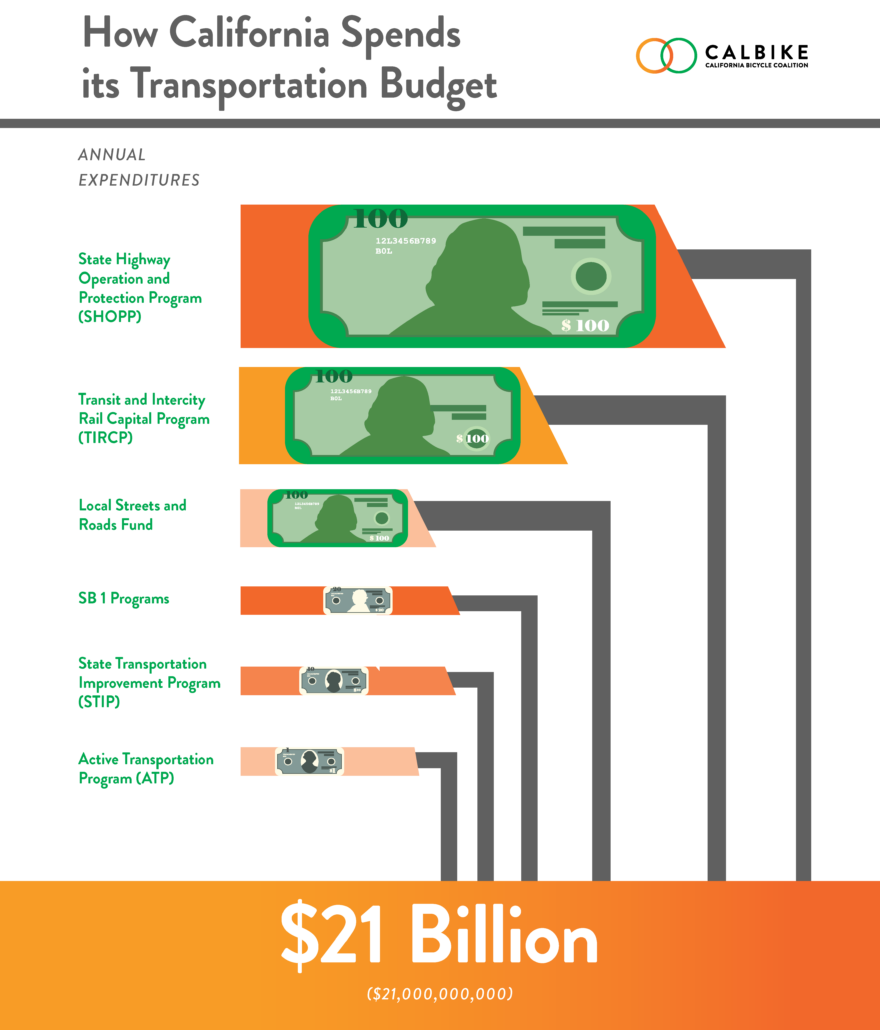
The entire state budget from last year was almost $300 billion. The transportation budget represented 7% of that: $21 billion.

Chart from TRANSPORTATION FUNDING IN CALIFORNIA 2023.
The governor and legislature dictate how state revenues are spent on the transportation network. The legislature appropriates state funding for specific purposes each year. Below are the main programs according to the 2023-24 budget year.
Dwindling gas taxes shouldn’t mean active transportation spending dries up
In December 2023, the California Legislative Analyst Office (LAO) issued a report on the future of transportation funding as more people move to electric vehicles and state gas tax revenues decline. This could pose a threat to the ATP, which receives most of its funding from gasoline taxes. But it shouldn’t.
The LAO report estimated that California’s funding from gas taxes will drop by over $4 billion in the next decade due to the state’s switch from gas- to electric-powered vehicles, about a third of that amount.
Six years after the passage of Senate Bill 1, the Road Repair and Accountability Act of 2017, California needs to draft a new mega-transportation bill. Rather than using the decline in gas purchases as an excuse to cut funding for the active transportation infrastructure we urgently need to complete the transition from fossil fuels, California must find sustainable funding sources to drive our transportation system.
State leaders were aware of this problem when SB 1 was being negotiated in 2016-2017, so they included a new tax on zero-emission vehicle owners called the “Road Improvement Fee.” The fee charges electric vehicle owners an annual flat $100 that is adjusted for inflation. The adjusted rate for the calendar year 2023 is $108. This fee only applies to electric vehicles with the model year 2020 or later.
The road improvement fee helps to offset the decline in gas tax revenue, but, as the LAO report suggests, California will have to find new funding sources or reduce its transportation spending. The solution may be to do some of both.
California can build an excellent transportation system that serves the needs of residents. The LAO report’s focus on highway maintenance and rehabilitation programs ignores the billions that go to capacity expansion for motor vehicles. Eliminating the short- and long-term costs of expanding freeway capacity, including canceling projects currently in the pipeline that have not begun construction, would immediately free up millions of dollars for Complete Streets, public transportation, and even deficit reduction. At the same time, this shift will help California get on track with its GHG reduction goals — goals impossible to meet if we keep building new freeway capacity.
Revenue decline will be slower than predicted
LAO bases its analysis on ARB’s Scoping Plan. As a recent NRDC analysis showed, the state is not even close to reaching the ambitious goals laid out in that plan. To use it as the foundation for analysis is inaccurate as it does not reflect the current policy reality. For example, the scoping plan sets VMT reduction goals that California isn’t meeting. In fact, the reverse is happening: VMT has soared in recent years, filling transportation coffers with gas tax revenue.
ZEV sales have increased from 4% of all new vehicle sales in 2017 to 25% in 2023. However promising sales of new ZEVs are in California, ZEVs still only make up about 3% of all light-duty cars on the road. Dirty heavy-duty trucks, buses, and vans are hardly transitioning to electric. While this is bad news for the environment, it leaves diesel tax revenue mostly steady for years to come. In reality, the decline in gas and diesel use will be much slower than the LAO posits.
A People-First Mobility Budget
In the coming days, CalBike will propose a People-First Mobility Budget that realigns California’s transportation spending to projects that provide more mobility options, healthier neighborhoods, more equitable transportation, and fewer harmful tailpipe emissions.
California can and should change its road-building priorities from expensive, climate-killing freeways and wide local thruways for cars and trucks. Complete Streets that accommodate all modes of transportation are cheaper to build, more economical to operate, and improve health and mobility for our state’s residents. We need a transportation budget plan that supports sustainable modes and a vision for the future. Our budget proposal will do just that.
CalBike Response to Governor’s 2024 Budget
For Immediate Release: 1/10/24
Contact: Jared Sanchez, Policy Director, CalBike, (714) 262-0921, Jared@CalBike.org
Governor’s Budget Steals from California’s Future
SACRAMENTO – The California Bicycle Coalition (CalBike) released the following response to Governor Gavin Newsom’s proposed budget, which fills a $200 million shortfall in the transportation budget by cutting $200 million from the Active Transportation Program (ATP).
Statement from Jared Sanchez, CalBike Policy Director:
“For the second year in a row, Governor Newsom is proposing to strip funding from one of the most cost-effective transportation programs in California. The ATP needs more money, not less, to fund dozens of worthwhile, shovel-ready projects that don’t make the cut each cycle because of inadequate funding. This is absolutely the wrong place to make cuts.
“The governor should pull funding from the State Highway Account to cover shortfalls rather than stretching climate funding from the Greenhouse Gas Reduction Fund (GGRF) even thinner. We need to stop spending on freeway expansion and double down on climate mitigation projects, like those funded by the ATP.”
From the Governor’s Budget Summary:
There is a $200 million hole in the transportation budget:
“The Budget proposes adjustments to transportation infrastructure to account for a reduction in forecasted General Fund revenue. The Budget includes a reduction of $1.1 billion General Fund, partially offset by $791 million of Greenhouse Gas Reduction Fund, for a net reduction of $200 million.” (Source: Governor’s Budget Summary, p. 109)
The proposed budget fills this shortfall by taking $200 million from the ATP:
“Active Transportation—A reduction of $200 million to the Active Transportation Program (ATP). This will leave the Active Transportation Program with $850 million in one-time funding. To ensure no impact to previously-awarded projects, the $200 million reduction will be backfilled from ATP funding that was anticipated to be available for allocation in future cycles.” (ibid, p. 35)
###
Stop Fueling Climate Change: Coalition Challenges Governor to Shift Transportation Spending
A week before Christmas, CalBike worked with a coalition of 25 transportation and environmental organizations to issue a call to action for California to align its transportation spending with its climate goals. The coalition sent a letter to Governor Gavin Newsom and our state transportation leaders, asking them to shift spending from projects that increase climate-altering emissions to those that mitigate climate change.
Critically, the letter doesn’t ask for any new funds. In a year with a large projected budget deficit, new spending programs would be a tough sell in Sacramento. However, as the letter details, the transportation budget has multiple dedicated funding sources and, thanks to the federal Infrastructure Investment and Jobs Act (IIJA), will have more cash in 2024.
Even without new revenue sources, it’s essential that California change where it spends transportation dollars. With a significant allocation of funding, we could build appealing, connected bikeways, transit infrastructure, and walkable neighborhoods that incentivize active and shared transportation. The build-it-and-they-will-come approach has worked in numerous European cities, and it can work in California, particularly because our wide roadways have the capacity to safely accommodate multiple transportation modes.
The letter provides a list of ambitious requests for the transportation portion of the governor’s budget.
- Consider any proposed reductions in General Fund spending on transportation infrastructure in the context of our climate and equity goals, and honor prior transit, clean transportation funding, and critical maintenance commitments, including but not limited to TIRCP ($2 billion/year), ATP ($500 million/year), and ZETCP ($1.1 million over four years).
- Backfill any General Fund cuts by leveraging the existing statutory flexibility of federal highway formula funds as well as funding from the State Highway Account. To maximize this flexibility, California can move up to 50% of National Highway Performance Program funding (nearly $1.25 billion) into the Surface Transportation Block Grant Program, which would make these funds eligible for a significantly wider array of investments, including investments in complete streets (including active transportation infrastructure and certain types of transit priority infrastructure), transit capital projects, climate resilience projects, workforce development programs, and more.
- Suspend California state investment in new highway capacity (with the potential to rescope or reimagine impacted projects to preserve investment levels and ensure community benefits) as an imprudent use of funds that the state cannot afford, given the realities of the state budget. Last year, the state spent several billion on expansion projects on state highways and local streets and roads. These allocations should be eliminated for this fiscal year to ensure fiscal responsibility and ensure we are not expanding our future pool of maintenance responsibility. Moreover, the effects of such projects further contributing to climate change, environmental injustice, and cumulative pollution burdens on communities will need to be remediated for an untold future cost.
- Develop a multi-year funding commitment that ensures at least 50% of the State Highway Account (SHA) funds go to VMT-reducing projects while prioritizing investments in California’s most burdened communities. This can include diverting funding away from traffic enforcement to invest in traffic calming and public transportation infrastructure, as that is a safer and more effective approach to achieving our transportation goals.
CalBike’s Best and Worst of 2023
After 2020, it seemed like things could only get better, or at least more normal. But weird seems to be the new normal, and 2023 was no exception, with a high-profile firing at Caltrans, cities declaring “e-bike emergencies,” and fast transportation mode shifts caused by freeway shutdowns rather than the ongoing emergency of climate change.
There have also been significant positive moves this year: legislation that will make streets significantly safer for people biking and walking, funding wins for active transportation, and an expanding coalition of groups amping up the pressure for California to turn to green transportation.
This year, we’re mixing things up by adding some (tongue-in-cheek) awards and our first CalBike Wrapped! We hope this holiday season is a time of renewal for you, and you come back in the new year ready to make it the best year ever for biking in California!
Worst attempt to hush up an unsanctioned freeway expansion that drew more attention to the problem and could lead to a whole agency restructuring: Caltrans firing Jeanie Ward-Waller

Caltrans fired Deputy Director for Planning & Modal Programs Jeanie Ward-Waller because she planned to blow the whistle on potentially illegal use of state highway repair funds to build an extra lane on I-80’s Yolo Causeway. The firing of CalBike’s former Policy Director, and one of the strongest voices in support of active transportation at Caltrans, set off a firestorm, leading to calls for greater oversight of the agency. It has also drawn greater scrutiny to freeway expansion projects like the Yolo Causeway expansion that Caltrans was trying to keep under the radar. Well done, Caltrans.
Best response to alleged state agency malfeasance: Community pushback on Caltrans after Ward-Waller firing
Change has been slow to come to Caltrans, which still mostly prioritizes moving cars and trucks over keeping people biking and walking safe and continues to approve projects that violate California’s climate policies. However, we’re encouraged by growing momentum in the movement to change Caltrans after the agency kicked out its most visible advocate for climate-friendly transportation infrastructure. CalBike was one of over 100 signatories on a letter to the governor asking for investigations of Caltrans operations and a halt to freeway expansion projects in the meantime. And there will be more action to come in 2024, with coalitions coalescing around forcing California to live up to its green transportation policies.
The Worst Euphemism Award: “Pavement rehab” by Caltrans
Why is it that highway resurfacing projects like the Yolo Causeway “pavement rehab” end up adding lanes — and VMT — to the roadbed? Hmm….
Sleeper bill that could have the biggest impact in the future: SB 695, Caltrans data transparency

Oversight is the key to changing how Caltrans operates. In the past, data about freeway projects was not only hard to parse but also hard to find. The Caltrans Data Transparency Bill, AB 695, authored by Senator Lena Gonzalez, requires the agency to make data about past and planned projects available on its website starting in 2025. It’s an excellent step toward a more accountable Caltrans.
The Don’t Threaten Us With a Good Time Award: 10 Freeway 6-Day Closure “Crisis”

The City of Los Angeles declared a state of emergency when a fire under an overpass shut down a portion of the I-10 freeway. It was such an emergency that city officials called on residents to do something radical: leave their cars at home and take the Metro. The transit agency even changed signal priority to make trains run faster. While that’s all great — and was all too temporary — it’s ironic a freeway closure led to these changes and not, for example, the ongoing and not easily reversible climate emergency made worse by LA traffic every day. Just saying.
Best budget decisions, state legislature edition: Reinstatement of full funding for ATP in final budget

In 2022, a year of budget surpluses, California put some of its excess funds, $1.05 billion, toward the Active Transportation Program, which funds biking and walking infrastructure projects across the state. As it became clear the State had to cut corners in 2023, the governor’s first draft budget cut half of that additional ATP funding, about $500 million. Happily, thanks to pressure from CalBike supporters who sent hundreds of letters to the budget committees and to our champions in the legislature, that funding was fully restored in the final budget. Of course, it’s still not nearly enough, and many excellent projects weren’t funded in the most recent funding round of the ATP (Cycle 6). We’ll continue to fight for more funding for active transportation in 2024.
Best budget decisions, state agency edition: CARB including $18 million for e-bike incentives as part of its clean transportation allocation

Although the rollout of the statewide E-Bike Incentive Project has been slower than anticipated, the California Air Resources Board (CARB) clearly recognizes that it will be a popular program. In addition to finding an extra $3 million on top of the $10 million allocated for the pilot by the legislature, CARB proposes $18 million for the program in the next fiscal year. That’s still a small amount compared to the size of California and the high demand for incentives, but it’s a significant chunk of CARB’s clean transportation budget and an excellent start as the program ramps up.
Worst response to a driver hitting and killing a bicyclist: Encinitas e-bike emergency after the death of Brodee Champlain-Kingman

What do you do if a person driving a car hits and kills a person riding a bike? What if the person riding the bike followed the rules of the road and “did everything right?” If you’re the City of Encinitas, you declare a state of emergency because — e-bike! Surely it must be the increased number of e-bikes on the road that’s causing drivers to hit them and not the fact that we haven’t built enough safe bikeways and our roads are designed to encourage people to drive fast. It’s the worst kind of victim-blaming that does nothing to address the actual problem.
Worst media take: New York Times elevates e-bike backlash

The New York Times jumped into the anti-e-bike fray with both feet…in its mouth. A series of articles about the dangers of e-bikes (cue scary music) in California, including a front-page article that blamed reckless teenage riders for recent collisions, using a bike rider killed after being rear-ended by motor vehicle driver, while the bike rider was obeying the rules of the road, as an example. With a fight over e-bike licensing looming in New York City, the paper has an opportunity to take a more balanced approach, but will it? Do better, NYT!
Best media response to worst media take: Streetsblog article on how to spot bad bike reporting

The bikelash posts spurred a backlash against the Times’s biased reporting, including CalBike’s guide to reporting on collisions involving e-bikes (and bikes in general). But we take our hats off to Streetsblog USA for the best response: Four Ways To Spot a Bad E-Bike Article by Kea Wilson. Favorite quote: “A Bad E-Bike Article doesn’t just make e-bikes look bad; it erases all the harm that the mode can reduce by replacing car trips, particularly when supported by great infrastructure, policy, and education to match. Until papers of record start telling that story, though, we should probably all remain prepared to call out Bad E-Bike Articles when we see them.”
The Footloose Award: Huntington Beach City Council

This award, named in honor of the movie, is given to the local elected body most committed to the misery of teenagers. Several Southern California cities recently decided that e-bikes are a menace, but Huntington Beach, whose city council likes to dabble in performative provocation, focused its ire on the dreaded youth on an e-bike (cue very scary music). This fall, the City enacted draconian e-bike regulations that single out people under 18. When a juvenile — but not an adult — is found to have violated the ordinance, Huntington Beach can impound their bike. What’s next, HB? A new law taking candy from babies?
Best legislation that will save pedestrian lives: The Daylighting to Save Lives Bill, AB 413

The Daylighting to Save Lives Bill, AB 413, authored by Assemblymember Alex Lee, makes it illegal to park within 20 feet of a marked or unmarked crosswalk. It’s one simple change that will improve visibility at intersections, reduce collisions, and make pedestrians and bicyclists safer.
About Time Award for a proven strategy to slow traffic on dangerous streets: AB 645, speed camera pilot finally becomes law

Finally! After dying in the legislature more than once, Assemblymember Laura Friedman’s automated speed enforcement pilot, AB 645, is moving forward. Starting in 2024, six California cities can use cameras to capture and ticket speeding cars. We look forward to seeing the results of the pilot and hope this is the first step in allowing speed cameras statewide.
Biggest loss for active transportation in the Assembly that could become a win at the federal level: Laura Friedman running for U.S. Congress
Assemblymember Laura Friedman has been a strong supporter of active transportation and an important ally in her role as chair of the Assembly Transportation Committee. Her run for Congress in California’s 30th District is bittersweet. While we’re sure she will do great things in D.C., we’ll miss her voice in California politics.
Best idea we’re not sure will work: Bike czar at Caltrans
Senator Anthony Portantino found bicycling during the pandemic and has become a powerful ally. We like his bold policy positions, including his bill to create the position of Bike Czar at Caltrans, SB 538. We’re just not sure we believe it will work. If Caltrans is willing to give the position power and listen to recommendations from that office, it could be part of a much-needed reorientation. But, given the ouster of Jeanie Ward-Waller and general agency intransigence, we’re going to hold our applause for now.
Worst response to the climate emergency: Every. Single. Thing. We. Do.

Despite an ongoing string of hard-to-ignore climate disasters and another one of the hottest years on record, California (and the whole U.S.) continues to drive with unwavering determination toward the climate cliff. Oh, and there was that climate summit in Dubai, a famously energy-intensive desert city that makes all its money from oil. Go us!
Still, there’s no reason to be concerned. California will build more 15-minute neighborhoods and bikeable, walkable streets. Just give us a decade or two to fight over the plans and figure out if we can give up a few parking spaces. No problem. Mother Nature is famously patient and willing to work within our time frames.
Best event to look forward to in 2024: the California Bicycle Summit in San Diego
The California Bicycle Summit is back and better than ever! The 2024 Summit will be held in lovely San Diego on April 18-19, and we can’t wait to get together and share ideas with all of you to make 2024 a year of many bests. Register now.

New E-Bike Training Resources Come Online
Over the past few months, government and nonprofit groups have published three online e-bike riding resources. We’ve reviewed them all so we can give you an overview.
Three e-bike courses
The training resources were created by the California Highway Patrol (CHP), PeopleForBikes (with the League of American Bicyclists and Bicycle Colorado), and the California Air Resources Board (CARB) E-Bike Incentive Program. All three include basic bike riding information that doesn’t offer much new to an experienced rider of any type of bike. However, all three include some helpful e-bike-specific content.
CHP: Electric Bicycle Safety and Training
In 2022, the California legislature passed AB 1946, which required the CHP to “develop, on or before September 1, 2023, statewide safety and training programs based on evidence-based practices for users of electric bicycles[.]” The result is an 11-module online manual which, confusingly, is not on the CHP website, as required by the statute, and doesn’t come up in a standard Google search.
The CHP course is mostly text and graphics, though it includes a few videos from the League of American Bicyclists. Oddly, there’s one question to answer in the middle. When you reach the end of the modules, there’s a button to get a completion certificate, but the link is broken. This course needs some work.
PeopleForBikes: E-Bike Smart
PeopleForBikes is the bike industry’s advocacy organization. Its E-Bike Smart online training is divided into five modules, each with a short video and multiple-choice questions afterward. The longest videos, at around six minutes each, are Rider Safety and Awareness and Etiquette, which cover safe riding on roads around motor vehicles and on shared biking and walking paths.
Pedal Ahead: E-Bike Safety Basics
In discussions with Pedal Ahead, the administrator for the statewide E-Bike Incentive Program, and CARB, the agency overseeing the program, the training required of voucher recipients has gone from 90 minutes to 30, to the video released on the program website that comes in at just under 12 minutes. The resources section of the website also promises an environmental impact module, yet to be released.
The video-only training covers e-bike -specific issues, such as safe battery charging and locking your bike, but devotes more than half its time to safe and courteous biking riding.
Where they overlap
Much of the content of all three e-bike resources is basic bike safety information because, basically, e-bikes are bicycles, and the same rules for safe and legal riding apply. All three include information about the ABC pre-ride checklist (air in tires/brakes/chain, crank, cogs). The e-bike version is ABC-e Quick Check, including checking the electrical components and charge and also ensuring all quick-release levers are securely closed before riding.
All three trainings also included basic information about e-bike classifications and speeds. And all three include extensive information on how to politely pass and share the road on shared paths, perhaps in a nod to complaints about people on e-bikes riding too fast on paths shared with people walking.
Where they differ
The CHP resource includes information about how to decide if an e-bike is right for you and how to pick a bike, but surprisingly, didn’t include any information about safe battery charging and storage. Not surprisingly, it includes more information about what is and isn’t legal, including citations to California Vehicle Code sections relating to bikes and e-bikes. It also includes some scary statistics about crashes the other trainings didn’t have and appears to put most of the onus for avoiding crashes on the bike rider.
The PeopleForBikes resource has a short but thorough and well-illustrated section on proper battery storage and charging. It’s the only one that tests your knowledge with each module, making it feel more like a training.
The Pedal Ahead video recommends taking a bicycle safety class, a suggestion we heartily endorse. It’s the only training to acknowledge that absorbing a short online training might not give new riders the tools and confidence to get the most out of their e-bike experience. Check your local bicycle coalition for upcoming classes; you might learn something valuable, even if you’ve been riding for years.
Which online e-bike training should you take?
If you absorb information best by reading, the CHP training might be best for you. However, it leaves out essential information on battery charging, and its emphasis on legal restrictions and crash statistics may discourage some riders.
For visual and auditory learners, the Pedal Ahead video provides constant narration while illustrating each point, and E-Bike Smart also provides video (though with less narration). If you’d like a little gamification, E-Bike Smart provides bike-sized nuggets and the satisfaction of getting scored.
Bottom line: Each of these resources includes helpful information and could be a good place to start, especially if you’re new to riding a bike. But there’s no substitute for in-person training with a licensed cycling instructor.
California Can’t Be a Climate Leader Until it Stops Building Freeways
This piece first appeared in Streetsblog California.
Representatives from the State of California are in Dubai, United Arab Emirates right now for COP28, the climate summit where world leaders make agreements to reduce greenhouse gas emissions. Our state is promoting itself as a climate leader, and in some respects, that’s accurate. But California can’t claim the mantle of responsible climate stewardship while it continues to build freeways that increase emissions and pollute vulnerable communities.
California’s delegation of high-level state officials discusses wind energy and EVs at COP28; back in California, Fresno residents have had to sue Caltrans for failing to disclose the carbon impact of two new freeway interchanges that will contribute to a significant increase in truck traffic.
While Caltrans spends billions each year repairing and mitigating the damage done by extreme weather caused by climate change, it continues to create the conditions for more harmful emissions. A planned freeway expansion in Yolo County, between Sacramento and Davis, may involve improper environmental review and misuse of state roadway repair funds. The controversy led to the firing of Caltrans deputy director for planning and modal programs Jeanie Ward-Waller, who planned to blow the whistle on the alleged malfeasance.
The Yolo Causeway project is supposedly designed to decrease congestion, but it’s old news that adding roadway capacity induces demand, resulting in more vehicle miles traveled and often more congestion. Calltrans understands induced demand–it even has information on its website–yet it continues to implement projects that will increase VMT without reducing congestion.
Caltrans should be inducing demand for active transportation by building protected bikeways with protected intersections that connect to robust local and regional networks of safe bike routes. It should be adding bus-only lanes and bus boarding islands, widening sidewalks, and improving conditions for people who walk or take transit.
In the middle of the last century, much of California’s identity centered on car culture. We invented drive-thru restaurants. You can even drive through a redwood or drive your car on the beach. We overshadowed once-bustling neighborhoods with freeways and built suburbs without sidewalks.
But California doesn’t have to be defined by its car-centric past. If we are to build a new image as a climate leader, we must move beyond the fragmented, speed-addled landscape dictated by subservience to the motor vehicle. We need to be leaders in mode shift, in 15-minute neighborhoods, in reducing pollution and deaths from traffic, in enhancing existing transit networks and building new ones.
A prerequisite to making these changes is radical change at Caltrans. We can’t let a benighted agency drag us into the past. Only by ending our state’s love affair with road building will we be able to realize the climate-friendly future Californians want and need. CalBike is focusing much of our energy on measures to make these changes a reality. We hope you’ll join us.
California Bicycle Summit Advance Session Generates Excitement About San Diego Bikeways
More than 100 people attended CalBike’s first Summit Advance Session on November 29, 2023. The webinar featured a panel of advocates and planners from San Diego, where the in-person California Bicycle Summit will be held on April 18-19, 2024.
The Summit will be jam-packed with panels and keynotes, advancing the latest thinking on active transportation advocacy and planning. The webinar highlighted another reason to go to San Diego: a chance to tour the city’s growing miles of separated bikeways.
The session included advocacy strategies from Chloé Lauer, San Diego County Bicycle Coalition executive director, and Anar Salayev, executive director of BikeSD. Josh Clark, a senior regional planner for the San Diego Association of Governments (SANDAG), detailed the agency’s progress in building 77 miles of bikeways and dramatic increases in ridership after the opening of protected and separated bikeways.
The COO and CDO of Circulate San Diego, Jeremy Bloom, talked about strategies to advance Vision Zero, including identifying the Fatal 15: the most dangerous intersections in the city. Everett Hauser, the City of San Diego Transportation Department’s bicycle program manager, outlined improvements, especially since the Summit was last held in San Diego in 2015. Randy Torres-Van Vleck, CEO of Tocayo Engagement and organizer of Los Cruzadores, spoke about San Diego’s role as a crossroads between the U.S. and Mexico and his hopes to organize a repeat of a 2015 cross-border ride for April’s Summit attendees.
Register for the California Bicycle Summit by December 15, 2023, to get early bird pricing.
Watch the webinar:
CalBike Joins Panel on E-Bike Incentives at Micromobility Conference
In October, Micromobility America brought a two-day conference and trade show of alternative transportation to Richmond, California. Exhibitors included manufacturers of a range of e-bikes and scooters, app developers, and even representatives from the U.S. Department of Transportation. CalBike participated in one of the many panel discussions, and you can view the recording below.
Our panel was titled How Cities Can Incentivize Electric Bikes and was expertly moderated by Colin Hughes. The panelists were:
- Ed Clancy from Pedal Ahead, which is administering the statewide E-Bike Incentive Program
- Heather House, a manager at the Rocky Mountain Institute, which has developed a tool for cities to measure the impact of e-bikes on reducing greenhouse gas emissions
- Kerby Olson, new mobility supervisor at OakDOT, which is preparing to introduce a local e-bike program
- Brett Wiley, senior program associate at East Bay Community Energy (since renamed Ava Community Energy, providing green energy in the San Joaquin Valley as well as the East Bay), which is planning an ambitious e-bike incentive program for its customers
- Laura McCamy, communication specialist and e-bike advocate for CalBike.
The discussion was fast-paced and fascinating. Our ears perked up at the plans for impactful e-bike programs coming to the East Bay — look for more information about that in the future.
Watch the micromobility panel.