Governor Gavin Newsom has signed Assemblymember Laura Friedman’s excellent OmniBike Bill, AB 1909. The legislature presented Newsom with 16 active transportation bills, and he has, to date, signed seven of them and vetoed only one. CalBike applauds Assemblymember Friedman for her strong support of people on bikes and her leadership on active transportation and community enhancement. And we thank the governor for recognizing the critical role that biking and walking must play in California’s fight to mitigate climate change and make our communities more liveable.
The OmniBike Bill (so-called because it’s an omnibus bill that combines several provisions) makes changes to the vehicle code to recognize that car rules don’t always work for bikes. Modifying the vehicle code to make people on bikes safer affirms that bikes belong on California streets.
Four bike-friendly code changes
The OmniBike Bill makes four changes to the vehicle code. Perhaps the most consequential is requiring drivers to change lanes whenever passing a bicyclist, if feasible. The prior rule, requiring people in cars to give people on bikes a 3-foot margin when passing, was difficult to enforce and not enough space for comfort in some situations. The change lanes to pass provision will make it easier for police to cite drivers who fail to give bikes room for safety.
The bill also stops cities and counties from enforcing bicycle license laws. Most residents aren’t aware of bicycle licensing requirements, and the regulations are rarely enforced. However, some jurisdictions have used them as an excuse to harass youth and BIPOC bike riders. AB 1909 removes another pretext for biased policing.
The OmniBike Bill expands access for people riding e-bikes. In some areas, some or all e-bikes were banned from certain bikeways. The bill requires that e-bikes get access while still allowing the Department of Parks and Recreation to prohibit them on some trails and local authorities to ban them from equestrian, hiking, and recreational trails.
The final provision would allow bikes to cross streets on pedestrian walk signals, rather than only a green traffic light. And, if the governor signs AB 2264, which requires Caltrans walk signals to give pedestrians a 3- to 7-second headstart on crossing the street, people on bikes would get a headstart, too. A study of several intersections in San Francisco showed that adding a headstart reduced right-of-way violations (when a car driver cut off a pedestrian) by 65% to 98%.
The bill will amend the vehicle code to include these provisions by the end of the year, except for bikes advancing on walk signals, which takes effect on January 1, 2024.
The bill section that won’t go into effect
The OmniBike Bill included one excellent provision, tied to CalBike’s Freedom to Walk Bill, AB 2147, that won’t take effect. The Freedom to Walk Bill prevents police from ticketing people for jaywalking when they make a safe midblock crossing but allows tickets for unsafe street crossings. AB 1909 would have removed tickets for pedestrians who safely cross without a walk signal. However, that provision could only take effect if AB 2147 was signed first, and the governor hasn’t taken action on the jaywalking bill yet.
However, that is only a tiny missed opportunity. The OmniBike Bill is a significant victory for people who bike in California, and CalBike is proud to be a strong supporter of this measure.
https://www.calbike.org/wp-content/uploads/2018/11/44006449071_58830a130d_z.jpg427640Jared Sanchezhttps://www.calbike.org/wp-content/uploads/2018/07/calbike-logo.pngJared Sanchez2022-09-09 16:03:102024-07-16 14:05:41Why a Bicycle Coalition Supports Scooters — And You Should, Too
CalBike: Active Transportation Bills Now on Governor Newsom’s Desk
Sacramento, CA – A slate of active transportation bills backed by the California Bicycle Coalition is now on Gov. Newsom’s desk. He has until September 30 to sign them into law. These bills make it easier and safer for Californians to choose biking, walking, and public transit as their everyday transportation. Jared Sanchez, senior policy advocate at CalBike, said, “The success of this legislation shows that our elected officials take the climate crisis seriously and are prepared to address it. Active transportation helps reduce the climate impacts of California’s transportation system and invests in clean alternatives for low-income communities who suffer the most from California’s air pollution.”
Two Cal Bike-sponsored bills on the Governor’s desk
The Plan for the Future Bill (SB 932, Portantino) will require general plans to include active transportation in their circulation elements and build them rather than sitting on those plans.
The Freedom to Walk Bill (AB 2147, Ting) will prevent police from issuing jaywalking tickets unless the street crossing is truly dangerous.
Bills CalBike supported in 2022 awaiting signature
The OmniBike Bill (AB 1909, Friedman) edits the California Vehicle Code to make it more bike-friendly, including requiring cars to change lanes to pass bikes when possible.
The E-Bike Incentives Bill (AB 117, Boerner Horvath) codifies a program included in last year’s budget with a $10 million allocation to give low-income Californians vouchers to help them purchase an electric bicycle.
CalBike also strongly supports these active transportation bills awaiting the governor’s signature:
AB 2438 Friedman – Align transportation funding with climate goals
AB 2264 Bloom – Pedestrian head start at crossing signals
SB 1107 Dodd – Protect California Drivers Act of 2022 increases liability insurance
AB 2863 Wilson – Bike parking standards in building codes (research)
We hope Governor Newsom signs every one of these bills into law.
Bills already signed
The governor has already signed some of the bike-friendly bills that reached his desk, two relating to bicycle education.
AB 1946 (Boerner Horvath) requires Caltrans to develop statewide safety standards and training programs for users of e-bikes.
AB 2028 (Davies) expands permitted school bicycle safety education partnerships in elementary and middle schools to include any agency or organization (not just law enforcement) at any public school.
AB 2174 (Chen) will treat bikes and scooters as vehicles for purposes of towing regulations.
https://www.calbike.org/wp-content/uploads/2022/09/California-flag-scaled.jpg25602203Jared Sanchezhttps://www.calbike.org/wp-content/uploads/2018/07/calbike-logo.pngJared Sanchez2022-09-06 16:39:572024-07-22 10:28:42Legislative Update: Active Transportation Wins Outnumber Losses as Bills Head to the Governor
CalBike is disappointed that AB 1713, the Bicycle Safety Stop, was withdrawn ahead of a likely veto from Governor Gavin Newsom. The bill would have allowed bike riders aged 18 and older to treat stop signs as yields. Riders would have been required to slow down, stop for pedestrians and cross traffic, and proceed carefully if the way is clear.
Once again, the governor has chosen to listen to law enforcement groups that oppose this bill. That opposition is based on biased accident data compiled by police who default to assigning blame for crashes to bike riders. A recent study added to previous data that bicyclists are often inaccurately deemed responsible for crashes.
Nine states already have similar laws on the books, and more are poised to join them. After Delaware legalized the bicycle safety stop, a study found that bike-involved collisions declined. Earlier this year, the National Highway Safety Traffic Administration endorsed stop-as-yield laws, saying, “Bicyclist stop-as-yield laws allow cyclists to mitigate risk to their advantage, increase their visibility to drivers and reduce exposure.”
While our state has embraced measures to make driving greener, it hasn’t done nearly enough to encourage alternative modes of transportation. We need to make it easier, cheaper, more convenient, and safer for people to bike, walk, and take public transit so we can reduce our dependence on private automobiles.
The bicycle safety stop is essential to creating the bike-friendly California we need. The administration’s position on this essential bike safety measure is wrongheaded and counterproductive. If, as promised, Assemblymember Boerner Horvath introduces it again in 2023, we hope Governor Newsom will have the vision to support it.
https://www.calbike.org/wp-content/uploads/2021/06/Stop-as-Yield_Graphic_2-1200x600-1.jpg6001200Jared Sanchezhttps://www.calbike.org/wp-content/uploads/2018/07/calbike-logo.pngJared Sanchez2022-09-06 13:25:332022-09-06 16:04:48CalBike Statement on the Withdrawal of the Bicycle Safety Stop Bill, AB 1713
During a recent meeting of the CARB Electric Bicycle Incentives Work Group, the comments made it evident that there are lots of Californians trying to figure out how to get help to afford an e-bike. The incentives program, which CalBike helped pass last year, will provide vouchers to low-income Californians for an e-bike purchase. When it comes online in early 2023, it will offer incentives of $750 to $1,500 toward an e-bike purchase.
However, if you don’t want to wait and you have an old car you’re ready to get rid of, you may qualify for a considerably higher voucher to buy e-bikes for multiple family members. A few years ago, CalBike got the Clean Cars for All program to include vouchers to purchase an e-bike as one of the options (the program offers incentives of up to $9,500 toward an electric car for people who turn in an older, gas-powered vehicle).
It’s not straightforward to figure out how to get a Clean Cars e-bike voucher, and each local air management district administers its own program, so there may be regional differences. We spoke with Berkeley resident Vicki Davis about her experience getting a voucher and a new e-bike through the program administered by the Bay Area Air Quality Management District (BAAQMD).
An e-bike that solves two problems
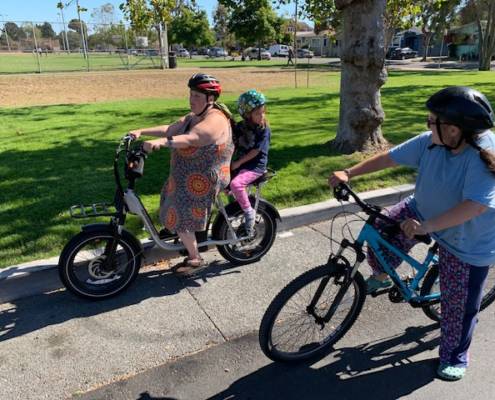
Vicki Davis with daughters Lyra (on back of bike) and Holly
During the pandemic, Davis’ older daughter went on bike rides with her dad for her PE requirement. Davis couldn’t join them because she has asthma and other health issues that would make it hard for her to keep up. Plus, she didn’t have a bike. Her younger daughter hasn’t learned to ride, so the two of them were stuck at home while the other half of their family had all the fun.
Her family had another problem: A 2000 Camry, her husband’s old car, with an unreliable battery. “Over the pandemic, he really got into biking and was using his car less and less,” she says, “and we would get tickets almost every month for street sweeping.”
The Clean Cars for All program solved both problems. Davis was able to take the Camry off the road, and, in return, the program gave her a voucher to buy one or more e-bikes. “We got $7,500, which is more than we could have gotten [for the Camry] had we sold it,” she says. She and her husband don’t have to worry about parking tickets, registration, or getting the car to pass smog. And Davis has a brand new Rad Runner Plus that allows her to keep up with her husband and older daughter and take her younger child for a ride on the back.
Here are the basics of the Clean Cars for All e-bike voucher program, including the timing and tips from Davis on navigating the process.
Step 1: Have an eligible car to trade and meet eligibility requirements
To qualify for a Clean Cars for All voucher, you must meet the program’s eligibility requirements. In the Bay Area, that includes living in an eligible zip code, meeting the income requirement (income within 400% of the Federal Poverty Level), owning a car that falls within the program parameters, and being a first-time applicant to the program.
The car must be drivable to qualify. Davis’ Camry had 180,000 miles on it and was in decent condition, but she was happy to scrap it. “It was basically like paying rent to have it parked on our street,” she says.
Step 2: Fill out lots of paperwork
“The very first step is preapproving that you can even apply,” Davis says. That part of the process was quick.
Once she was preapproved, she could submit paperwork proving her income and ownership of the car. The website was not mobile-friendly, which presented an extra challenge.
When her husband found out about the program through a post on Twitter, he didn’t believe it was real, but he sent her the information, and she submitted the application because they were desperate to get rid of their second car. It took so long for her to hear back from BAAQMD that she figured it wasn’t real or the program had run out of money, but she finally got approved.
She submitted paperwork through an online portal where she could check her application status and can now check the balance on her voucher and get purchases approved.
Pro Tip: Davis notes that the program promotes itself as a subsidy to buy an EV, and it’s harder to find the e-bike option. In the Bay Area, that option is listed under Mobility Options, which includes a grant for transit passes. When you choose what kind of voucher you want, it looks like you’re opting for a transit pass — the e-bike grant is in small print.
Step 3: Get the car inspected at a salvage yard.
“I think a lot of the delays were me, to be honest,” Davis says. It took her a while to complete the many steps of the process, and, she adds, scrapping the car was a whole second chore that she hadn’t bargained on. She had to get the battery working to drive the vehicle to the salvage yard for inspection.
There was an issue with the yard sending her documents through to the Clean Cars program, and getting the information sent again was a big hassle. Her tip: “Keep copies of things. Follow up.”
Step 4: Wait.
Davis found out she was eligible to apply for a Clean Cars voucher in March of 2021. She submitted her paperwork in April. Her status changed to Under Review in July and Approved in November.
Step 5: Take the car back to be junked.
After she was approved, Davis took her car to be junked in November. It took a few more weeks for the grant to come through; she got her voucher in late December of 2021.
Step 6: Buy your new e-bike, accessories, and more
Davis bought a Rad Runner Plus Class 2 e-bike for about $2,100, including tax and accessories. “The thing I really like about the one I got is that it has a seat on the back for my younger daughter,” she says.
She chose the Rad Runner even though her voucher would have enabled her to get a more expensive e-bike because it fit her style better. She likes having the throttle option so she can keep going if she gets too tired.
The voucher is on a pre-loaded credit card, and Davis can submit what she wants to buy beforehand to get it pre-approved or approved after the purchase. She must load receipts for each purchase and show that it’s related to her e-bike. When she needed an extension cord for charging and bought a milk crate for an inexpensive basket, she had to load photos of the items in use since they weren’t classified as bike accessories.
With the $4,600 she has left, she can buy e-bikes for other family members, and she’s going to see if she can get a bike rack to put her e-bike on the back of the family car. She also has the option to convert the balance into money for transit passes. The program gives her up to three years to spend the funds.
Step 7: Ride everywhere and have a blast!
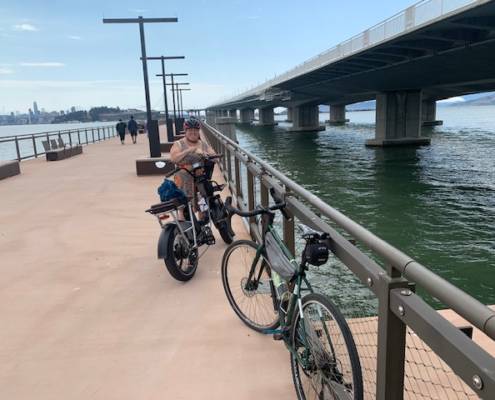
Davis is having a great time riding her new e-bike with her husband and kids. “We rode over the Bay Bridge, which was so exciting,” she says. She’s been taking her younger daughter to and from school by bike and riding alongside her older daughter to Berkeley High.
“Even though it’s an electric bike and I use the assist, I am getting exercise,” Davis says. Some of the things she loves about being able to bike now include “going places where we don’t have to worry about parking” and “not having to stress about my second car.” She’s getting less nervous about riding and expanding her comfort zone; she recently did her first ride in the dark.
If you think you might qualify for the Clean Cars for All program and would like an e-bike voucher, check the program webpages for information on where to apply in your region. And you can out more details about the Bay Area program on this handy reference page.
https://www.calbike.org/wp-content/uploads/2022/09/IMG_6635.jpg480640Laura McCamyhttps://www.calbike.org/wp-content/uploads/2018/07/calbike-logo.pngLaura McCamy2022-09-01 15:33:272022-10-26 10:38:11How to Get a Clean Cars for All E-Bike Voucher in the Bay Area
Historic Active Transportation Slate Poised to Make it to the Governor’s Desk
Sacramento, Calif – As we head into the final stretch for legislation in 2022, a slate of excellent active transportation bills has been voted on in the Senate and Assembly. Almost all of the bills we supported are already on the governor’s desk, including at least two that have been signed into law. Of the 18 active transportation bills that made it to the end of the session, one was withdrawn by the author (the Bicycle Safety Stop), and only one remains to be voted on. The other 14 bills have passed both houses and are on their way to Governor Newsom’s desk, if they aren’t there already.
CalBike applauds the California legislature for recognizing the critical role that biking, walking, and public transit will play in our response to climate change and our efforts to create healthier communities.
Jared Sanchez, senior policy advocate at CalBike, said, “We’re encouraged by the overwhelming support for most of the bills we have been following in 2022. The success of this legislation shows that our elected officials take the climate crisis seriously and are prepared to address it. Active transportation helps reduce the climate impacts of California’s transportation system, and it’s frankly, the healthy and fun way to get around town!”
Here is an update of the active transportation bills CalBike supports that are still in play in Sacramento:
Requires cities to ensure that a modified circulation element additionally includes bicycle and pedestrian plans and traffic calming plans. Enrolled and presented to the governor
AB 2438 Friedman – Aligning transportation funding with climate goals
Requires all transportation projects funded at the local or state level to align with the California Transportation Plan and the Climate Action Plan for Transportation Infrastructure adopted by the Transportation Agency Enrolled and presented to the governor
SB 457 Portantino and Wilk – Car-Free Tax Credit
Creates a rebate program for each person without a car in a household
Authorizes cities to use sound-activated enforcement devices to capture vehicle noise levels that exceed the legal limits. Enrolled and presented to the governor
Allows the Great Redwood Trail agency further authority to build out the Great Redwood Trail, a 320-mile, world-class, multi-use rail-to-trail project connecting California’s San Francisco and Humboldt Bays. Enrolled and presented to the governor
SB 1230 Limon – Zero-emission and near-zero emission vehicle incentive programs
Extends environmental review exemptions for transit and active transportation infrastructure improvements. Forbids auto capacity increases. Enrolled and presented to the governor
AB 1919 Holden – Free Student Transit Passes
Develops Youth Transit Pass Pilot Program that will allow transit agencies to provide free youth transit passes to all persons 25 years of age.
Requires Caltrans and cities to update all pedestrian control signals to operate giving a pedestrian a head start between 3 to 7 seconds to enter an intersection with a corresponding circular green signal Enrolled and presented to the governor
SB 1107 Dodd – Protect California Drivers Act of 2022
Would modernize California’s outdated minimum auto financial responsibility limits (known as liability insurance) and would change our underinsured motorist law so that drivers get the full value of the policy they paid for. Enrolled and presented to governor
AB 2174 Chen – Treat bikes and scooters as vehicles for purposes of towing regulations.
AB 2028 Davies – School instruction for bike and scooter safety
Expands permitted school bicycle safety education partnerships from law enforcement agencies in elementary and middle schools to any agency or organization at any public school. Approved by the governor and chaptered
WITHDRAWN
AB 1713 Boerner Horvath – The Safety Stop
Requires adults on bikes to yield at stop sign-controlled intersections instead of stop unless stopping is necessary for safety. Withdrawn by author
Earlier this month, CalBike’s long-time executive director, Dave Snyder, left to join People for Bikes. CalBike’s Board of Directors has now opened its search for CalBike’s next executive director. Please share with your networks! And please visit our careers page to see the listing for our other job opening, part-time individual giving manager.
Executive Director job description
The California Bicycle Coalition (CalBike) is seeking an executive director to continue its record of successful active transportation advocacy and lead the organization as it continues to expand its reach and impact in generating an equitable and sustainable transportation system. The executive director will guide the strategic direction of the organization and build new programs to support that vision.
CalBike’s director will share our members’ passion for better biking and be enthusiastic about our mission to advocate for equitable, inclusive, and prosperous communities where bicycling helps enable all Californians to lead healthy and joyful lives. The incoming executive director must have a thorough understanding of bicycle and active transportation advocacy work. They must be able to engage strategically with partners and understand relevant policy impacts in intersecting and interconnected issue areas such as policing and traffic enforcement; housing, gentrification, and displacement; transit advocacy; climate change and sustainability; and disability mobility.
The executive director is the chief executive officer of the California Bicycle Coalition, a 501(c)(4), and the California Mobility Fund, a 501(c)(3). The executive director reports to the board of directors and is responsible for ensuring the organization consistently achieves its mission and financial objectives.
The executive director will be supported by our small, tight-knit team, which works remotely and collaboratively.
About CalBike
CalBike is California’s state-level bicycling advocacy organization. We advocate for pro-bicycle and equitable mobility legislation in Sacramento and work closely with state agencies to secure funding for infrastructure and programs that make our streets and communities safer and more welcoming to people who walk and bike. CalBike also represents California transportation positions and initiatives at the national level and works to ensure continued funding and focus from federal programs to support California’s active and accessible transportation goals.
Compensation
CalBike offers a competitive compensation package with a salary ranging from $130,000-$150,000, commensurate with the candidate’s qualifications. CalBike also provides employer-paid medical, dental, and vision insurance, a bike commuter benefit, cell phone and internet reimbursement, ergonomic office stipend, a 3% employer match to a SIMPLE IRA retirement plan, and a generous paid leave policy.
Location
The executive director must be based in California. Most work will be remote. Preference for Sacramento, the Bay Area, or a location where you can easily travel to Sacramento as needed to meet with legislators and agency personnel.
Responsibilities of the Executive Director include:
In collaboration with staff, board, and stakeholders, develop and execute an inspiring, ambitious, and achievable vision for CalBike
Act as the principal spokesperson for the organization and our campaigns, including representing CalBike in California legislative hearings and sessions, as well as building relationships with elected and government officials
Support policy work by planning and working in collaboration with staff to develop effective communications strategies for policy and advocacy initiatives
Represent California in national bicycling and transportation discussions and act as the key subject matter expert on developing partnerships with federal government funding to support California state active transportation initiatives
Develop and steward relationships with donors, funders, and movement allies
Actively participate in fundraising activities to solicit contributions from major donors, grantmakers, and corporate partners
With the program team, develop and support external partnerships to grow CalBike’s coalition of support and advance our leadership and reputation across California and nationally
Work with finance and operations staff to ensure compliance with state and federal requirements, develop and monitor the annual budget, provide timely internal reporting and forecasting, and ensure that adequate funds are available to permit CalBike to carry out its work
Lead, grow, and manage an effective and enthusiastic team
Maintain and advance a healthy, diverse, inclusive, and positive workplace with a climate of trust and openness
Facilitate a strong board of directors, engaging members around strategic planning, fundraising, and long-term programmatic and organizational goals
What we’re looking for:
Our executive director will have most or all of these qualifications:
A minimum of 10 years of relevant experience, including at least 5 years in a senior leadership position with strategic planning, budget, and management responsibilities.
Professional and/or personal experience working in and with broad and diverse communities, including but not limited to BIPOC communities, communities negatively impacted by environmental injustice, and other underserved and historically marginalized groups
A thorough understanding of issues related to racial justice and equity, a clear vision that will enable the advancement of diversity, equity, justice, and inclusion, internally and externally, and a track record of implementing those same principles
Experience as a coalition builder, strategist, and team leader who is passionate about bicycling and its various intersections
A track record of successful nonprofit fundraising, including experience with public and private sector funding, cultivating high net worth donors, and soliciting and closing major gifts
An inclusive leader who can strengthen and build upon CalBike’s value of supporting people marginalized by racism, sexism, and other forms of oppression to grow and advance their careers
Experience developing partnerships among nonprofits, community-based organizations, private sector entities, and social justice organizations
An innovative thinker and skilled collaborator who can work effectively and deepen relationships with a diverse staff, board members, and external stakeholders
Confidence representing CalBike and presenting ideas to a range of audiences, including internal and external stakeholders
Sets clear goals and expectations, thoughtfully gives and receives feedback, encourages a healthy work-life balance, and promotes both personal and professional growth.
How to apply:
Please send a resume or CV with a cover letter as a single PDF document, with a subject line including the job title and your full name, to cbc@calbike.org.
Applications will be accepted until the position is filled. All applications and candidates will be kept confidential.
CalBike provides equal employment opportunities without regard to age, ancestry, color, creed, mental or physical disability, marital status, medical condition, national origin, race, religion, sex, gender, sexual orientation, veteran status, or any other consideration made unlawful by federal, state, or local laws.
We strongly encourage people from all backgrounds to apply, especially people of color, women, immigrants, people of all abilities, and members of the LGBTQ+ community. Top applicants might not have expertise related to every qualification listed above, but will bring experience in at least two, plus a willingness to learn and excel at the others. A core qualification for this position is that you must advocate for and deeply value equity and inclusion.
https://www.calbike.org/wp-content/uploads/2016/09/thumb-1.jpg640480Kevin Claxtonhttps://www.calbike.org/wp-content/uploads/2018/07/calbike-logo.pngKevin Claxton2022-08-31 13:16:492022-08-31 13:18:12CalBike Announces Executive Director Search
On August 24, 200 people showed up for a Work Group Meeting for the Electric Bicycle Incentives Project held by the California Air Resources Board. It was a big turnout for a meeting held during the workday on a Wednesday afternoon. But it’s not surprising considering the tremendous interest in the program (CalBike’s interest list for the program has more than 6,600 people — scroll down to sign up).
The meeting included a lot of great feedback and some breaking news: the announcement of the program administrator. Here’s what happened and what’s next for the e-bike incentives program.
CalBike supporters make a strong showing
CalBike had little notice of this meeting, and it became clear that CARB isn’t used to its programs receiving so much interest and input from the public. The facilitators were overwhelmed by the number of comments and questions; at one point, 50 people were waiting to speak.
A big thank you to everyone who could participate in a meeting during the workday with little advance notice. We must keep the pressure on CARB to be more transparent and take more public input. Many commenters mentioned CalBike, which strengthens our position to negotiate on your behalf to create a robust and successful program.
There will be a follow-up to the August 24 meeting because there wasn’t time to take everyone’s comments. Even if you registered to attend that meeting, you won’t automatically get notified about the follow-up and future meetings. Please subscribe to CARB’s e-bike mailing list to learn about e-bike work group meetings. And sign CalBike’s e-bike list to get the latest updates and learn how you can get involved.
Program basics revealed
At the meeting, the outlines of the program became clear, though it’s not clear whether public input could change some of the details.
CARB’s current program specs:
To qualify for the incentive program, participants’ household income is capped at 400% of the federal poverty level (FPL). That’s $51,000 for a single person and $106,000 for a family of four.
Vouchers will be up to $750 for a regular e-bike and up to $1,500 for a cargo or adaptive e-bike. People whose income is under 225% FPL or who live in disadvantaged communities qualify for additional incentives.
The program will support the purchase of Class 1 (up to 20 mph, pedal assist only) and Class 2 (up to 20 mph, pedal assist and throttle) e-bikes. Class 3 (up to 28 mph, pedal assist only) will be excluded.
Participants must purchase a bike from a California bike shop or online from a company with a business location in California.
The program will launch in the first quarter of 2023. The law creating the program specified a start date of July 1, 2022, but, as a CARB administrator explained at the meeting, one to two years is the minimum needed to launch a brand new program at a state agency.
Most of the discussion at the meeting centered on the income caps. In California, 55% of the population (about 21 million people) makes less than 400% of the FPL and would qualify for e-bike incentives under the current program. The income caps match those of other clean vehicle programs administered by the Air Resources Board (Clean Vehicle Rebate Project and Clean Cars for All).
The program has $10 million in funding, which may cover an estimated 7,000 e-bike vouchers at the proposed funding levels. For perspective, CalBike’s interest list for the program currently has more than 6,600 people on it — almost enough to fill the whole program if everyone qualified.
Several people on the call expressed interest in getting help to buy an e-bike but said they wouldn’t qualify under the proposed income caps. Commenters were divided between wanting the incentives to go only to low-income households and advocating for some portion of the money to be made available to higher-income people.
E-Bike incentives administrator named
The standalone e-bike incentive program will be administered by a third party, with a single application process for all Californians. That will make the program easier to access.
E-bike vouchers through the Clean Cars for All program, which CalBike helped pass, took a long time to roll out (partly due to pandemic delays) and aren’t uniformly available. Regional air resources boards were tasked with adding e-bike vouchers to their program; some regions have the program up and running while others don’t.
CARB was considering three nonprofits to administer the program and announced during the work group meeting that it has chosen Pedal Ahead, based in San Diego. Pedal Ahead has run a local e-bike program in San Diego since 2020. Streetsblog’s article about the meeting has more background on the chosen administrator.
Next steps: second meeting, CalBike follow-up
CARB has posted a recording of the August 24 work group meeting (see below). It had already planned another work group meeting for later in the fall but will add another meeting because there was too little time to get to the public comment at the August meeting. If you can’t attend a meeting or weren’t able to comment at the last meeting, you can email feedback to the CARB at CleanTransportationIncentives@arb.ca.gov.
CalBike is following up on the meeting with a technical letter to CARB to advocate for a robust program, and we will meet with CARB staff in the coming months to help guide the program launch. Our main goal is for this first year to be an instant success, showing Sacramento that the $10 million allocated for the pilot is just a start and that e-bike subsidies should be an annual budget item. In future years, we hope to see most of the funds set aside for low-income Californians but some help provided for middle-income residents.
We’ll need your help to keep up the pressure.
Video of the August 24, 2002 CARB Electric Bicycle Incentives Project Work Group Meeting
https://www.calbike.org/wp-content/uploads/2019/10/mom-and-kids-on-bike.jpeg8651305Laura McCamyhttps://www.calbike.org/wp-content/uploads/2018/07/calbike-logo.pngLaura McCamy2022-08-26 18:14:072024-08-06 13:28:15CalBike Supporters Make Big Impression at CARB E-Bike Work Group Meeting
Before Jenn Guitart joined CalBike in 2014, initially as director of development and communications, she worked for an organization that promoted comprehensive sex education. “I like to joke that I’m more passionate about bikes than I am about sex,” she says. “When I started working at CalBike, I realized that it was exactly what I was looking for. I said, ‘Wow, this is my dream job.’”
Now Guitart is leaving her post for another dream job. Starting in September, she’ll be leading TransForm, a nonprofit that advocates on issues of transportation, housing, and equity. “I’m really excited that my work as executive director of TransForm is going to be building on a lot of the things CalBike is working toward. It’s broader, though, with a focus on land use and housing as well as transportation,” she says. “But as with CalBike, the goal is to build a more equitable California.”
A force for growth at CalBike
As CalBike’s director of advancement, Jenn Guitart has transformed CalBike. The budget more than tripled since she took on development responsibilities. And her work on CalBike’s communications has helped CalBike reach more Californians. She spearheaded CalBike’s rebranding and website development.
Guitart appreciates that CalBike gave her the freedom to exercise leadership and expand her skillset. “I feel so incredibly lucky to have spent the last eight years doing this amazing work alongside these incredible people,” she says. “One of the things I’m most proud of is that I was part of the hiring decision for most of our team.”
Strengthening alliances
TransForm and CalBike have been allies in the past, frequently supporting the same causes. CalBike will miss Guitart’s creativity, energy, and enthusiasm. But we are excited to be seeding the advocacy world with another passionate bike advocate.
“Working at CalBike has been such an enormous pleasure,” she says. “I feel confident and excited for CalBike’s future. I’m so pleased to be leaving CalBike in such a good place.”