On December 2, 2025, the Sunnyvale City Council approved buffered bike lanes on Hollenbeck Avenue. The vote was 6–1. It marks a momentous milestone: the culmination of more than a year of focused, volunteer-driven campaigning, powered by perseverance of groups like Sunnyvale Safe Streets.
CalBike applauds the many community members who made this possible and the Council for choosing a design aligned with Sunnyvale’s safety and climate goals.
Here are the four core strategies that made this possible:
1. Work Within the City’s Process
Advocates followed Sunnyvale’s Study Issue process rather than relying on ad-hoc lobbying. Showing up at every decision point — year after year — kept Hollenbeck in the city’s line of sight. As Sharlene Liu put it: “Don’t bring something up at random times. Bring it up when decisions are actually being made.”
2. Build a Support Infrastructure
A simple website and petition became the campaign’s backbone. Flyers at schools and transit stops, PTA outreach, and community partnerships built a growing base of supporters who could mobilize on short notice.
3. Knock on Doors and Know Your Numbers
Volunteers canvassed more than 1,100 homes within a mile of Hollenbeck. The findings were decisive: 60% support, only 6% opposition. Clear data helped reassure policymakers and surfaced new speakers for the final vote.
4. Use Trickle Advocacy
For months, supporters delivered one focused point per council meeting: parking, safety, crash history, design options. By the time of the final hearing, the Council already understood the case for buffered lanes.
That preparation mattered. As Councilmember Richard Mehlinger explained: “I concluded that the benefits to the City of buffered bike lanes, regional active transportation connections, letting kids bike to school safely, reducing our climate impact, substantially outweighed the costs.”
What happened on Hollenbeck in Sunnyvale is a reminder that local change doesn’t arrive in a burst; it accumulates through steady, values-driven work that reshapes what a city believes is possible.
Across California, campaigns like this one are quietly rewriting the expectations for safety, mobility, and community voice. CalBike is proud to stand with advocates who do this patient, often invisible, labor because when residents organize around the simple idea that their streets should protect their children and reflect their shared future, they expand the horizon for all road users.
https://www.calbike.org/wp-content/uploads/2025/12/Sunnyvale.jpg9663375Andrew Wrighthttps://www.calbike.org/wp-content/uploads/2018/07/calbike-logo.pngAndrew Wright2025-12-11 11:16:232025-12-11 13:05:49Four Strategies That Helped the Hollenbeck Project Pass
CalBike’s 2026 Agenda Reveal looked back at hard-won gains on Complete Streets and funding, then made the case for what comes next: billions for bikes, sane e-bike rules, real answers to traffic violence, and a 2026 Bicycle Summit that turns that agenda into action.
Here are responses to the questions submitted that we didn’t get a chance to answer during the webinar:
Q: I want to see drivers who use their car horns to startle or harass or worse to bicyclists aggressively arrested and charged with appropriate offense and fined for such activity, which I perceive as a very real threat to biker safety.
A: Thanks for this recommendation. We agree this is frustrating. We have floated the idea of a statewide vulnerable road user law, which would create specific penalties for targeting bicyclists. Anti-harassment ordinances are also possible at the local level to punish the behavior you mentioned. Here is a bit more information including where they are adopted in CA.
Q: What lessons from your advocacy for Quick Build legislation can we use for local quick build project advocacy? We have a concept for a pilot El Camino Real bikeway project in Menlo Park.
Q: As a follow-up to the education issue. The biggest threat I feel when riding is uneducated drivers. Many folks simply don’t know what to do around bikes on the road. I have felt there is a need to strengthen the statewide drivers manual and license testing process. Is any work being done on this aspect of driver education?
A: We have been pursuing changing driver education to consider more vulnerable road users and the changes road users face to newer multi-modal street design. However there has been little interest from elected officials to champion this cause. Given the ongoing transformation of the Department of Motor Vehicles (DMV), legislators may be sensitive to adding new requirements for drivers.
Q: Does CalBike have a policy perspective on e-scooters? Any differences from e-bikes?
A: We are supportive of legal and responsible use of micromobility, including e-scooters. We treat each separate device differently, given context and problem arising. We support the existing statute as it relates to e-scooters. We do primarily put our interest towards the bicycle, but advocate for the proliferation of safe and accessible use of all micromobility.
Q: Is there motion to create the “Engineers” handbook for informing municipalities about updated laws and how they can be implemented?
A: This is a great idea! We have a few Campaign ideas circulating focused on the general public, but this is a good addition to consider.
Q: Has there been a protected intersection design guideline in addition to DIB-94?
A: There haven’t been any additions to DIB-94 yet. Caltrans typically doesn’t open DIBs for revision for at least 2 years. They have been asked by California Walk Bike TAC for the opportunity to revise at the earliest opportunity.
Q: Can we get state legislation which increases the length of time that plaintiffs have to file suit against municipalities after a crash? Currently, there is a 6 month max. Many PDs, however, take >6 months to complete their investigations. This creates a conflict of interest where PDs can slow walk investigations in order to mitigate legal risk for the municipality. This is important as threat of litigation could be one of the primary tools to get cities to install more infrastructure and increase enforcement.
A: Thank you for the idea. We have several concepts around the legal system and bicyclist interaction after crashes that we are pursuing.
Q: What is the new study re: E-Bikes you mentioned? Is CalBike authoring this?
A: Mineta Transportation Institute is authoring it. More info here.
https://www.calbike.org/wp-content/uploads/2025/12/zoombanner.jpg29456138Andrew Wrighthttps://www.calbike.org/wp-content/uploads/2018/07/calbike-logo.pngAndrew Wright2025-12-04 10:13:382025-12-04 10:18:552026 Agenda Reveal, Recap, and Q&A
To understand why data accuracy matters to LA Metro’s riders, Nina Kin — Tech Lead on LA Metro’s Digital Experience Team — often points to moments like this:
It’s 7:48 a.m., and a parent on a tight schedule is trying something new: leaving the car at home. She drops her child at daycare, locks her bike, and jogs to the bus stop, coffee in hand. The app says the bus will arrive in three minutes, then one, then nothing. The icon disappears, the bus never comes, and by the time another line rolls past, trust has already left.
Quiet failures in an otherwise ordinary morning that shape how Angelenos decide whether to trust public transit again.
Metro, the agency that once embodied car-era Los Angeles is beginning to recognize how bikes and transit aren’t separate systems — they’re halves of the same promise.
When we talk about infrastructure, we usually mean concrete. For Kin, though, the foundation of a great transit system isn’t poured; it’s published via an app with a superb user experience.
“We really want the customer experience to be a focus on the same level as operations,” Kin says.
Architecture of reliability
Kin’s world runs on a few unglamorous acronyms that quietly shape every trip you take: GTFS and GBFS.
GTFS, the General Transit Feed Specification, is the open-data format that lets your phone tell you when the next bus will arrive. GBFS, the General Bikeshare Feed Specification, does the same for bike-share systems: where docks are, how many bikes are waiting, and whether there’s space to return one at your destination.
To most riders, those acronyms are invisible. But to Kin, they represent the nervous system of public mobility, the difference between trust and frustration. A “ghost bus,” or one that does not appear when scheduled, isn’t just a missed ride — it represents a broken promise. When a bus app says five minutes and the bus never shows up, it changes how people plan their lives. They start padding their commutes, stop believing arrival times, or give up on transit altogether.
That emotional impact is exactly what Kin is trying to solve: “When people see that the information matches reality, they feel like the system respects their time.”
The same principle applies to bikes. Both standards help riders trust what they see in their apps today, but Kin is focused on what they could enable tomorrow. A near future where the two feeds talk to each other where a trip planner app doesn’t just tell you the next train but shows the safest, low-stress bike route to get there, and whether there’s a dock or secure rack waiting when you arrive.
Data standards as public goods
The deeper Kin goes into open-data governance, the more she sees civic technology as an equity issue. “These standards — GTFS, GBFS — are community-governed,” she says. “Public-interest advocates deserve a seat at that table.”
She points to Boston’s MBTA as a model, with dedicated staff for rider-facing technology and a “pathways” dataset that helps wheelchair users navigate stations. “The next step for systems like Metro ahead of the mega events in the next few years is using data to make the system legible and easy for everyone.”
We can easily envision how a pathways guide for users on their smartphone would have a “curb cut” effect, making transit more approachable not just for wheelchair and mobility device users, but for those with heavy e-bikes and strollers.
In the end, trust is infrastructure, and the bricks and composite of that infrastructure are safety and accessibility for every user. If we want bikes and transit to compete, and win, against car dependence, the experience can’t just be good; it has to be impeccable. The path, the data, the station, the app — they all have to tell the same story: “you belong here, and you can count on this.” That’s the quiet revolution happening inside Metro and across California’s cities: a recognition that the future of mobility isn’t only about speed or capacity, but about credibility, a public realm reliable enough to believe in.
https://www.calbike.org/wp-content/uploads/2025/11/Metrope.jpg17805394Andrew Wrighthttps://www.calbike.org/wp-content/uploads/2018/07/calbike-logo.pngAndrew Wright2025-11-25 09:53:102025-11-25 09:53:11“Trust Is Infrastructure”: How LA Metro’s Nina Kin Is Building Better Data for Transit Riders on Bikes
https://www.calbike.org/wp-content/uploads/2025/11/cap.jpg17805394Andrew Wrighthttps://www.calbike.org/wp-content/uploads/2018/07/calbike-logo.pngAndrew Wright2025-11-20 14:49:092025-11-25 15:06:47Pave First, and Ask Questions Later
https://www.calbike.org/wp-content/uploads/2025/11/bikez.jpg16402461Andrew Wrighthttps://www.calbike.org/wp-content/uploads/2018/07/calbike-logo.pngAndrew Wright2025-11-10 14:10:332025-11-10 14:10:34California Independent Electric Mobility Council Status Update
CARB’s decision to absorb the remaining funding from the E-Bike Incentive Project into Clean Cars 4 All is a telling political moment—one that mistakes “cleaner cars” for genuine progress. It’s easier to imagine replacing every gas car with an electric one than to imagine a California where people can move freely without cars at all. But the latter is what true climate leadership requires. The E-Bike Incentive Project wasn’t flawless, but it represented a rare, tangible step toward that future: a policy backed by funding that helped Californians drive less, not just differently. Reversing it is a step backward for the state and a disservice to the people who believed in it.
Requiring a car trade-in shifts the focus from helping people get around to helping them replace a vehicle. That’s the quiet but crucial difference between mobility and motors, between freedom and another form of dependency. Households across California were ready to drop a car, saving thousands every year on insurance, maintenance, and gas – money that could instead go to rent, childcare, or education. A project meant to deliver on climate goals, traffic reduction, and helping families balance checkbooks all at once.
The state is taking the wrong lessons from the turbulence of the EBIP roll out; the overwhelming demand makes clear this is a popular program that people want. Tens of thousands of Californians lined up for each round of the e-bike incentives, waiting hours online for a chance at a modest voucher. Their wants and needs are clear and simple – a new, affordable, economical way to get to work, to school, to the grocery store without being locked into the cost and burden of car ownership.
Ending that opportunity now ignores that clear demand and walks back hard-won progress toward a more livable, affordable, and sustainable California.
https://www.calbike.org/wp-content/uploads/2025/10/carbebip.jpg30005394Andrew Wrighthttps://www.calbike.org/wp-content/uploads/2018/07/calbike-logo.pngAndrew Wright2025-10-29 13:55:242025-10-29 13:55:25Response to CARB on Ending the E-Bike Incentive Project
The Week Without Driving seeks to highlight that nearly a third of Californians can’t rely on driving for their personal mobility. This year, the South Bay Transit Summit in Torrance also exposed how overlapping systems of infrastructure, regulation, and enforcement leave even willing bike riders few real choices. In the South Bay, this coercion isn’t theoretical.
LA County’s South Bay offers a case study in how dependence becomes design. A refinery explosion in nearby El Segundo averting catastrophe only by luck of the wind made it an apt week to reconsider life beyond fossil fuels. Yet the region’s streets, laws, and enforcement practices make that reflection nearly impossible. Here, driving isn’t merely convenient; it’s compulsory.
The gap between what’s possible and what exists is a frequent source of frustration for locals like Grace Peng at South Bay Forward, “Torrance/Carson is the third-largest job center in LA County. El Segundo/LAX is No. 4. Providing car-free access to these jobs is not just business-friendly; it’s also the minimum requirement for responsible regional sustainability and economic vitality.”
A Region That Criminalizes Alternatives
The South Bay’s coastal streets could be an ideal place for short trips by bike or on foot: most residents live within three miles of work, school, or errands. Instead, high-speed arterials, wide intersections, and sidewalk bike riding bans make those short distances feel like hostile terrain.
Local governments have responded to the rise of e-bikes not as an opportunity to improve safety or expand access, but as a crisis to be contained. Torrance has considered banning e-bikes from sidewalks where no dedicated bike infrastructure exists — forcing riders into 45 mph traffic lanes (alongside the other South Bay refinery that blew up ten years ago: https://www.csb.gov/exxonmobil-torrance-refinery-explosion-/).
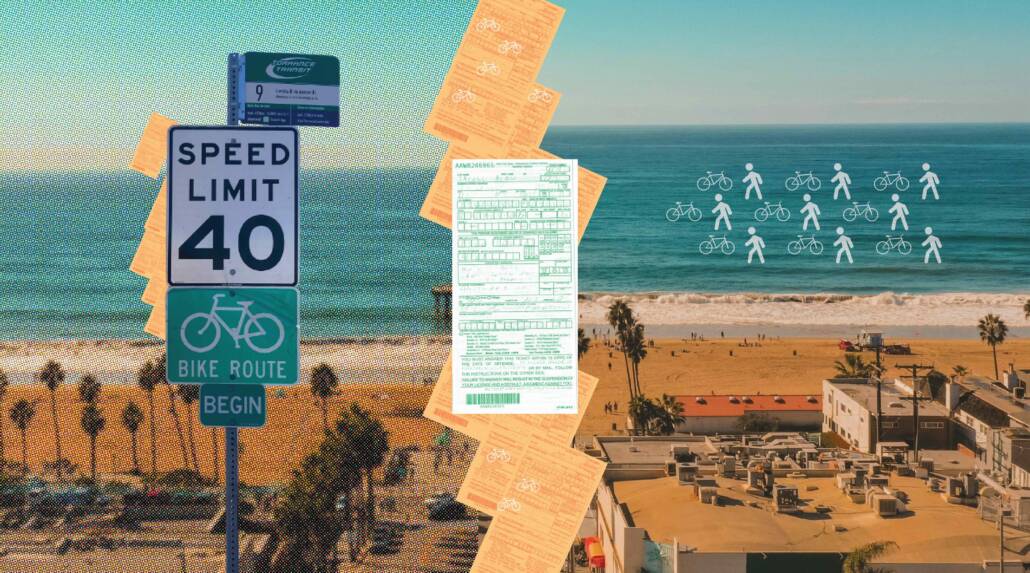
The penalty in Manhattan Beach is far more extreme. Riders report receiving municipal citations rather than standard traffic tickets, meaning the city — not the state — sets the terms. Contesting one of these citations requires a $1,500 deposit up front, returned only if the appeal succeeds. One rider who tried to challenge his ticket described paying nearly $900 in total after multiple hearings and days lost to court appearances.
“I received my ticket on Redondo Ave and 19th Street at 8:15 a.m. during peak school drop-off time,” said Mark Polak. “I had blown through the stop sign without significantly slowing, but did not interfere with anyone’s right-of-way. The policeman said he was going after bikes and cars equally — but the bicycle fine is $500, while the State of California fine for running a stop sign in a motor vehicle is $238.”
Polak added that Manhattan Beach once offered an educational diversion program for bicycle infractions. That’s gone now. “He said I might be able to negotiate the fine down with the city finance office, but when I called, they thought I was crazy. I paid the fine.”
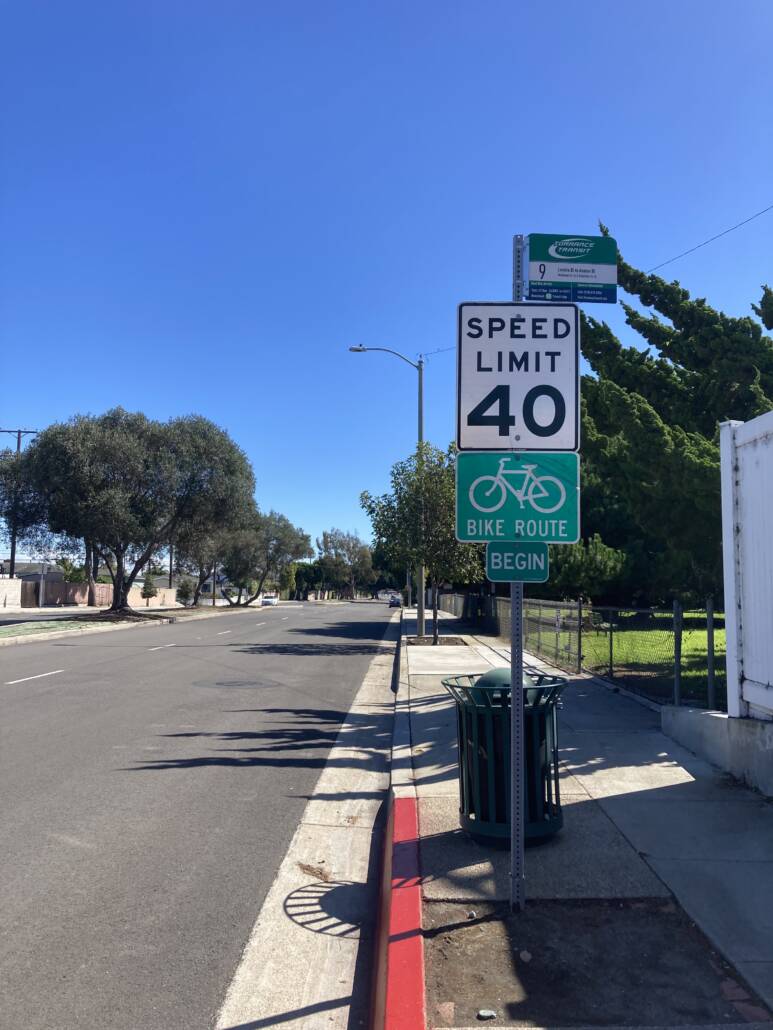
“Now that I’ve had one ticket, I’m worried about getting another with an enhanced fine for something I do every day,” he said, noting the lack of signal sensors that detect bicycles and the absence of safe crossings on Redondo Avenue — ironically a designated bike route. “Sometimes I even run the red light very early in the morning because the sensor doesn’t register bikes.”
Another rider, Kyle Richardson, was cited while taking his two children to AdventurePlex in Manhattan Beach on an electric cargo bike.
“For years I’ve taken my kids to daycare, school, and the beach on our electric cargo bike,” Richardson said. “On the morning of August 20, 2025, I was taking my two kids to AdventurePlex — one of the more affordable childcare facilities in the South Bay. When we arrived at N Redondo Ave, the road was busy with cars. I did a rolling stop to keep momentum with our 400-pound bike and checked that no cars were coming. Still, two officers pulled me over and wrote me a $500 ticket.”
He added, “I lead a bike bus in North Torrance at Carr Elementary. The Torrance Police Department supports and has attended our bike bus. The Manhattan Beach City Council, mayor, and Police Department should do more to support families in their communities to ride their bikes to school rather than punish them with excessive fines.”
Meanwhile, cars routinely roll through stop signs, block bike lanes, and speed down residential corridors with little consequence.
Predictable poor results
Infrastructure that privileges speed over safety, ordinances that ban bikes from the only safe spaces to ride, and a ticketing regime that fines bicyclists hundreds of dollars for common-sense behavior all converge to send a single message: don’t bother trying. Even as residents look for ways to reduce their reliance on fossil fuels, especially in a region defined by refineries and freeways, the system keeps them cornered, forced back into cars by design.
If the South Bay offers a preview of what happens when local policy drifts away from statewide mobility goals, it’s a warning worth heeding. The conditions that make driving mandatory here are not accidents of geography or culture; they are the predictable results of rules, enforcement priorities, and infrastructure decisions that have made any other way of getting around feel impossible.
It’s hard to miss the irony. In a week marked by yet another refinery explosion, South Bay residents were reminded that the region’s dependence on oil doesn’t just pollute the air — it dictates how people move. The smoke clears, the streets reopen, and the cycle continues: fossil fuel production and fossil fuel consumption reinforcing each other, one ticket and one traffic lane at a time.
https://www.calbike.org/wp-content/uploads/2025/10/SouthBay.jpg30005394Andrew Wrighthttps://www.calbike.org/wp-content/uploads/2018/07/calbike-logo.pngAndrew Wright2025-10-16 10:51:292025-10-16 10:51:32How South Bay Cities Enforce Car Dependence by Design
On September 9, 2025, the U.S. Department of Transportation canceled grants for bike lanes, safer intersections, and pedestrian facilities with a stunning rationale: they were “hostile to motor vehicles.” In San Diego, a safety project was rescinded because it “appears to reduce lane capacity and a road diet that is hostile to motor vehicles.” In Alabama, converting a lane into a bikeway was deemed “counter to DOT’s priority of preserving or increasing roadway capacity for motor vehicles.” In Boston, a redesign of Mattapan Square was rejected for daring to change the “current auto-centric configuration” because it might “impede vehicle capacity and speed.”
This is not a misunderstanding. It is a declaration: the federal government is explicitly draining funding from active transportation in favor of cars.
If Safety Is “Hostile,” What Side Is DOT On?
Let’s be clear: Cars aren’t the enemy. But traffic violence is. And when the nation’s transportation agency labels safety improvements “hostile,” it is taking the side of pollution, congestion, and preventable deaths over common sense.
If your definition of quality of life is simply more car travel, you’ve missed the point. More cars mean more pollution, more danger, and more preventable deaths. Real quality of life comes from streets where people can move safely, breathe clean air, and choose how they get around.
Safe Streets Are Not a Partisan Luxury
This isn’t about left or right. Florida, Texas, and Alabama — hardly bastions of anti-car politics — are expanding bike paths and trail networks. Families everywhere want the same thing: streets where children can walk to school, seniors can cross safely, and anyone can ride a bike without risking their life.
To label that “hostile” is an insult to communities across the political spectrum working to make daily life safer and healthier.
CalBike Will Not Be Deterred
At CalBike, we don’t need Washington to tell us what freedom looks like. You don’t either. We know what real freedom looks like: the freedom to walk to school, ride to work, or roll to the store without fear. The freedom to breathe clean air and live in neighborhoods built for people, not traffic. The freedom to choose how we move.
The Department of Transportation may cling to an auto-centric past, but we are building the future together. So let Washington call it “hostile.” We call it progress. We call it life-saving. And we call on our friends, our allies, and every Californian who dreams of safe, vibrant streets: stay in this fight with us, because the road ahead belongs to all of us.
This post is sponsored by Bike Legal: At Bike Legal, we advocate for protected bike lanes that separate cyclists from motor vehicle traffic. Yet even the best infrastructure cannot remove every danger. We encourage riders to protect themselves by always wearing a helmet and using lights even during the day to increase visibility. Safer streets come from both strong infrastructure and personal responsibility working together. To learn more about how Bike Legal advocates for all bicyclists, check out our blog on bicycle safety, what to do after a crash, and cyclists’ rights on the road.
So you’ve spotted a shiny new bike lane on your commute, or maybe your city just opened a “Class IV separated bikeway” (that’s planner-speak for one with real protection). Fantastic! But then come the signs. Some are obvious, some feel like they were designed by a traffic engineer after their third cup of coffee. Let’s decode them together so you know exactly where you – and your bike or e-bike – belong.
The MUTCD makes it clear: bike signs aren’t optional decoration. They’re standardized, retroreflective, and placed with intent. Their job is to:
Define spaces for bicycles and tell motorists when to stay out.
Warn about hazards that could toss you over your handlebars.
Guide you through routes, intersections, and crossings.
Help separate users; walkers, e-bikers, skateboarders
Common Signs and What They Mean
Bike Lane (R81(CA)) – This is the core bikeway sign. It marks where a bike lane begins, continues, or ends. You’ll usually see it at every arterial street or at half-mile intervals on long stretches. It regulates both bicycle and car behavior (Page 1369)
Bicycles May Use Full Lane (R4-11) – This sign makes it clear that bicycles have the legal right to use the entire lane. It’s particularly important on streets without usable shoulders or for e-bike riders moving at traffic speed (Page 1370)
Begin Right Turn Lane, Yield to Bikes (R4-4) – Found where right-turning cars must cross a bike lane. It tells drivers to yield and watch for bicycles in the lane (Page 1369)
STOP and YIELD Signs (R1-1, R1-2) – On shared-use paths, these signs apply to bicyclists at roadway crossings. If you see a STOP sign facing your direction, you’re expected to obey it (Page 1368).
No Motor Vehicles (R5-3 / R44A(CA)) – Typically posted at entrances to bike paths. Some paths also have signage to exclude “motorized bicycles,” which apply to e-bikes, depending on local policy (Page 1370).
Bicycle Warning (W11-1) and Bicycle/Pedestrian Warning (W11-15) – Yellow diamonds that warn of bicycle crossings or shared crossings with pedestrians. They’re often placed before intersections or shared-use path crossings to alert car drivers (Page 1372).
Surface Condition Warnings (W8-10, etc.) – Signs like “BUMP,” “DIP,” or “PAVEMENT ENDS.” They’re meant for bicyclists, warning about conditions that can cause a loss of control (Page 1372).
Bike Route Guide (D11-1, M1-8) – Green directional signs that confirm you’re on a designated bike route. They sometimes include mileage to destinations and function like breadcrumbs across the network (Pages 1373–1374).
–
E-Bikes and Signage
Speed limits: Some trails and paths set maximum speeds, often around 15 mph, regardless of whether you’re riding a traditional bike or an e-bike.
No Motorized Bicycles: Signs with this wording may exclude certain e-bikes, particularly Class 3 models (up to 28 mph). Always check posted signs before entering a path (see Page 1370).
Final Thought: Read the Signs, Ride with Confidence
New bikeways can be confusing for riders and drivers. But once you know the signage, you’ve got the inside scoop. Think of these signs as a secret code: crack it, and you’ll always know where you belong.
And hey, the next time you roll past a “Bicycles May Use Full Lane” sign, don’t just pedal nervously on the edge. Sit tall. You’ve got the right to be there. The sign says so.
One last story: remember the old “Share the Road” plaques? They were meant to remind drivers to watch for bikes, but many motorists read them as instructions for bicyclists to get out of the way. The confusion was so common that agencies retired the sign in favor of clearer language. It’s a good reminder that signs evolve, just like our streets. When the message is muddled, engineers sharpen it; when drivers or riders get it wrong, the code gets rewritten.
So read the signs, ride with confidence, and know this: the language of bikeways is still being refined—and you’re part of helping everyone learn how to speak it.
https://www.calbike.org/wp-content/uploads/2025/10/ARW_0749-rotated.jpg57603840Andrew Wrighthttps://www.calbike.org/wp-content/uploads/2018/07/calbike-logo.pngAndrew Wright2025-10-01 14:27:082025-10-01 14:27:37What to Expect When You Are Expecting a Bikeway