When California launched its long-awaited E-Bike Incentive Project in 2024, applicants weren’t the only ones navigating uncharted territory. Retailers had to figure out how to translate vouchers into bikes on the ground. CalBike spoke to Upway, the retailer that has processed multiple vouchers and recently opened its West Coast headquarters in Redondo Beach.
Two Paths to a Voucher Bike
Erik Haamer, Operations Director for Upway, described seeing two distinct customer experiences. The simplest cases came in person: riders showed up with a voucher and ID, eligibility was confirmed, and the bike rolled out the door. Four out of six early attempts worked just like that.
Online voucher redemption was another story. The program required vouchers verified through the state’s portal, bikes to be delivered assembled, and signed receipts collected at delivery. That meant more paperwork, more moving parts, and smaller profit margins, making the redemption tougher on both sides of the transaction.
What California Got Right, and What Could Be Smoothed
Comparing California’s program with those of other states and localities highlights the different choices incorporated into program design. Haamer noted that in Minnesota, Upway delivered more bikes with greater ease. Retailers were allowed to ship in-box rather than needing to deliver bikes fully assembled, the bike criteria are less stringent, and the state cut checks directly as opposed to direct deposit payments for California retailers.
California took a different tack: eligibility rules that prioritize greater safety, additional paperwork for retailers, and higher delivery standards, ensuring the people who received bikes didn’t have to assemble the bikes themselves. That narrowed the number of bikes that qualified, including popular mountain and road e-bike models, and slowed things down for people who sell bikes. But it also meant the bikes approved under the program met higher safety standards and were not able to travel at speeds outside of that allowed for legal e-bikes.
Proof of Concept
Despite higher standards, the program worked. People who never would have been able to afford an e-bike are now riding them. Some wanted features the rules didn’t allow, but all applicants with a voucher found reliable bikes that fit their needs.
Retailers quickly learned the California system, verified voucher numbers, and adapted their shipping process to meet requirements. That effort mattered to customers who wanted online purchases. One rider put it simply in a review: “Upway was pretty much the only retailer that would deliver according to the program’s specifications… I’m getting exactly what I wanted, not having to settle.”
Next Rounds
California’s e-bike voucher program has proven its value: people who get vouchers are riding away on clean, affordable transportation. That’s no small thing. For many households, the $1,750 value makes the difference between putting off an e-bike purchase and actually owning one. The result is more people using bikes for everyday trips, more car miles replaced, and more momentum for clean mobility.
The main hitch isn’t eligibility rules or retailer logistics — it’s scale. Nearly 100,000 people tried for just 1,500 vouchers in the first application window. Each new round sees more applicants than available incentives, leaving tens of thousands of people on the sidelines. Retailers have shown they can adapt to the program’s requirements, and Californians are eager. The bottleneck is simply that the state hasn’t funded enough vouchers to meet the demand.
Families across the state, especially low-income households, need access to reliable, sustainable transportation options to help combat climate change. California’s e-bike voucher program has already proven what’s possible: when people get support, they choose clean mobility. The only barrier left is scale. With more robust funding, the state could turn a small but successful pilot into a cornerstone of its climate and transportation strategy helping thousands more households swap car trips for bike trips and building momentum for healthier, safer roads.
Every two years, CalBike gathers bike advocates, transportation planners, government staffers, and more from around the state and globe at the California Bicycle Summit to exchange ideas and shape best practices for safer streets. In 2026, the Summit will return to Sacramento on April 23 and 24. Attendees will also have the opportunity to join CalBike on Wednesday, April 22, for a rare bicycle-focused optional lobby day in our state’s capitol.
Early bird registration for the 2026 Summit will open on November 1, 2025. We’ll also issue a call for workshop proposals later this fall. Opportunities for scholarships and sponsorships will also be available.
A historic venue
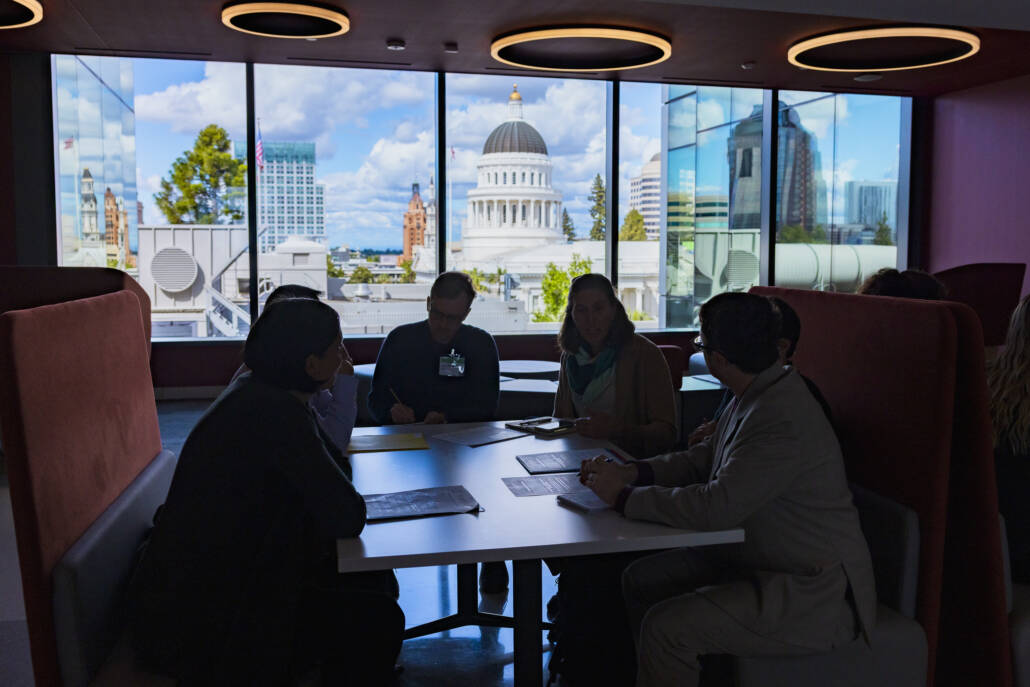
The 2026 Summit will be held at the Tsakopoulos Library Galleria in downtown Sacramento. In addition to several spaces for breakout sessions and networking, attendees will enjoy the Library Galliera’s expansive five-story atrium for keynote speeches and plenaries.
The central downtown location allows for a short, three-block walk to the Capitol Mall for participants in our optional pre-Summit Lobby Day. We will also enjoy easy access to nearby bicycle and pedestrian infrastructure for mobile sessions on foot and by bike.
Two days of inspiring plenaries and breakout sessions
The Summit will include two plenary sessions and numerous breakouts on topics ranging from design, planning, and policy to infrastructure and activism. We’ll hear from state agency staffers, elected leaders, advocates, bike industry representatives, and more. The breakout sessions generate inspiring discussions, create new connections, and offer actionable resources that attendees can take home to their communities and organizations.
Bike tours and cultural events
No California Bicycle Summit would be complete without bike rides. In San Diego in 2024, we offered several biking and walking sessions led by our local hosts to show off the infrastructure and history of the area.
We’ll also host a social event where attendees can meet up with friends old and new.
Lobby day
Our Sacramento location allows us to host an optional Lobby Day the day before the Summit. Participants will gather in the late morning for a training session on a set of key campaign issues provided by CalBike staff. We’ll break for lunch, then visit assemblymembers, senators, and staff in the afternoon.
A lobby day gives us the chance to show our representatives in Sacramento the power of the movement for active transportation. We’ll talk with them about ongoing challenges, such as active transportation funding, as well as bike-friendly bills in the 2026 session.
On August 20, CalBike held its latest online Summit Session: Bike Highways: Creating a Path to the Future of Bicycling. Panelists included two staffers from Assemblymember Steve Bennett’s office, Arwen Chenery and Atticus Reyes. Bennett authored the Bike Highway Bill, which CalBike is sponsoring. We also heard from Mauricio Hernandez of Alta Planning + Design, and, joining from Bogotá, Colombia, Lorena Romero of BiciActiva.
The Summit Sessions are a way to continue the discussions started at our biennial California Bicycle Summit throughout the year, and the online format allows us to bring in voices from across the U.S. and the world.
Watch the full webinar.
Bike highways are happening in California
Chenery and Reyes shared the journey of the Bike Highway Bill this year, as it got watered down from a pilot in two regions to a planning recommendation because of budget concerns. Bennett plans to introduce legislation next year to move forward with a specific bike highway in his district, spanning cities from Santa Paula to Ventura. The Santa Paula Branch Line Trail follows a railroad right-of-way, and a fully connected bike highway along the route would connect residents in lower-income communities with opportunities for education and jobs. Parts of the route are already built; Bennett hopes to get state help to close the gaps and create an intercity bike route.
Bike highways are already happening in California. Participants called out several of them:
Vine Trail in Napa is nearly finished and stretches 47 miles from Vallejo to Calistoga.
The SMART train in Sonoma and Marin right-of-way includes a multi-use path parallel to the train for most of the route, also known as the Great Redwood Trail.
CV Link, a 40-mile bikeway in the Coachella Valley, is partially open.
Design principles for bike highways
Hernandez shared some design best practices for bike highways, a topic the highly engaged attendees were very interested in. He outlined principles for bike highway design:
Providing direct routes between regional destinations
Primarily separated and dedicated bike facilities
Allowing for higher-speed travel
Low-effort routes with minimal elevation changes and limited friction at intersections
Increasing mobility by giving people fast routes between regional destinations and connecting with local bike routes
He noted that, while the facilities are generally designed for bike riders traveling around 18 mph, bike highways can also accommodate slower users, with minimum speeds around 7.5 mph. Hernandez led attendees through more design specifics; you can view his presentation below. Even people walking are often allowed on bike highways, but they are designed to prioritize bikes and limit the number of people walking.
The slides below and the recording contain a wealth of practical and technical information Hernandez shared.
Romero shared the history of Bogotá’s bike highways, called ciclorutas, the connection to the city’s famous Ciclovia, and the effect of connected, protected bikeways on biking in the city. She emphasized the importance of culture, sharing photos of existing bicycle infrastructure from 10 years ago, when BiciActiva was formed, with cars and trucks parked in them.
Romero painted a picture of persistence, working with local governments, and persuading neighborhoods to get on board with new bike facilities. The change in the perception of bicycling is a critical component of the shift that has made Bogotá one of the cycling capitals of the world.
https://www.calbike.org/wp-content/uploads/2025/08/Bike-Highway-Denmark.jpg414621Kendra Ramseyhttps://www.calbike.org/wp-content/uploads/2018/07/calbike-logo.pngKendra Ramsey2025-08-27 18:47:572025-08-27 18:47:59New Directions for Bike Highways
For most of its existence, CalBike has worked to secure more funding for bike infrastructure and safety improvements. We were instrumental in getting dedicated funding for biking and walking projects through SB 1 gas tax revenue for the Active Transportation Program (ATP). In recent years, we’ve seen the small percentage of our transportation dollars allocated for active transportation clawed back while huge pots of money still flow to climate-killing highway projects.
As the death toll on California’s roads rises and the climate crisis becomes more dire, the solutions embraced by our elected leaders look a lot like the things that got us here. With our Invest/Divest campaign, CalBike urges elected officials to stop digging us into a deeper climate hole and shift funding priorities to programs that will help us get out of the hole.
Addressing the transportation crisis
In times of crisis, state and local governments can find the will and the money to take extraordinary steps to meet community needs. We saw that in a fast-moving emergency with the heroic efforts to fight the Los Angeles fires earlier this year. California’s housing shortage is a long-term emergency, but lawmakers have taken aggressive steps to remove obstacles and reduce costs, thus incentivizing home building.
In Paris, Mayor Anne Hidalgo is addressing another long-term crisis: climate change. With ambitious goals to add bikeways and make biking an appealing option for getting around the city, Paris has dramatically reduced air pollution — and thus carbon emissions.
The transformation of Paris isn’t cheap. The city’s plan comes with a budget of 250 million euros (around $300 million USD), and it’s taken a great deal of political will and a commitment across government agencies to make the changes happen.
But that’s what we do in a crisis, isn’t it?
Engineering as an obstacle
Like the bills aimed at growing our housing stock, California lawmakers have taken some steps toward making it easier to build biking and walking infrastructure. The Complete Streets Bill, which CalBike sponsored and helped pass last year, strengthens requirements for Caltrans to include bike, pedestrian, and transit priority elements in its road repair projects, tapping into the large pot of funding the agency has for maintaining and improving state routes. And SB 71, authored by Senator Scott Wiener, would give bikeway planning a permanent exemption from CEQA, California’s environmental review law, and extend the temporary exemption for bikeway infrastructure projects to 2040. These are important steps, but they’re not enough.
One of the lessons bike advocates have learned through hard experience is that something isn’t always better than nothing. A bikeway that drops off at an intersection or stops short when competing uses make allocating street space complicated won’t encourage people to get around by bike. To give Californians true options in how they get around, we need the commitment to push through the hard spaces, overcome NIMBYism, and build connected, protected bike routes.
European cities have one advantage over the U.S.: there is no room for hard-and-fast rules. In adding modern transportation to places built before bicycles or cars were invented, planners are forced to be creative. When the sidewalk dwindles down to nothing in the face of a building that’s stood for centuries, people walk in the street. There is no minimum lane width, as cars, buses, and delivery vans (and delivery bikes, in Amsterdam) jostle for space with pedestrians, bike riders, trams, and vendors pushing carts.
We need design guidance for safe bikeways and traffic lanes, but we also need flexibility to find new solutions when a street narrows rather than dropping the bike lane because “we couldn’t build it safely.”
What this moment asks of us
Climate change is an existential crisis that calls on us to step outside of our comfort zone and take bold actions. Here are three things California needs to do to shift our transportation priorities from fossil-fueled disaster to human-centered safety.
Slow down cars. There’s no solution that keeps people on bikes and walking from interacting with vehicular traffic. Reducing speeds through design and, ultimately, changing cultural norms is the only way for all modes to peacefully coexist.
Spend A LOT of money on active transportation infrastructure. By a lot, we mean A LOT. Spend like there’s a climate disaster paired with rising pedestrian and bicyclist deaths, and we actually want to solve this rather than slowly roasting in a fiery pit of our own making. For context, California’s annual transportation budget is around $20 billion; combined with federal funds, we spend over $30 billion. The ATP gets approximately $300 million a year — that’s the same amount Paris spent on active transportation, but spread across a state with 40 million people. We can afford a moonshot to make our state more bikeable if we make it a priority.
Make traffic engineering flexible and evidence-based. Traffic engineers are extremely risk-averse and often unwilling to build infrastructure that isn’t sanctioned in one of the official documents they treat like bibles. But those manuals are car-centric, often recommending infrastructure that isn’t safe for vulnerable road users. Shifting the mindset of hundreds of engineers isn’t easy. It might require new laws, lifting more regulations, or changing liability laws.
There aren’t enough electric cars to save us from climate catastrophe. We’re going to have to make big changes to our transportation systems. Cities in other countries that have done this have seen better health outcomes, reduced deaths, and a higher quality of life. CalBike is committed to bringing those benefits to our state.
https://www.calbike.org/wp-content/uploads/2023/11/15238601937_f33c0ab197_o-scaled.jpg14562560Jared Sanchezhttps://www.calbike.org/wp-content/uploads/2018/07/calbike-logo.pngJared Sanchez2025-08-26 17:09:252025-08-26 17:09:25Shifting Transportation Funding Priorities to Meet the Moment
Twopeople on bikes were killed in Bakersfield last week, not by the 100-degree heat but by cars.
In a city where a Kern County Civil Grand Jury claimed bike lanes are a “waste of money” because it’s too hot to ride, we showed the reality. On a typically balmy Central Valley August afternoon, dozens of riders gathered at Dagny’s Coffee for the “Bakersfield Beats the Heat” ride. We rode through the city together and ended at City Hall to deliver a simple, urgent message to the Bakersfield City Council:
We can’t change the sun. But the city can change the streets.
Calling for safe infrastructure
The grand jury’s report ignored the obvious: safer street designs save lives. When people are told that the heat is the biggest barrier to bicycling in Bakersfield, it sends a dangerous message that nothing can be done. Our ride showed that Bakersfield riders are ready to bike in any weather if the streets are safe. Riders, community leaders, and even Bakersfield City Councilmembers Bob Smith and Eric Arias joined us to call for real investment in bike infrastructure.
While portions of Kern County and Bakersfield do have newly installed bike infrastructure, it is largely disjointed with varying degrees of protection that leaves even experienced riders nervous. Participants at the ride shared how certain roads leave families feeling that they are risking their lives by bicycling, which should be a simple and enjoyable way to travel to school. Grizzly Cycles co-owner Kevin Talley posted recently on Instagram about some of the best bike lanes in the area and how they disappear completely, leading to some of the most dangerous areas in Bakersfield.
As CalBike Executive Director Kendra Ramsey said, “We want to draw attention to the fact that we need more safe bike infrastructure everywhere, including Bakersfield.”
Within 24 hours of our ride to City Hall, news broke of another person killed while biking in Bakersfield. It was a grim reminder that the campaign for safe bike infrastructure is not abstract. Every day of delay, lives are lost. Bakersfield, like cities across California, needs to move quickly to build bikeways that save lives without the roadblocks the grand jury tried to throw in front of active transportation infrastructure.
The solutions are within reach: protected bike lanes, traffic calming, and Complete Streets policies that put people ahead of speed. Bakersfield riders are ready. City leaders need to meet that urgency, not bow to the whim of a misguided grand jury.
Thank you
This powerful ride would not have been possible without our incredible partners. Thank you to our host Dagny’s Coffee and our friends at Bike Jam, Critical Mass Bakersfield, Bike Bakersfield, and Grizzly Cycles for riding with us and demanding safer streets.
After some delay, Caltrans recently released its draft Director’s Transit Policy, as required by the Complete Streets Law, SB 960, which CalBike helped pass in 2024. This internal policy is similar in form and function to DP-37, the Director’s Policy for Complete Streets, released in 2021.
As we know from DP-37, these policies are a major commitment on paper, but implementation can be lackluster, and Caltrans often balks at actually committing state transportation funds to alternative modes of mobility (walking, biking, transit, etc.). Internal director’s policies are a great first step, but to actually move the behemoth of Caltrans will take dedicated follow-up to ensure the greener infrastructure is being built. The first step is reviewing the draft policy and providing public comment; CalBike is working on that.
Seeking feedback on transit priority policies on state routes
The Caltrans Director’s Transit Policy will serve as a high-level guide that outlines the department’s commitment to supporting public transit on the state highway system. The policy encourages flexible, context-sensitive solutions to better connect and improve transit options for people of all ages and abilities. Where feasible, Caltrans will integrate public transit features within highway projects to strengthen transit networks across the state. To put the policy into action, Caltrans is also developing an implementation plan with specific steps and strategies. This plan will be informed by input from partners and stakeholders and is expected to be released in summer 2026.
Caltrans is currently seeking public feedback on the draft policy. Comments are due Monday, August 18, 2025. We encourage our members to pay attention to this policy so that it can be substantively used to advance more transit options on the state highway system. Caltrans is also having a workshop on Wednesday, August 6, 2025, from 10 a.m.-12 p.m., for the public to engage directly. Register here to attend.
Transit struggles
The fate of public transit continues to be a significant political and policy issue, as advocates attempt to secure more funds for transit in the state budget. Despite stopgap funding measures, transit is still not sustainably funded and receives a small amount of the total transportation budget.
Since the pandemic, many transit operators have been struggling to cover operating costs as they work to reclaim ridership. In 2023, SB 125 established the Transit Transformation Task Force led by the California State Transportation Agency to develop policy recommendations to grow transit ridership, improve the transit experience, and address long-term operational needs. This task force continues to meet to develop its final recommendations.
Without transit, California’s urban centers would be nearly impassible, with gridlocked freeways and local streets and more traffic carnage for vulnerable road users. CalBike supports robust transit systems, which are a vital component of safe streets for everyone.
Getting bikeways, crosswalks, or other Complete Streets elements into a Caltrans project can be challenging. Convincing Caltrans to alter a previously approved project to add bikeways is an even bigger lift, but local advocates in the East Bay did just that. We spoke with Robert Prinz, Bike East Bay’s advocacy director, and Drew Dara-Abrams, who sits on the City of Alameda Transportation Commission, about what worked to get Caltrans to change its plans.
The project: SR 61 from San Leandro to Alameda
The project, approved in the 2020 State Highway Operation and Protection Program (SHOPP), would repave State Route 61 from Davis Street in San Leandro, where it’s named Doolittle Drive with a 45-50 mph speed limit through Oakland, and across a bridge to become Otis Drive in Alameda, then move over to Encinal Avenue, bisecting the island city.
The most cost-effective time to build new bikeways is during repaving or repair work. CalBike’s Complete Streets bills all called for including Complete Streets in SHOPP projects. Yet getting Caltrans to take the infrastructure needs of people biking and walking seriously when planning projects that impact local streets has been a challenge. CalBike’s Incomplete Streets Report highlighted some of the excuses the agency has used to shortchange active transportation. With the passage of SB 960, the Complete Streets Bill, we are optimistic that Caltrans will do better on future projects.
But that doesn’t solve the problem of SHOPP projects approved in the past, some of which are only now being constructed. With SR 61, advocates faced the challenge of getting present-day Caltrans to honor Complete Streets obligations in a project initiated by past Caltrans. Here’s how they did it.
San Leandro to Oakland: Bike East Bay
Bike East Bay’s Robert Prinz worked mainly on the San Leandro and Oakland segments of the project, while local advocates in Alameda took the lead on the segment running through that city. The Project Initiation Document (PID), completed in 2020, failed to reference local bike plans from Oakland and San Leandro calling for protected bikeways on Doolittle Drive, even though the bike plans predated the PID. Bike East Bay pointed this out to Caltrans; Prinz has email threads going back to 2020. It took until 2024 for Caltrans to agree to reconsider the plan.
This segment covers a gap in the Bay Trail, a biking and walking trail that is envisioned to one day provide an unbroken route around the San Francisco Bay. While a future Bay Trail segment is planned to connect to Alameda, a protected bikeway on Doolittle closes a “gap between where one part of the Bay Trail ends and another begins,” Prinz said, noting that there’s no room for a Class I separated path in this area, so a Class IV protected bikeway is critical.
Prinz noted that some SHOPP projects do a good job with active transportation infrastructure, but the process could use more transparency. “We’ve had some good SHOPP projects funded, and it’s just a mystery as to why,” he said, citing a $40 million Complete Streets project in Union City and Fremont that he didn’t know was in the pipeline.
The breakthrough for Prinz was getting Caltrans to come to a meeting of the Infrastructure Committee he chairs on Oakland’s Bike/Ped Advisory Commission. It was hard for Caltrans staffers to refuse — their office is just two blocks from OakDOT’s. “Later we learned that Oakland DOT staff had been saying the same thing to Caltrans,” he said, noting that “ultimately I think it was Caltrans hearing from a lot of different partners” that got them to add a bikeway to the plan.
Prinz also cited the local bike plans as essential to the process with Caltrans. “Plans matter,” he said. “Very often, plans get overruled, but it does still help if you can point to something in one or more adopted plans to back up your requests.” He added, “Individual design details are important, and I wish we could spend more time working on that.” Making sure the bikeway is usable and “not just a line on a map,” he said, is just as important as the bikeway class, noting that some of Oakland’s bike lanes have had to be upgraded multiple times as design standards change.
He also cited the value of having more pools of advocates when working on a cross-jurisdictional project like this one. He hopes to see more advocates looking across borders and joining forces to work on projects that span multiple cities because “most people don’t bike in only one city.”
Alameda: Drew Dara-Abrams
Drew Dara-Abrams describes the four-lane state route that cuts across Alameda as running next to a city park, an elementary school, and houses with minimal setbacks. It’s the kind of roadway where cities like Alameda have consistently added bulbouts and other traffic calming features.
Not so with the Caltrans project. “Caltrans is stuck in the past of auto throughput, auto throughput, auto throughput,” he said. “Compared with all the design aspects we can expect to be part of a process for locally controlled roads, it’s just a black box.” When he first reached out to Caltrans to ask why project plans didn’t reflect statewide Complete Streets policies adopted in 2021, district staff said certain project documents were filed internally in 2019 and therefore avoided all subsequent requirements — including policies requiring sign-off on Complete Streets reviews by their district leadership.
Photos of Otis Drive in Alameda courtesy of Drew Dara-Abrams.
Like Prinz, Dara-Abrams also found that getting Caltrans staff to a public meeting was crucial. Holding a City of Alameda Transportation Commission meeting on the project “enabled residents to write in and attend and speak,” he said. “That really brought some light to the project.” They got 40 pages of emailed comments, including a letter from the principal of the neighboring elementary school. Public awareness and input didn’t move Caltrans, but it moved local leaders to meet with Caltrans staff, which was an important part of the process.
Dara-Abrams began writing about the project on his blog in 2023 and describes his advocacy as “pingponging back and forth between different groups and local leaders, which helped elevate this and make the local Caltrans district care at a leadership level.” Involving Caltrans leadership was crucial. “It turned out city staff and Caltrans staff had been going back and forth about the project for years,” he said. “The impetus for change has to come from the leadership level to give them permission to do things that might take a little more time or a little more budget.” With public scrutiny, Caltrans could no longer ignore local staff.
He said getting to know local staff was crucial because they know what projects are coming up. He’s learned from them and given himself an education in reading complex Caltrans and CTC documents.
In the short run, the changes make Caltrans staffers’ jobs harder, Dara-Abrams says, but “in the long run, this is in Caltrans’ interest — getting these details right.”
CalBike: Support from the statewide bike coalition
While local advocates took the lead in working with Caltrans on the SR 61 project, CalBike played a supporting role. We wrote letters of support and helped open lines of communication with Caltrans staff, while continuing to put pressure on district and headquarters regarding their CS policies and SB 960, which was signed into law during this time.
Hearing a similar message from a number of organizations let Caltrans know that people were paying attention and helped elevate the message up the chain of command to key decision-makers. This included an official response letter from then-District 4 Caltrans Director Dina El-Tawansy, who has since been promoted to Caltrans director at headquarters in Sacramento.
“The work Robert and Drew did on this project shows what’s possible if you’re persistent in working with Caltrans,” said Jared Sanchez, CalBike policy director. “I hope to have the opportunity to support more local advocates in finding the right levers to apply pressure to improve local projects.”
Results and takeaways
For both segments of the project, the advocates didn’t get everything they wanted. On Doolittle Drive, the bike facility won’t be very wide and doesn’t provide separation as robust as many other new East Bay bikeways. But, Prinz said, “It’s all iterative. We want Caltrans staff to get more experience with this kind of stuff, and we’ll get them to beef it up at some point.” And, once complete, this will be one of the longest Class IV bikeways in Oakland, and the only one east of Fruitvale Avenue.
In the Alameda segment, there will be small but targeted additions of pedestrian refuge islands and curb extensions at popular intersections, which fell short of the lane reductions local advocates wanted. But they got a promise from Caltrans District 4 to study a road diet and potentially implement lane reductions. That project is expected to get programmed into the 2028 SHOPP with construction in 2032, moving at the normal, glacial pace of Caltrans projects. CalBike’s Quick-Build Bill could provide more momentum, especially for projects that address safety hazards for vulnerable road users. The bill would allow Caltrans districts to use quick-build methods, when warranted, to swiftly address dangerous roadways.
“The fact that Caltrans was willing to update their plans at all is progress,” Prinz said. “It’s been a long process, but thanks, Caltrans, for listening.”
Key takeaways from this project:
Take your concerns to district leadership, and also reach out to staff at Caltrans headquarters and the California Transportation Commission, which provides funding for SHOPP projects.
Hold public meetings with Caltrans staffers present to hear comments and answer questions.
Ask Caltrans staff for project initiation documents, traffic analyses, and engineering plans. Use these materials to ask targeted questions and propose specific improvements.
Be persistent. Working with Caltrans is a long-term project.
Find your allies. Work with city staffers, elected officials, other advocacy groups, and people who live in adjacent cities or neighborhoods toward your shared goal of safer streets and connected bike routes.
CalBike continues to work at the state level to implement better policies on our state-controlled streets. Those policies pave the way for more transparency at Caltrans and a greater role for local communities in shaping the roads that run through their neighborhoods.
https://www.calbike.org/wp-content/uploads/2025/07/SR-61-bike-riders.jpg14752617Laura McCamyhttps://www.calbike.org/wp-content/uploads/2018/07/calbike-logo.pngLaura McCamy2025-07-23 02:06:102025-07-23 02:06:11Adding Bikeways to State Routes: Two Local Advocates Share Strategies for Change
A secure place to park is essential to making bicycling an appealing way to get around. So, CalBike and 17 of our local partners submitted a letter to the California Building Standards Commission, which is updating California’s Green Building Standards Code. Including robust residential and commercial bike parking standards in those codes is an important step to creating bike-friendly neighborhoods.
Bike parking standards
The letter outlines several basic suggestions:
Refer to and follow the Association of Pedestrian and Bicycle Professionals (APBP) Bicycle Parking Guidelines.
Require some bike parking spots to accommodate larger bikes such as e-bikes, cargo bikes, and adaptive bikes.
Site short-term bike racks near entrances — ideally within 50 feet, but no more than 100 feet away.
Include at least one long-term bike storage space per residential unit in multifamily buildings.
Provide access to charging outlets for e-bikes with long-term spots.
Use only APBP-approved bike racks.
Restrictions on new building codes may affect bike parking regulations
The letter also asked for clarification on the impact of AB 130, a new law intended to encourage more residential construction by easing requirements. The bill prohibits new building standards unless certain conditions are met. Hopefully, the rush to get more residential units built won’t leave bikes in the dust.
Advocacy continues
The new bike parking standards are expected to go into effect on January 1, 2026. However, the California Department of Housing and Community Development is holding a workshop on July 30, which might be the final chance to give feedback on the new bike parking requirements. CalBike will be there, continuing to advocate for safe, abundant bike parking in and around new buildings.
https://www.calbike.org/wp-content/uploads/2021/05/CalBike-Insider-Image4.png7201280Jared Sanchezhttps://www.calbike.org/wp-content/uploads/2018/07/calbike-logo.pngJared Sanchez2025-07-22 12:55:302025-07-23 02:01:17CalBike Insider: Updating Bike Parking in Green Building Codes
In 2023, CalBike supported AB 645, which created a pilot program for six cities to install cameras for automated speed enforcement. San Francisco is the first to have its cameras fully installed and up and running, and the program is yielding a trove of data. The biggest takeaway will come as no surprise to people who bike and walk: a lot of drivers speed.
Useful data
San Francisco started installing its 50 speed cameras in March and completed installation in early June. The San Francisco Metropolitan Transportation Agency (SFMTA) will issue warnings until August 6, 2025, when it will start sending tickets for violations.
San Francisco has created a dashboard where the public can access data about the program. As of July 8, SFMTA has issued almost 132,000 warnings to people driving 11 mph or more over the posted speed limit, showing how widespread speeding is in the city.
Almost one-third of the speeders were clocked at just two intersections: eastbound and westbound at 2530 Fulton Street next to Golden Gate Park, between Arguello and 2nd Avenue, and northbound at 511 Bryant Street near 3rd Street (Bryant is one-way). More than 28,000 warnings were issued at the Fulton Street location and over 14,000 on Bryant Street.
San Jose is hoping to get speed cameras installed this summer to go live by fall, and Oakland plans to have cameras online by this winter. Glendale is aiming for late 2025, and Los Angeles plans to launch its program in 2026; there’s no start date for automated speed enforcement in Long Beach yet. If all these cities share data from their speed cameras with the public, it will provide valuable insights into driver behavior at the most dangerous intersections.
Tickets under the pilot program start at $50 and go as high as $500, but low-income drivers pay reduced fees. Given the prevalence of speeding found in San Francisco, the program could be a significant source of revenue once cities start issuing tickets. But hopefully, those numbers will go down as drivers become aware of the program. Gathering consistent data on how many people speed can reveal spots that put vulnerable road users at risk, beyond crash data. That can show where additional signage or infrastructure for traffic calming might be needed and provide a roadmap for future infrastructure improvements to make California streets safer.
https://www.calbike.org/wp-content/uploads/2025/07/traffic-camera-speed.jpg42895723Kendra Ramseyhttps://www.calbike.org/wp-content/uploads/2018/07/calbike-logo.pngKendra Ramsey2025-07-09 16:50:202025-07-09 16:50:21Automated Speed Enforcement Cameras Show Prevalence of Speeding