AB 371 Could Deal Fatal Blow to Bike/Scooter Sharing
Sacramento – The California Bicycle Coalition (CalBike) opposes AB 371 by Assembly Member Jones-Sawyer that would impose an onerous insurance burden on shared-mobility providers and likely put them out of business across the state. A similar provision was defeated in the 2020 legislature.
The bill is now headed to the Senate Committees on Judiciary and Insurance.
Dave Snyder, executive director, CalBike:
“Shared bikes and scooters are a critical complement to public transit. We’ve only just begun to see the benefit that we’ll enjoy once we expand these systems and integrate them with transit. Unfortunately, we may never see that future if AB 371 passes. It will place unprecedented insurance requirements on bike- and scooter-share systems that would end this vital last-mile transportation option in California.
Private and Public Micromobility Systems Threatened
The insurance requirement will apply to nonprofit services, like bicycle libraries that lend out bikes on a short-term basis to low-income neighborhood residents, as well as public transit agencies like LA Metro, and private providers like Spin or Bird. It would put them all out of the shared micromobility business and kill this promising low-impact, low-cost transportation mode. This comes just when we need it the most and when bikeshare systems are reporting record ridership.
Update: View our OpEd produced in collaboration with the Los Angeles County Bicycle Coalition and TransForm.
https://www.calbike.org/wp-content/uploads/2020/08/bike-share-narrow.jpg4811024Kevin Claxtonhttps://www.calbike.org/wp-content/uploads/2018/07/calbike-logo.pngKevin Claxton2021-06-08 10:00:002021-07-07 08:00:44AB 371 Could Deal Fatal Blow to Bike/Scooter Sharing
AB 1238 To Decriminalize Jaywalking to California Assembly Floor Vote
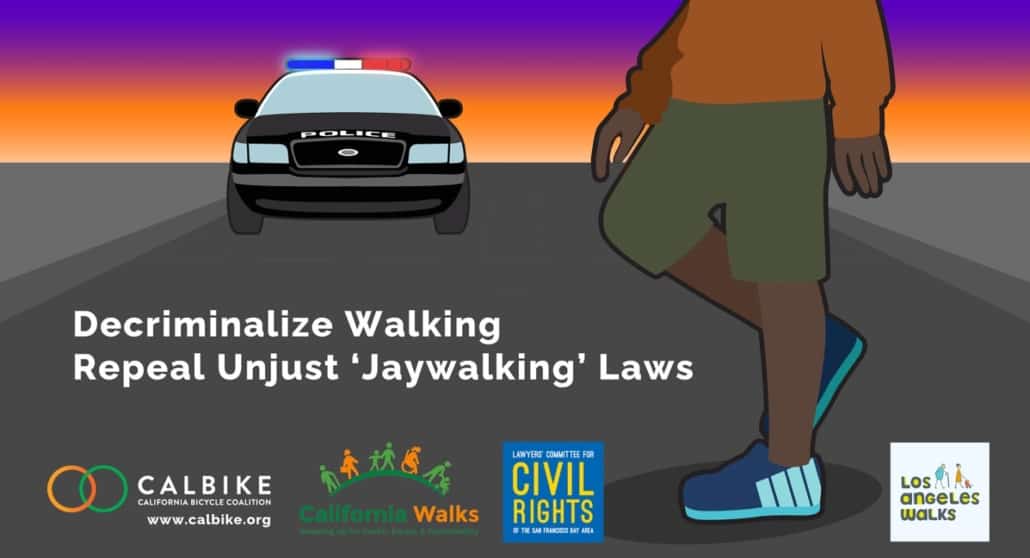
Sacramento – The Freedom to Walk Act, a bill to eliminate jaywalking laws in California, will be up for a vote on the Assembly floor this week. Authored by Assemblymember Phil Ting of San Francisco, AB 1238 will make it legal for pedestrians in California to make mid-block crossings and cross against traffic lights, provided they don’t interfere with traffic.
“The Freedom to Walk Act is a necessary step to right historic injustices,” said Jared Sanchez, CalBike Senior Policy Advocate. Jaywalking citations are disproportionately issued to Black Californians – they are up to 4.3 times more likely to be stopped than their white counterparts. CalBike is a leader among a coalition of more than 85 groups and individuals who support the repeal of jaywalking laws.
“Decriminalizing jaywalking will remove an opportunity for biased policing, and get rid of an unjust burden from low-income California residents, who can least afford to pay the fines and who are more likely to live in neighborhoods that lack infrastructure for people who walk, making jaywalking unavoidable,” Sanchez said.
“The incredible rate at which pedestrians are dying from crashes should compel us to understand why fellow Californians navigate as such, not criminalize them. This is just the first of many steps in our fight to provide all those who walk and roll with a little more dignity. We look forward to the work ahead,” shared John Yi, Executive Director of Los Angeles Walks.
“We must correct historical wrongs. We hope our legislators commit to creating safe public spaces by changing policies that have disregarded the safety, existence, and joy of primarily low-income people of color across the state. This bill will begin to do that by ensuring that people forced to ‘jaywalk’ are not punished due to the decades of intentional poor infrastructure in their neighborhoods,” said Caro Jauregui, Co-Executive Director of California Walks.
CalBike, California Walks, and Los Angeles Walks are sponsoring the Freedom to Walk Act, which has strong support from a broad base of community organizations. Supporters include the Greenlining Institute, NACTO, ACLU California Action, and Disability Rights California.
# # #
https://www.calbike.org/wp-content/uploads/2021/03/jaywalking-scaled.jpeg14552560Jared Sanchezhttps://www.calbike.org/wp-content/uploads/2018/07/calbike-logo.pngJared Sanchez2021-05-31 08:30:002021-05-28 16:51:59Full Assembly to Vote on AB 1238, to Decriminalize Jaywalking
CONTACT: Dave Snyder, Executive Director, California Bicycle Coalition, 916-251-9433, dave@calbike.org
STUDY: E-Bikes Are the Best Climate Investment for California
SACRAMENTO – A recent study found that subsidies for electric bikes are more cost-effective than electric car incentives at reducing greenhouse gas emissions from private cars. Yet very few programs to incentivize the uptake of the best climate investment exist. As lawmakers in California contemplate billions of dollars in spending to reduce greenhouse gas emissions from private cars, including $1.5 billion to subsidize electric cars, they have a chance to also support electric bikes with a bill being advanced by the Assembly.
AB 117, the E-Bike Affordability Bill (Boerner Horvath), would establish a pilot program to incentivize the purchase of electric bicycles as a means of reducing vehicle miles traveled (VMT), reducing air, water, and noise pollution, and helping Californians get more exercise. To implement the program, legislators must allocate $10 million in the budget being negotiated among the capital’s leaders this month.
“If California is serious about tackling climate change, promoting e-bikes needs to be front and center,” said Assemblymember Tasha Boerner Horvath, the bill’s author. “E-bikes help us cut out shorter car trips, reduce emissions, and move closer to our ambitious climate goals. Now is the time to make e-bikes affordable for all Californians.”
“Compared to EVs, e-bikes are carbon crushers. This fact adds urgency to the effort to help communities move away from car dependence and its terrible impacts,” said Dave Snyder, Executive Director of the California Bicycle Coalition, the sponsor of the E-Bike Affordability Act. “If California’s climate investments are supposed to prioritize solutions that have additional benefits, then this is a no-brainer. Investing in biking makes people healthier and happier, improves traffic safety, and reduces traffic congestion.”
The study focused on the greenhouse gas (GHG) impacts of subsidies for electric bikes, battery-electric cars, and plug-in hybrid electric cars in Oregon. It found that e-bike subsidies, like those in CalBike’s proposed $10M E-Bike Affordability Program, were the most cost-effective way to reduce GHG emissions.
Even with rebates, most Californians can’t afford electric cars. Fewer than 1% of vehicles registered in California today are all-electric. The E-Bike Affordability Program provides purchase incentives targeted at low-income residents, putting zero-emissions transportation within reach for many more Californians. Plus, e-bikes plug into a regular wall outlet and cost about $0.01 per mile to operate — no need for charging stations.
“Electric bicycles (e-bikes) have been found to offer a promising solution to reduce the greenhouse gas (GHG) impact of a region’s passenger transportation system….The literature shows that despite having slightly higher lifecycle emissions than conventional bicycles, privately owned e-bikes emit far less than other motorized modes.”
https://www.calbike.org/wp-content/uploads/2019/05/e-bike-single-man-cropped.jpg200544Kevin Claxtonhttps://www.calbike.org/wp-content/uploads/2018/07/calbike-logo.pngKevin Claxton2021-05-10 08:34:002021-05-07 16:57:07E-Bikes Are the Best Climate Investment for California
CalBike Announces New Legislation to Eliminate Jaywalking Tickets in California
San Francisco: Jaywalking is arbitrarily enforced throughout California. When it is, tickets are disproportionately given to Black Californians, and sometimes these encounters with police turn life-threatening. In an effort to reform this unfair system, Assemblymember Phil Ting (D-San Francisco) — along with CalBike, California Walks, and Los Angeles Walks — has introduced AB 1238, The Freedom To Walk Act, which would decriminalize jaywalking.
“Whether it’s someone’s life or the hundreds/thousands of dollars in fines, the cost is too much for a relatively minor infraction,” said Ting at a San Francisco press conference. “It’s time to reconsider how we use our law enforcement resources and whether our jaywalking laws really do protect pedestrians and all road users.”
The Freedom To Walk Act promotes the fair and equitable use of roadways by:
Legalizing crossings, when safe, outside of a marked or unmarked crosswalk or against a traffic light;
Stopping the undue financial burden of jaywalking tickets on low-income people, whose fines can range to hundreds of dollars, if not more, because of added fees tacked on by the court, county, city, and others;
Preventing police from using jaywalking as a pretext to stop Black Californians; and
Ending the criminalization of people in disadvantaged communities that lack adequate pedestrian infrastructure.
“Jaywalking laws do more than turn an ordinary and logical behavior into a crime; they also create opportunities for police to racially profile. A stop for a harmless infraction like jaywalking can turn into a potentially life-threatening police encounter, especially for Black people, who are disproportionately targeted and suffer the most severe consequences of inequitable law enforcement,” said Jared Sanchez of the California Bicycle Coalition (CalBike), co-sponsor of The Freedom To Walk Act.
“Low-income communities and communities of color are more likely to be cited for crossing unsafely due to societal racial bias and poor crosswalk conditions in their neighborhoods that emphasize drivers’ needs over other road users. Walking should not be a dangerous activity in the communities where people rely on walking for transportation,” said Caro Jauregui, Co-Executive Director of California Walks.
“It’s time we stop blaming pedestrians for trying to navigate streets that all too often prioritize cars and fast traffic. If we want neighborhoods that are community-centered, where our children and seniors can move with safety and ease, let us begin by treating those who walk or roll with some dignity,” said John Yi, Executive Director of Los Angeles Walks.
There are many examples of where a jaywalking stop has gone wrong in California. The most recent case occurred in September of 2020, when San Clemente Police killed Kurt Reinhold. In the Bay Area, Chinedu Okobi was killed more than two years ago in Millbrae by San Mateo County deputies. And in 2017, Nandi Cain Jr. was beaten by Sacramento Police. The victims in each of these cases were Black, and video captured each incident.
Jaywalking citation statistics highlight the way that this harmless behavior is used to target and victimize communities of color through pretextual policing. From 2018-2020, data compiled by the California Racial and Identity Profiling Act (RIPA) shows Black Californians are disproportionately stopped for jaywalking, up to four-and-a-half times more than their White counterparts.
Jaywalking laws were invented in the 1930s by the emerging auto industry as an attempt to shift the blame from drivers to walkers after the number of deadly car crashes skyrocketed. Over the years, street design has prioritized the needs of drivers, failing to accommodate people who aren’t in cars.
California has already begun making changes. In 2018, crossing at a traffic light after the countdown meter has begun was legalized. The Freedom to Walk Act repeals the state’s remaining jaywalking laws. Other countries, including the United Kingdom, have shown that this can be done safely. The U.K. allows pedestrians to cross mid-block, yet it has roughly half as many pedestrian deaths as the United States.
In March 2021, Virginia became the first state to decriminalize jaywalking. Last summer, the New York Attorney General recommended that the State of New York do the same. California needs to pass The Freedom to Walk Act and decriminalize jaywalking. It’s the right thing to do.
https://www.calbike.org/wp-content/uploads/2021/03/jaywalking-scaled.jpeg14552560Jared Sanchezhttps://www.calbike.org/wp-content/uploads/2018/07/calbike-logo.pngJared Sanchez2021-03-25 13:03:432021-03-30 16:09:59CalBike Announces New Legislation to Eliminate Jaywalking Tickets in California
Contact: Dave Snyder, California Bicycle Coalition, dave@calbike.org | 916-251-9433
CalBike Releases How-to Guide for Building Safer Streets Quickly and Cheaply
The California Bicycle Coalition and Alta Planning + Design today released a Quick-Build Guide for planners, officials, and community leaders to encourage the construction of safe bikeways quickly and affordably.
The guide promotes the “quick-build” method for safety improvements. Quick-build projects use materials that can be installed quickly and at a low cost. Quick-build design allows active transportation projects to be completed in months rather than years. Because quick-build projects rely on inexpensive materials, they are a good fit for California’s COVID-strapped municipal budgets.
The 77-page Quick-Build Guide, created by Alta Planning + Design, is available for free. This resource will help planners, city staffers, and advocates understand the tools and processes that lead to successful quick-build projects.
In addition to the guide, the project includes a 4-page introductory brochure. Both are available online at calbike.org/quickbuild.
“We hope this guide will help California capitalize on the huge increase in biking and walking we’ve seen during the pandemic,” said CalBike Executive Director Dave Snyder. “Quick-build allows communities to build on that momentum to create the kinds of safe, separated spaces that people of all ages need to feel comfortable biking and walking in their neighborhoods. There’s no good reason to wait years for safer streets and plenty of reasons to act quickly.”
“Rapid implementation of bike and pedestrian networks through Quick-Build is one of Alta’s core priorities for transformative investment in transportation,” said Brett Hondorp, President of Alta Planning + Design. “This guidebook gives communities the resources to quickly, inexpensively, and equitably create safe spaces for people on our streets, turning the pandemic walking and biking boom into sustained active transportation mode shift.”
The partnership to create this guide matches Alta Planning’s design expertise and experience with CalBike’s network of planning and advocacy communities throughout California. It will give cities a tool they can use to build safe biking infrastructure when and where it’s needed.
The Quick-Build Guide was made possible by funding from the Seed Fund and the SRAM Cycling Fund.
“Quick-build works to meet mobility needs by helping people to choose active modes more often. Those mobility needs will vary depending on the community and may include safer crossings, slower streets, an extended bikeway network, or safer routes to transit, schools, and essential workplaces. In every case, people require a safe, connected, and comfortable network for active transportation.”
“We as transportation experts need to be thinking strategically about whether or not we need to spend three years talking about doing something important, or three weeks to just try something.”
― Warren Logan, Transportation Policy Director of Mobility and Interagency Relations at Oakland Mayor’s Office
COURT OF APPEALS RULING AFFIRMS RIGHT OF CYCLISTS TO SAFE ROADS
The California Court of Appeal recently rejected an appeal by the County of Sonoma that would have threatened the safety of everybody who rides bikes on roads “for recreation.”
The case stemmed from a lawsuit brought by Catherine Williams, who suffered severe and permanent injuries when she struck a large pothole on a county road. The 4-inch deep, 13 square foot wide pothole had been reported to the County six weeks earlier. The jury sided with Williams, declaring the road to be an illegal “dangerous condition.”
The County’s appeal claimed that Williams was engaging in a “sport” and therefore had to assume the risk of a crash, according to state law that exempts the state from liability for dangers inherent in a sport. The Court disagreed, stating that the County already owed a duty to other foreseeable users of the road to repair the pothole, the policy reasons underlying the primary assumption of risk doctrine support the conclusion that the County owes a duty not to increase the inherent risks of long-distance, recreational cycling.
The decision is incredibly important to everyone who rides a bike on public roads.
Eris Weaver, Executive Director of the Sonoma County Bicycle Coalition, hailed the victory. “As California burns, the need to reduce greenhouse gas emissions and get people out of cars is visible in the smoky air. The vast increase in bike sales since the beginning of the COVID-19 pandemic demonstrates great interest and willingness among our residents to shift their mode of transportation. The ruling in this case affirms the rights of ALL users to safe transportation and puts cities and counties on notice that cyclists cannot be treated as second-class citizens.” with the County, the government would have no expectation of safe conditions on the roadway
Napa appellate specialist Alan Charles “Chuck” Dell’Ario represented Williams on appeal following an excellent trial presentation by Oakland lawyers Todd Walburg and co-counsel Celine Cutter. “This is an important victory for the cycling community statewide,” Dell’Ario said. “All public entities have a duty not to increase the inherent risks of cycling.” The state association of counties and league of cities had filed briefs supporting the county.
“We’re grateful that the Court demonstrated common sense. Bicycling is a joyful thing and not a dangerous sport if the government maintains the roads in the condition that they should,” said Dave Snyder, Executive Director of the California Bicycle Coalition.
Governor’s Executive Order to Promote Clean Transportation Is Weak and Vague on the Most Important Strategies to Address the Climate Crisis
Sacramento, CA—Governor Gavin Newsom today released Executive Order N-79-20, calling for reduced carbon pollution from the transportation sector. Cars and trucks account for nearly 40% of all greenhouse gases emitted in California. The order gives strong support to electric cars but fails to set goals for reducing dependence on automobiles. California needs much more if we are to have any hope of forestalling a severe climate crisis and worsening poverty.
The first five of the order’s 12 clauses relate to converting gas-powered vehicles to electric. They set the goal of prohibiting the sale of gas-powered vehicles by 2035 and call for various other measures necessary to meet that goal. Other clauses refer to gradual reductions in oil extraction in California.
Only one clause calls for giving Californians better ways to get around than private electric cars. It requires the state’s transportation agencies to “identify near term actions and investment strategies to improve clean transportation.” The order specifies that those strategies should include “supporting bicycle, pedestrian, and micro-mobility options, particularly in low-income and disadvantaged communities in the State, by incorporating safe and accessible infrastructure into projects where appropriate.” This is too vague and weak at a time when bold action is called for.
Statement from CalBike
“We’ll never solve the climate crisis unless we also address the economic crisis, and we can’t do either without reducing our dependence on cars and trucks. California needs to replace gas-powered cars with electric ones, very quickly, but doing that alone is a recipe for total failure. We need to make it dramatically easier for people to walk, bike, and take transit to reduce greenhouse gases from the transportation sector and still provide affordable mobility, improve health, and create good jobs.” — Dave Snyder, Executive Director, CalBike
This executive order is an important first step for California toward finally taking action to reduce greenhouse gas emissions from the transportation sector, where we have made next to no progress toward California’s climate goals.
Governor Newsom’s order provides specific direction to six state agencies to achieve the important and necessary goal of eliminating sales of new gas-powered cars by 2035. It calls for a just transition to a carbon-free transportation sector by emphasizing the creation of good jobs and the improvement of infrastructure in disadvantaged communities.
However, the order is vague when it comes to the transition away from automobiles to public transit, walking, and biking. This transition is critical, especially for the state’s disadvantaged communities. Public investment in charging stations in disadvantaged communities will not serve the majority of households in these neighborhoods who cannot afford an electric car, even with a subsidy. Nor will such investment in electric cars serve the one-in-three households in low-income communities in the Bay Area, for example, who don’t even have a car.
Reducing the need for cars and trucks is paramount to the successful mitigation of climate change. Reducing car dependence reduces costs for the lowest-income Californians, improves health and safety for everyone, and creates more jobs than other transportation investments.
The Governor’s order specifically calls out the need to support micro-mobility in disadvantaged communities. Expanding access to public transit by including shared bikes and scooters as part of public transit systems is the key to equitable mobility. CalBike’s work to create the Clean Mobility Options for Disadvantaged Communities program supports this expansion, but much more investment is needed.
The Governor specifically called on three agencies to improve clean transportation: the California State Transportation Agency, the Department of Transportation, and the Transportation Commission. CalBike will work with all three to help define a future where Californians have clean transportation options beyond gridlocked freeways and expensive EVs. As the agencies ‘identify the near term actions” necessary to implement Governor’s order, CalBike will work to ensure they focus on making the improvements needed by those who would bike, walk, or take public transit if given the opportunity.
https://www.calbike.org/wp-content/uploads/2018/11/44006449071_58830a130d_z.jpg427640Kevin Claxtonhttps://www.calbike.org/wp-content/uploads/2018/07/calbike-logo.pngKevin Claxton2020-09-23 17:40:212020-09-23 17:41:20CalBike Statement on Governor’s Executive Order to Promote Clean Transportation
California Bicycle Coalition Applauds Caltrans Move to Add Complete Streets to SHOPP Projects
At the May 13, 2020 meeting of the California Transportation Commission (CTC), the Director of the State Department of Transportation (Caltrans), Toks Omishakin, asked the CTC to set aside $100 million from the 2020 State Highway Operation and Protection Program (SHOPP) for bike and pedestrian safety improvements in SHOPP projects. CalBike applauds Caltrans leadership for championing the Complete Streets improvements that many California streets desperately need. Please take a moment to thank Caltrans Director Toks Omishakin.
A technicality at the CTC meeting prevented the commission from approving the whole $100 million. However, the conversation among commissioners made it clear that they intend to approve the rest of the funding at its next meeting in June.
The request came as part of the director’s stated commitment to make good on the governor’s promise that Caltrans will implement the intent of last year’s Complete Streets Act despite his veto. “While the state has a long way to go to turn the SHOPP and other state programs into funding sources for safety and sustainability and equity, this unprecedented action indicates the agency is serious about changing how it implements the SHOPP. These funds are essential to make desperately needed improvements for biking and walking safety,” said Dave Snyder, CalBike Executive Director.
Prior to the meeting, Commissioners received a letter from CalBike as part of a coalition of organizations led by Esther Rivera of California Walks. The letter commended the proposal to set aside $100 million, but expressed concern that Caltrans might not spend that money on the projects that would make the most difference because of its poor record of community engagement. Caltrans did identify 22 projects that would benefit from $50 million of the funding, but at the CTC meeting, Director Omishakin made clear that Caltrans would work with community partners to improve outreach. Several other high-ranking Caltrans staff have already reached out to CalBike offering to collaborate on outreach so that they can make the best decisions on how to prioritize that $100 million.
When Governor Newsom vetoed the Complete Streets for Healthy Living bill (SB 127 – Wiener) last year, it was a blow for the safe streets movement. The bill would have required Caltrans to consider adding Complete Streets elements to repair projects on state routes that double as local streets. It also created a public comment process if Caltrans decided Complete Streets features were infeasible. However, the governor issued a statement with his veto that made it clear that he expected Caltrans to find a way to implement the spirit of the law. With the 2020 SHOPP, we can see that Caltrans takes the need for Complete Streets seriously.
There has never been a more important time to build streets that encourage biking, walking, and taking transit. Changing our transit choices is a critical element of climate change mitigation. In addition, the current pandemic has shown us how vital California’s street spaces are to provide safe places to exercise and get fresh air. And bikes have become an even more important transportation option, to create space on public transit for those who need to ride and provide healthy and inexpensive transit for essential workers.
https://www.calbike.org/wp-content/uploads/2018/11/Paul-Krueger2-1.jpg12761920Laura McCamyhttps://www.calbike.org/wp-content/uploads/2018/07/calbike-logo.pngLaura McCamy2020-05-14 18:32:482020-09-03 20:07:32California Bicycle Coalition Applauds Caltrans Move to Add Complete Streets to SHOPP Projects
California Bicycle Coalition Calls for Free Rides
on Shared Bikes and Scooters for Essential Travel
While Californians heed the extraordinary orders to maintain social distance, those who still have to travel risk spreading the virus if they normally rely on public transit and don’t have an alternative. Shared bikes and scooters can provide safe mobility in this time of crisis. Governments and bike- and scooter-share companies should do everything they can to encourage this healthy mode of travel.
CalBike is calling for shared mobility providers to maintain their fleets and to make them free for new users who normally rely on transit and who need to travel for essential activities. CalBike commends the Breeze Bike Share system in Santa Monica for waiving all fees and the gruv system in Oakland and San Jose for providing a $10 coupon and free rides for first responders, doctors, nurses, pharmacists, and grocery store employees.
Bike use has boomed in cities around the world as people protect themselves and others from the coronavirus through social distancing. Some cities, like New York and Bogota, are building emergency protected bikeways to encourage the increase in bike use, and Copenhagen encourages people to switch from transit to bikes if possible.
This crisis shows the importance of shared micromobility and why cities should have more control over the systems, even if it means subsidizing the systems to support their operations when they are not profitable. They are as essential as public transit and provide redundancy to make our transportation system more resilient in the event of an emergency.
“There are many co-benefits of biking in addition to helping you avoid transit crowds. Sharing bikes and scooters after hand sanitizer and/or gloves affords protection. In addition, exercise is crucial for physical and mental health. Sunlight boosts the immune system, and the UV in sunlight kills the CoVid virus. Drink lots of water and enjoy community while staying six feet away from anyone,” says Dr. David Pepper, a physician and public health educator based in Berkeley, California.
“It’s great to see so many sectors of society come together to accomplish this critical goal of slowing the pandemic. I’m proud of Californians, our political leaders, and those companies and their employees who are working to keep their fleets in service,” said Dave Snyder, Executive Director of the California Bicycle Coalition. “We’d love to see more, and urge mobility companies to continue to provide shared bikes and scooters for essential travel, including discounts and free service to new customers, especially people providing essential services.”
Every transit passenger who is able to switch to a bike or scooter makes it easier for other transit passengers to maintain social distance when they take the bus or train, Snyder said, adding that regardless of ridership declines on public transit, “public transit remains essential and should continue to operate at full strength to provide the necessary capacity to allow passengers to maintain social distance.”
###
https://www.calbike.org/wp-content/uploads/2020/03/breeze-bike-share.jpg522789Kevin Claxtonhttps://www.calbike.org/wp-content/uploads/2018/07/calbike-logo.pngKevin Claxton2020-03-20 13:14:152020-03-20 13:19:12CalBike calls for expanded shared micro mobility to prevent CoViD spread