Until 2024, Napa didn’t have any protected bikeways. The Napa County Bicycle Coalition (NCBC) had long advocated for them, but maintenance challenges kept projects in limbo. Local officials acknowledged the need for increased safety, yet the estimated $200,000 to buy a street sweeper designed to clean a protected bikeway was a significant hurdle.
Then, in January, Caltrans resurfaced West Imola Avenue (SR 121), a key east-west route in Napa. The project added new flex post barriers to existing painted bike lanes. While the new infrastructure is a win for bike safety, keeping the lanes clean is critical to creating a comfortable and inviting place to ride. Debris in bike lanes — including glass, gravel, and dirt — poses significant hazards to cyclists, forcing them into vehicular lanes and increasing the risk of collisions. But traditional street sweepers can’t fit into protected bikeways, and this issue nearly led Caltrans to remove the protective posts.
Bicycle-powered bikeway sweeping
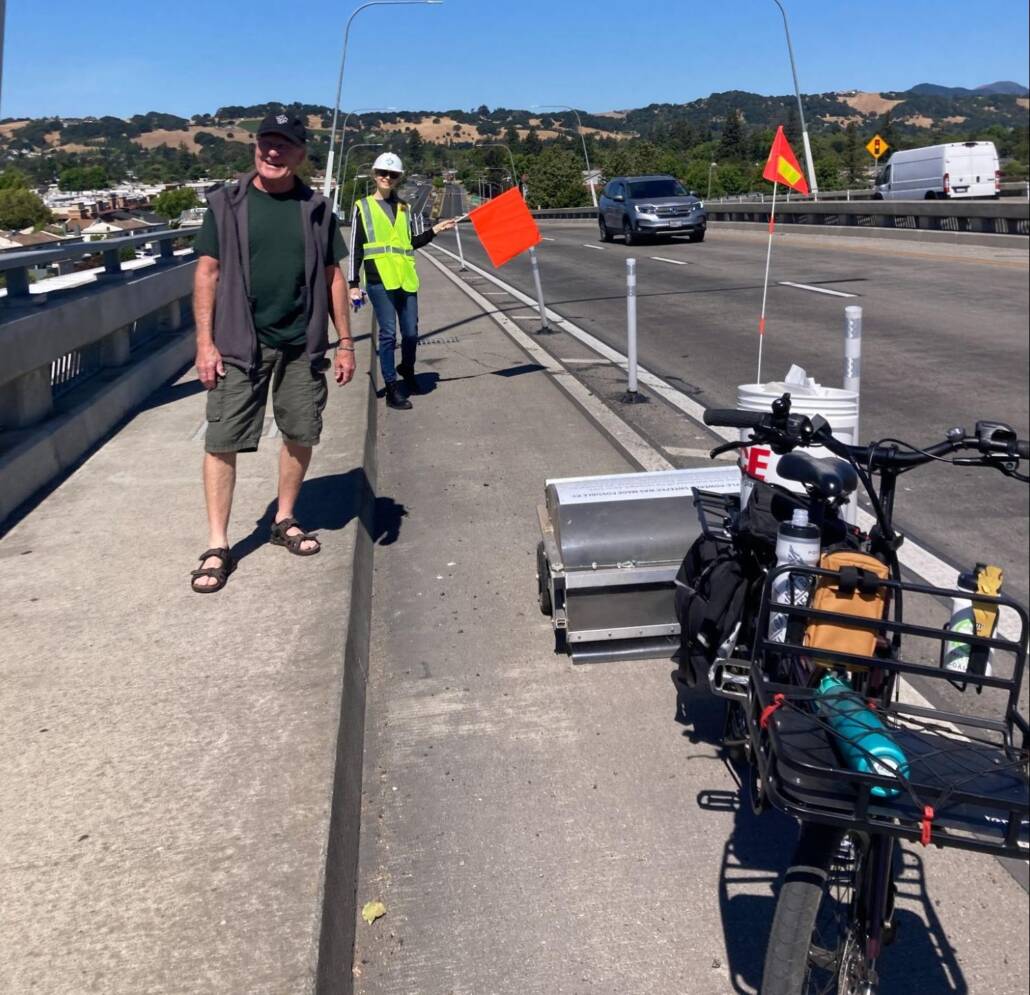
Faced with this potential setback, the Napa County Bicycle Coalition offered to adopt and maintain the protected bikeways on West Imola, and Caltrans accepted, modifying the Adrop-A-Highway program specifically for this bike facility. A local bike coalition can’t afford the $200,000 price tag for a motorized, bike lane-sized sweeper, so, to keep the lane clear, NCBC invested in an innovative new street sweeper designed by California inventor Pierre Lermant.
“Regular cleaning is the Achilles heel of protected bike lanes, as its budget is rarely factored in when the lanes are built,” says Lermant. “The Napa Valley initiative demonstrates how the Eco Sweeper devices can bridge budget shortcomings and leverage the community to help clean up bike lanes and promote bicycling, our shared ultimate goal.”
The sweeper, a battery-powered device that attaches to the rear wheel of a bicycle with a Burley bike trailer-style hitch, efficiently cleans bike lanes. And, at just $4,500, the cost is a fraction of a traditional sweeper.
NCBC launched a GoFundMe campaign on May 21, 2024, to raise the money to buy the sweeper. Thanks to the generosity of 50 donors, including a significant contribution from coalition member Bill Tuikka, the campaign met its goal in just one day.
Efficient, effective, and economical bikeway cleaning
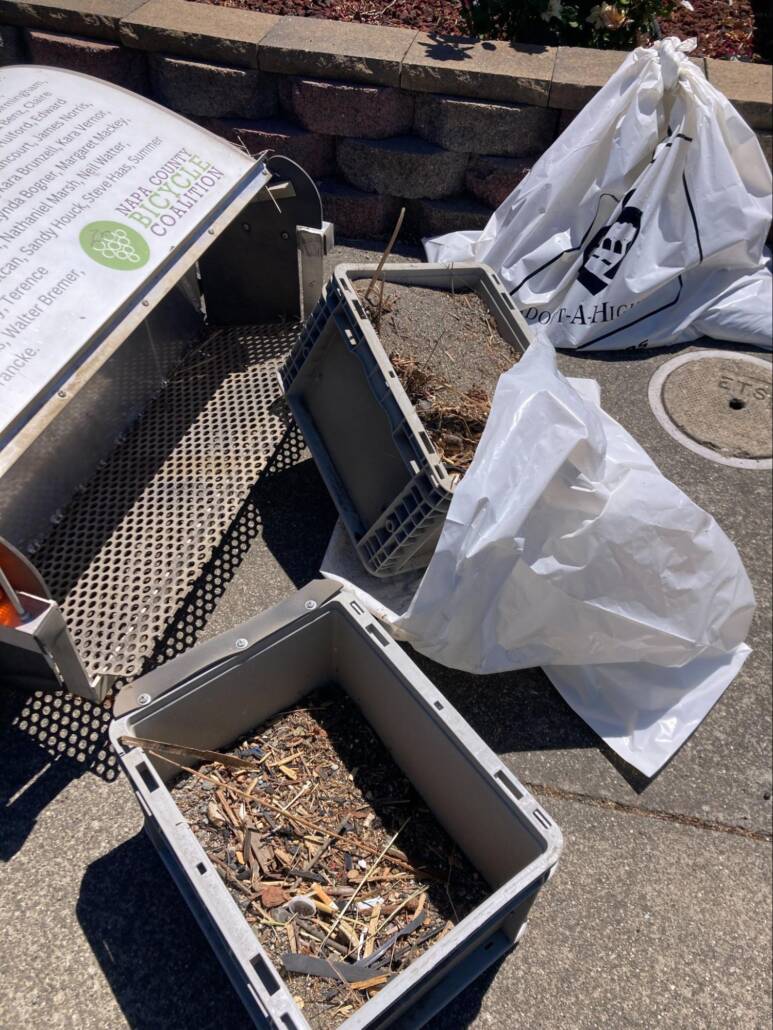
During its first run on June 17, 2024, the sweeper collected nearly 36 gallons of debris, a hefty load for a compact, bicycle-pulled device.
“We appreciate Caltrans for partnering with us and for being willing to pilot changes to their Adopt-a-Highway program that allowed us to find a solution. Napa County’s first protected bike lanes are on our high-injury network, so preventing the removal of these improved lanes was critical for improving safety,” says Napa County Bicycle Coalition Executive Director Kara Vernor.
The tow-behind bike lane sweeper is not just a practical solution for Napa; it represents an approach to urban planning and public safety that other cities can learn from. By steadfastly advocating for and embracing innovative solutions, Napa is setting a precedent for a safer, more bike-friendly future.
https://www.calbike.org/wp-content/uploads/2024/08/Napa-bike-street-sweeper-e1722889440231.jpg14721999Andrew Wrighthttps://www.calbike.org/wp-content/uploads/2018/07/calbike-logo.pngAndrew Wright2024-08-05 13:29:262024-08-05 18:11:59Innovation on the Streets: Napa’s Pedal-Powered Bike Lane Sweeper
https://www.calbike.org/wp-content/uploads/2024/07/Eureka-Broadway-CS-project.jpg8071023Jared Sanchezhttps://www.calbike.org/wp-content/uploads/2018/07/calbike-logo.pngJared Sanchez2024-07-31 17:08:312025-06-06 16:56:26Incomplete Streets Part 3: Even When Caltrans Is Right, It’s Wrong
Last week, the Complete Streets Bill, SB 960, passed the Assembly Transportation Committee by a wide margin (11-4). As Streetsblog correctly pointed out, the bill exited the committee weaker than it entered it, but CalBike still supports the measure, and we remain optimistic that its passage will spur Caltrans to do a better job providing infrastructure for people biking and walking.
Caltrans comes to the table
The good news is that Caltrans has stepped forward to offer amendments to the Complete Streets Bill. Reaching an agreement with Caltrans means the agency is less likely to oppose the final bill if it makes it to the governor’s desk. The last time Senator Scott Wiener introduced a Complete Streets Bill, SB 127, in 2019, the bill passed the legislature, but Governor Gavin Newsom vetoed it, so getting Caltrans’ (and CalSTA’s) approval could make the difference between passing and failing.
Unsurprisingly, the Caltrans amendments weaken provisions in SB 960, making it easier for the agency to find reasons not to include elements that improve safety for people biking, walking, or taking public transportation in its repaving projects. Critically, the changes would allow Caltrans to continue citing budget limitations as a reason to exclude Complete Streets from the project scope. However, SB 960 increases scrutiny and accountability of Caltrans’ decision-making process and will pull back the bureaucratic curtain that the agency uses to the detriment of people biking and walking in their communities.
CalBike wants more State Highway Operation and Protection Program (SHOPP) dollars (our state highway maintenance program) to go to active transportation infrastructure, moving us away from our car-dominated transportation system. We will keep moving further from Vision Zero as long as Caltrans corridors prioritize fast-moving motor vehicles without providing complete sidewalks and crosswalks, protected bike lanes, and safe bus stops. And we have no hope of averting our shared climate crisis if we don’t create comfortable, appealing connections for active transportation.
Still, we see the glass as half full with the Complete Streets Bill. Caltrans is a huge agency with entrenched operating systems. Change may be slower than we want and need, but codifying a Complete Streets requirement in state law will certainly bring even more change in the coming years.
Fate of safe streets package rests with Assembly Appropriations Committee
The legislature is on recess until August 5. When it returns, the Complete Streets Bill will have until August 18 to clear the Assembly Appropriations Committee. Bills for that committee are placed in the Suspense File (cue ominous music) and only move forward for a full floor vote if they are released from suspense. Senator Wiener’s companion bill, SB 961, the Safer Streets Save Lives Bill, is also in Appropriations.
The Appropriations Committee in either house is a fraught step in the life of a bill. Even measures that have no fiscal impact can die in suspense, sometimes due to opaque backroom negotiations, multimillion-dollar lobbying groups, or the opposition of a single powerful legislator.
The best antidote is a strong show of public support. CalBike has created an action allowing you to directly voice your support for the Complete Streets Bill to East Bay Assemblymember Buffy Wicks, the influential Appropriations chair. Feel free to customize your email and let Assemblymember Wicks know if you’re in her district.
https://www.calbike.org/wp-content/uploads/2018/11/complete-streets-silhouettes.png171864Jared Sanchezhttps://www.calbike.org/wp-content/uploads/2018/07/calbike-logo.pngJared Sanchez2024-07-11 13:10:462024-07-11 13:10:46Next Steps for Complete Streets Bill
The California Transportation Commission (CTC) will hold a workshop next Wednesday to get public input on some choices it needs to make in administering Cycle 7 of the Active Transportation Program (ATP). The good news is that there will be a Cycle 7 since the governor’s proposed $600 million cut was partially rolled back. But funding will be less than $200 million, around one-third of the usual amount available for biking and walking infrastructure projects around the state.
Still, we are encouraging people who care about safe streets to attend next Wednesday’s meeting, if possible, to show the strong support the ATP has in the community and to help make the best of a bad situation.
What: 2025 Active Transportation Program Budget Update Workshop
It’s a given that the ATP will have more worthy, shovel-ready applications than it can fund. In the budget agreement between the governor and the legislature, the possibility of backfilling the additional $400 million cut from the program was left open. CTC proposes creating a list of projects that would be next in line for funding if more money becomes available.
CalBike encourages you to support a contingency list. It’s the most efficient way to quickly distribute funds. Also, it will be a good way to build support in the legislature for finding the rest of the money, as senators and assemblymembers see projects in their districts that could be funded.
Choice two: How should CTC break ties?
The ATP funding cutoff point often falls among multiple projects with the same score. Within the adopted 2025 ATP Guidelines (Section 20), there are three criteria CTC uses to break ties and select which projects get the funds, but there are so many worthy projects that these aren’t always enough. The current tiebreakers are which project is most shovel-ready, followed by which has the higher scores on application questions with the two highest point values. CTC will present a list of additional possibilities at the meeting and ask attendees to weigh in.
We know the ATP and Complete Streets have strong support. Showing up and voicing our opinions at every opportunity shows our elected officials that we are united in the desire for more and better facilities for bicycling and walking. While we work on increasing funding for these deserving projects, it is also critical to weigh in on how the available funding will be spent.
https://www.calbike.org/wp-content/uploads/2023/11/15238601937_f33c0ab197_o-scaled.jpg14562560Kendra Ramseyhttps://www.calbike.org/wp-content/uploads/2018/07/calbike-logo.pngKendra Ramsey2024-07-11 12:30:352024-07-11 12:30:35CTC Invites Public to Weigh in on Active Transportation Program
SACRAMENTO — CalBike appreciates the Legislature and Governor’s efforts to restore the $600 million cut from the Active Transportation Program in the governor’s May Revise. The final budget, announced over the weekend, restores $100 million in the 2024-2025 fiscal year, with another $100 million promised for 2025-2026. The remaining $400 million could be restored by future appropriations, leaving the door open for future growth of the program.
CalBike led the coalition that pushed elected leaders to deliver on their promises and restore full funding to the only dedicated state funding source for projects that make our streets safer for people riding bikes, walking, and taking transit, especially in disadvantaged communities where safe street infrastructure is most lacking.
“We are running out of time to change our transportation systems to protect the lives of Californians and our climate,” said CalBike Policy Director Jared Sanchez. “Californians want safe streets. I hope this budget deal signals willingness to commit to funding infrastructure that supports carbon-free transportation options and reduce the horrendous toll of traffic violence on our streets.”
The $100 million restored in the current budget comes from the General Fund rather than our state transportation funds. As California transportation dollars continue to surge with federal funds from the Bipartisan Infrastructure Law, state leaders have made bold claims about how much highway funding already supports active transportation on Caltrans projects. CalBike will hold them accountable to those claims by pushing for passage of Senator Scott Wiener’s Complete Streets Bill, SB 960. The Complete Streets Bill is a critical step toward mandating implementation of biking, walking, and transit facilities on state highways.
“Given the difficult budget year, we appreciate the final budget agreement protecting $200 million for the Active Transportation Program,” said CalBike consultant Jeanie Ward-Waller. “However, we have more work to do to continue to grow the most equitable and sustainable transportation program in future years. We look forward to working with the legislature and the governor to prioritize more active transportation funding in the future.”
Note: This information was compiled in August of 2023 and updated in June 2024. California laws and regulations are subject to change. Please consult the California Vehicle Code (CVC) sections governing e-bikes for the most up-to-date information.
Some of the recent furor over the increased presence of e-bikes on California streets has centered on mobility devices sold as e-bikes that may push the boundaries of what counts as an electric bicycle in the state of California. So here’s a look at e-bike classification, an emerging class of two-wheeled vehicles called ZEMs, and the gray area in between.
E-bikes and the law
As legally defined vehicles, e-bikes are subject to several laws in California (and even some federal regulations as well). Under California law, an e-bike is essentially treated the same as a standard bicycle—with a few exceptions. E-bikes are to be operated like conventional bicycles in California and are not considered motor vehicles under the California Vehicle Code.
As such, e-bikes in California are exempted from various laws and requirements that apply to motorcycles and automobiles. For example, e-bike operators need not have or use:
Operator’s licenses
State or local registration
Motor vehicle insurance
License plates
So what is an e-bike?
California’s e-bike classifications
The California vehicle code defines e-bikes as: “[A] bicycle equipped with fully operable pedals and an electric motor of less than 750 watts.” It further breaks e-bikes into three categories, following a classification system created by PeopleForBikes that has been adopted in 40 states.
Class 1: Provides assistance only when the rider is pedaling and ceases to provide assistance when the bicycle reaches a speed of 20 mph
Class 2: Operates via pedal-assist or throttle and ceases to provide assistance when the bicycle reaches a speed of 20 mph
Class 3: Provides assistance only when the rider is pedaling and ceases to provide assistance when the bicycle reaches a speed of 28 mph
Because there is some variation in e-bike classification from state to state, an e-bike manufacturer may not specify an e-bike’s class on their website. You can determine the class by comparing the bike’s specifications to the information above or asking at the bike shop where you buy your e-bike.
Who can operate an e-bike in California?
There are no age restrictions on Class 1 and 2 e-bikes. Riders must be at least 16 to operate a Class 3 e-bike, and all Class 3 riders must wear helmets. All riders under 18 must wear a helmet on any type of bike, motorized or not.
Who can carry passengers on an e-bike?
All e-bikes set up to accommodate passengers are permitted to carry a passenger. Riders and passengers under 18 must wear a helmet. Passengers of all ages on Class 3 e-bikes must wear helmets.
Which e-bikes are pedal assist only?
Class 1 and Class 3 e-bikes provide a boost from the motor only when the rider pedals. If the rider stops pedaling, the motor cuts out and the bike loses momentum.
What’s the top speed of a throttle e-bike?
Class 2 e-bikes, which have a throttle that allows the motor to power the bike without the rider pedaling, have a maximum motor speed of 20 mph.
Can e-bikes go faster than their assist limits?
E-bikes provide a boost up to their speed limits (20 and 28 mph). A rider may go faster than that by pedaling harder, but the motor won’t give any additional propulsion over those speeds.
What’s a zero-emission motorcycle (ZEM)?
Electric motorcycles, classified as zero-emission motorcycles (ZEMs) by the California Air Resources Board (CARB), can include anything from a moped or motorized scooter to a full-sized motorcycle. A ZEM may have a powerful enough engine to travel at freeway speeds, but not all do.
Unlike e-bikes, ZEMs must be registered with the DMV and are not allowed to ride in bike lanes. ZEMs do not have pedals and operate solely on motor power.
CARB is working on creating incentives for ZEMs as part of California’s transition to clean transportation.
Where can I ride?
The law prevents cities from restricting access to e-bike riders in places like bicycle paths or trails, bikeways, and bicycle lanes.
People may ride e-bikes on roadways but are subject to the California Vehicle Code (CVC)—which covers basic rules of the road, like going with the flow of traffic and obeying lights and signs.
Local authorities could still block access to e-bikes on certain equestrian trails or hiking and recreational trails. The Department of Parks and Recreation may prohibit the operation of an electric bicycle or any class of electric bicycle on any bicycle path or trail within the department’s jurisdiction.
New e-bike regulations in the works
Several laws relating to e-bikes are moving through the California legislature and, in addition, local jurisdictions are creating local restrictions on where people can ride e-bikes. You can find a list of Orange County local regulations in this spreadsheet and we recently wrote a summary of e-bike bills. Join CalBike’s mailing list to stay up to date on the latest developments.
Two-wheeled EVs in the gray area
Some electric, two-wheeled vehicles fall into a gray area between e-bikes and ZEMs. These bikes can be manufactured and sold in California but may not be street-legal under California e-bike regulations.
For example, at least one manufacturer markets their products as e-bikes but sells bikes with an “off-road” setting with a top speed listed as “28+ mph,” implying that the motor is capable of providing a boost above California’s top e-bike speed of 28 mph. Another brand doesn’t list the top speed or e-bike class on its website.
It’s unclear whether bikes like these qualify as e-bikes under California law, which states, in part: “On and after January 1, 2017, manufacturers and distributors of electric bicycles shall apply a label that is permanently affixed, in a prominent location, to each electric bicycle. The label shall contain the classification number, top assisted speed, and motor wattage of the electric bicycle, and shall be printed in Arial font in at least 9-point type.”
It may not look like a bike
E-bikes evolved from traditional bikes, so many e-bikes resemble standard bikes modified to include a motor and battery. However, some new e-bike models are moving away from traditional bicycle design. They may have fat tires and frames that resemble small motorbikes more than standard bicycles. As long as they have operable pedals and fall within California’s e-bike classification system, these e-bikes are bicycles and may use bike lanes.
What is not an e-bike?
According to the California DMV, two categories of classification exist between e-bikes and motorcycles.
A motor-driven cycle is “a motorcycle with less than a 150 cc motor size.” These bikes are not allowed to operate on controlled-access freeways or highways.
A motorized bicycle or moped is “a two or three-wheeled device, capable of no more than 30 miles per hour (mph) on level ground.” The vehicle code further defines this type of bike as “having fully operative pedals for propulsion by human power, or having no pedals if powered solely by electrical energy.” The DMV notes that these vehicles may use bike lanes, if authorized by local ordinance.
Both motor-driven cycles and mopeds must be registered with the DMV (e-bikes are not required to register), and riders need a motorcycle license to operate them.
Some of the bikes that fall into the gray area may be more properly classified as mopeds or motorcycles (if their motors go faster than 30 mph) than e-bikes.
CalBike is committed to working on legislation to clarify the role and place of bikes in our communities. We also continue to advocate for more funding to build bikeways that are comfortable for all riders, on e-bikes or standard bikes. And, in the future, maybe we’ll need to build bicycle fast lanes!
https://www.calbike.org/wp-content/uploads/2021/03/Yuba_bikes_spicy_curry_blue_sideboards_bread_basket_deck_couple_mucem_woman_hands_in_the_air-copy-scaled.jpeg17072560Kevin Claxtonhttps://www.calbike.org/wp-content/uploads/2018/07/calbike-logo.pngKevin Claxton2024-06-21 16:51:152024-08-06 13:26:14What Is an E-Bike? A Guide to California E-Bike Classifications.
As e-bikes grow more popular, a spate of bills and regulations have cropped up at the state and local levels. CalBike is following several measures in the California legislature that relate to e-bikes. We’re also keeping an eye on new local measures that restrict e-bike use, mostly in Southern California.
Here’s a complete recap of the state legislation we’re watching and a very incomplete accounting of local proposed e-bike restrictions.
CalBike supports: E-bike battery safety
The E-Bike Battery Safety Bill (SB 1271, Min) would require all electric bikes sold in California to meet certain minimum safety standards and be certified by an accredited testing laboratory. We support this bill, which passed in the Senate and was just approved by the Assembly Transportation Committee. The next step is the Assembly Committee on Emergency Management.
Battery safety is critical for e-bikes since people often park their bikes inside homes or garages and bring the batteries inside to charge. Poorly manufactured lithium-ion batteries can overheat during charging and start fires. New York City, where delivery drivers often ride hundreds of miles and rely on jury-rigged aftermarket batteries for extra power, has seen several devastating fires. Senator Dave Min’s bill will prevent California from experiencing the same problem and push the market toward safety-tested batteries.
CalBike supports: E-bike modification
The E-Bike Modification Bill (AB 1774, Dixon) would make it illegal to tamper with an e-bike to make it give an electric boost faster than 28 mph, which is the top boosted e-bike speed allowed in California. Current law says that all e-bikes must be labeled as Class I, II, or III, depending on the top speed (20 or 28 mph) and whether it has a throttle.
If someone modifies an e-bike so it operates as a different class, the label must be changed to reflect the new classification. This bill is aimed at some vehicles sold as e-bikes in California that can be modified to get around speed limiters on the motor or have “off-road” modes that go faster than 28 mph. CalBike supports this bill.
CalBike is watching: Local e-bike restrictions
Two bills advancing through the legislative process would create pilot projects for greater restrictions on e-bike use. AB 1778 (Connolly) would extend the restrictions that currently apply to Class III e-bikes, which can go up to 28 mph with pedal assist, to Class II e-bikes, which have a top speed of 20 mph with a throttle as well as pedal assist. The pilot in Marin County would prohibit people under age 16 from riding a Class II bike and require helmets for all users, should a city pass a local ordinance.
We initially opposed Assemblymember Tasha Boerner’s AB 2234 when it proposed statewide e-bike licensing. However, the bill has been amended and is now a local pilot in San Diego County that allows local jurisdictions to prohibit people under 12 from operating Class I or II e-bikes. People under 16 are already prohibited from riding Class III bikes. The pilot would continue through 2029 with a reporting requirement to assess its effect on safety.
Died in committee: Banning e-bikes on boardwalks
Southern California beach towns have a good problem: their lovely oceanfront pathways and boardwalks are too popular. More people than ever are coming out to walk or bike on off-road paths, and the crowded conditions have led to conflicts between pedestrians and bike riders.
Unfortunately, the most logical solution, to create more space for active transportation and recreation, is time-consuming and costly. So, many officials have turned toward e-bike restrictions as the solution (more about that below). Assemblymember Diane Dixon’s AB 1773 would have added boardwalks to the list of facilities where e-bikes may be banned. The measure died quickly in the Assembly Transportation Committee, but local officials are coming up with creative ways to restrict e-bikes.
Local e-bike restrictions
It’s almost summer, so it’s time for the seasonal freakout over e-bikes in Southern California. Orange County recently passed new regulations, some of which needlessly duplicate state laws (bike riders under 18 must wear helmets, no one under 16 can ride a Class III e-bike).
But the regulations go beyond state law in limiting e-bikes to no more than 28 mph on county highways (riders could exceed that speed through pedal power, and some even ride faster than that on road bikes). They also prohibit bike riders from being more than two abreast, which sounds like a buzzkill for group rides, and, confusingly, prohibit passengers except small children in child seats or people on a tandem.
The Orange County regulations seem to be designed to preserve road space for motor vehicles rather than ensure the safety of people on bikes. Riding in a group is safer than riding alone. Passengers haven’t been the cause of any e-bike crashes CalBike is aware of, and many e-bikes are designed to accommodate an adult passenger.
Hermosa Beach has banned e-bikes from the Greenbelt in response to an incident where a group of teens riding e-bikes threw fireworks into a crowd on the Hermosa Beach Pier. The actions were illegal and dangerous, but it was the people on the bikes, not the e-bikes, that launched the fireworks. Would the city have banned cars from the area if someone had thrown fireworks out a car window? Of course not.
CalBike’s Andrew Wright, who rides in this area, noted, “This path is the safest bike route in the Beach Cities corridor. Forcing riders onto perilous roads like Sepulveda Blvd or Highland Ave — already treacherous and congested — poses an unacceptable risk, particularly for children enjoying a summer ride.”
Orange County and Hermosa Beach are just two examples of scapegoating e-bikes. There may be real problems that need to be addressed, but restricting people from enjoying bike rides or getting where they need to go without a car is not the solution.
https://www.calbike.org/wp-content/uploads/2020/03/e-bike-slider-v2.jpg4301500Jared Sanchezhttps://www.calbike.org/wp-content/uploads/2018/07/calbike-logo.pngJared Sanchez2024-06-18 18:58:142024-06-21 17:02:29E-Bike Bills and Regulations Update
The Bicycle Kitchen in Los Angeles, a volunteer-operated bicycle workspace, recently launched FTWNB Fridays, a special time from 6 pm to 9 pm dedicated to supporting and celebrating volunteers who are femme, trans women, and non-binary individuals. Join them at 4429 Fountain Ave in Los Angeles for this inclusive and empowering event.
This guest post is by Julieta Renteria
I first came to the Bicycle Kitchen on a Saturday afternoon last year to replace a stolen bike. There was a big group of school-age boys working their fixies and about a half-dozen male volunteers showing them the ropes. It didn’t bother me much; I was used to being the only woman at the ride. At most of the bike shops I’d visited, male mechanics were often condescending and sometimes creepy; at least here they were friendly, even if they did make assumptions about my experience as a rider. I’d seen similar organizations in other cities and wanted to get involved, so I came back to volunteer. I met Tiff Smith, a local legend among endurance racers, an encyclopedia of bike knowledge, and the Bicycle Kitchen’s only woman mechanic at the time.
The Bicycle Kitchen is a nonprofit community workshop focused on educating and empowering more people to get on their bikes while advocating for active transportation and accessibility for all. It’s a cross-section of the Los Angeles bike community where road racers, dirt riders, and everyday commuters of all ages and backgrounds come together to share their love of bikes. Even here, in a place that prioritizes equality, the participants are overwhelmingly men. Today, less than 15% of volunteers identify as women, and even fewer as trans or nonbinary.
It wasn’t always this way. Thirteen years ago, when Tiff first came to the Kitchen, about a third of the volunteers identified as women. Those individuals helped lay the groundwork for growth and set up many of the processes for how the organization currently operates. There was a dedicated volunteer shift composed completely of women, and the Kitchen hosted events for female riders.
While it is the nature of a volunteer-operated organization to have some turnover, today we’re faced with a catch-22: it’s difficult to recruit and retain gender-diverse volunteers because there is no gender diversity. Although most men at the kitchen would call themselves allies, they don’t share the kind of connection and solidarity it takes to build community. Representation matters. If we aren’t intentionally saving a seat at the table for people of diverse identities, then those people won’t feel welcomed to participate, and that’s a loss for all of us.
Graphic by Matilda Pham
I kept coming back during Tiff’s shifts and slowly grew my confidence with a wrench. I made it a point to welcome women and gender-expansive folks, and I saw that there wasn’t a lack of interest, just lack of visibility. Groups like Wild Wolf Cycling Collective, Gender Expansive Ride, LA Cyclery, and Los Angeles Bike Academy are holding space for women, trans, and non-binary riders. Now, as more non-male riders and volunteers are getting involved, the Bicycle Kitchen has begun holding space every Friday for femme, trans, non-binary, and women-identifying folks to be in community. It’s a time to fix bikes, learn from and uplift each other, and, more importantly, feel seen and be fully ourselves.
Sometimes it’s intimidating to stand my ground and claim space within a culture that can feel oppressively male, but the sense of empowerment that comes with being able to fix my own bike makes it worthwhile. It’s a feeling I hope all women, trans, and non-binary riders can enjoy. I’m honored to be a part of a new, more inclusive chapter of the Bike Kitchen’s story.
https://www.calbike.org/wp-content/uploads/2024/06/IMG_3666-scaled.jpeg25601920CalBike Staffhttps://www.calbike.org/wp-content/uploads/2018/07/calbike-logo.pngCalBike Staff2024-06-18 18:48:322024-06-18 18:56:13The Importance of Intentionality when Creating Gender-Expansive Space in Bicycle Communities
The Building Standards Commission is updating the California Building Standards Code sections governing bicycle parking, pursuant to a 2022 lawCalBike helped pass. That law requires bicycle parking standards to be added to the code during its next update.
The commission seeks public comment by July 1, 2024. You can view the proposed rules online and see CalBike’s comment letter below for more information. Send comments to cbsc@dgs.ca.gov.
Why bicycle parking matters
A safe place to store a bike is essential if people are going to adopt the bicycle for everyday transportation. Bicycle theft is widespread, and leaving a bike out in the elements can increase wear and cause it to require more frequent maintenance. With the popularity of e-bikes, theft is an even bigger consideration. So the availability of secure bike parking in residential buildings is existential for bike riders.
Car parking adds to the expense of building, reduces the space available for housing humans, and encourages more driving. Bicycle parking is much more space efficient. Ample, secure bike parking in a residential building or at a business incentivizes and normalizes active transportation.
Bike parking is a nerdy and arcane topic. But, like many such topics, it has a crucial role to play in our move toward more climate-friendly transportation.
CalBike recommendations: space for cargo bikes, e-bike charging, and short-term bike parking
The Building Standards Code will set minimum requirements for bicycle parking in new and remodeled residential and commercial buildings. Cities can have stronger requirements but must at least adhere to these minimums.
The proposed change to the code would require 0.5 long-term bike parking spots per unit in residential buildings. We think that’s not enough and recommend doubling that to one spot per unit. These spots must include some that can accommodate longer or wider bikes such as cargo bikes and adaptive bicycles. In addition, the parking area needs outlets for e-bike charging.
For commercial spaces, the standard for requiring additional bike parking when remodeling is vague and will be difficult, if not impossible, to enforce. Rather than relying on a hard-to-measure standard of increased foot traffic, we believe the code should require businesses that don’t meet current standards to upgrade bicycle parking when they remodel or make improvements.
See our letter below for more detailed and specific recommendations.