
Bike Buses Show Us How Mode Shift Really Begins
There’s a familiar story we often tell in active transportation advocacy: we build safer streets, and then people will use them. That story is true, and it remains the goal. Protected bikeways save lives, expand access, and make everyday biking possible for far more people.
There’s another part of the story we don’t talk about enough: how people get far enough along to demand those safer streets in the first place. Bike buses tell that story. They show how mode shift often begins not with a plan or a capital project, but with families riding together, even informally, and discovering what’s possible. When that happens, institutions follow. Schools, parent groups, law enforcement, and local advocates move quickly from cautious observers to active supporters. Because, ultimately, children rolling down a street in unison are more convincing than any report, study, or press release.
Think of it not as build it and they will come, but as come together and suddenly there’s something worth building for.
Bike buses are proof of latent demand for mode shift. They’re a rare “who says no?” idea: delivering safety, independence, and community buy-in all at once, while strengthening the case for the protected infrastructure that makes these rides safer, easier, and more equitable over time.
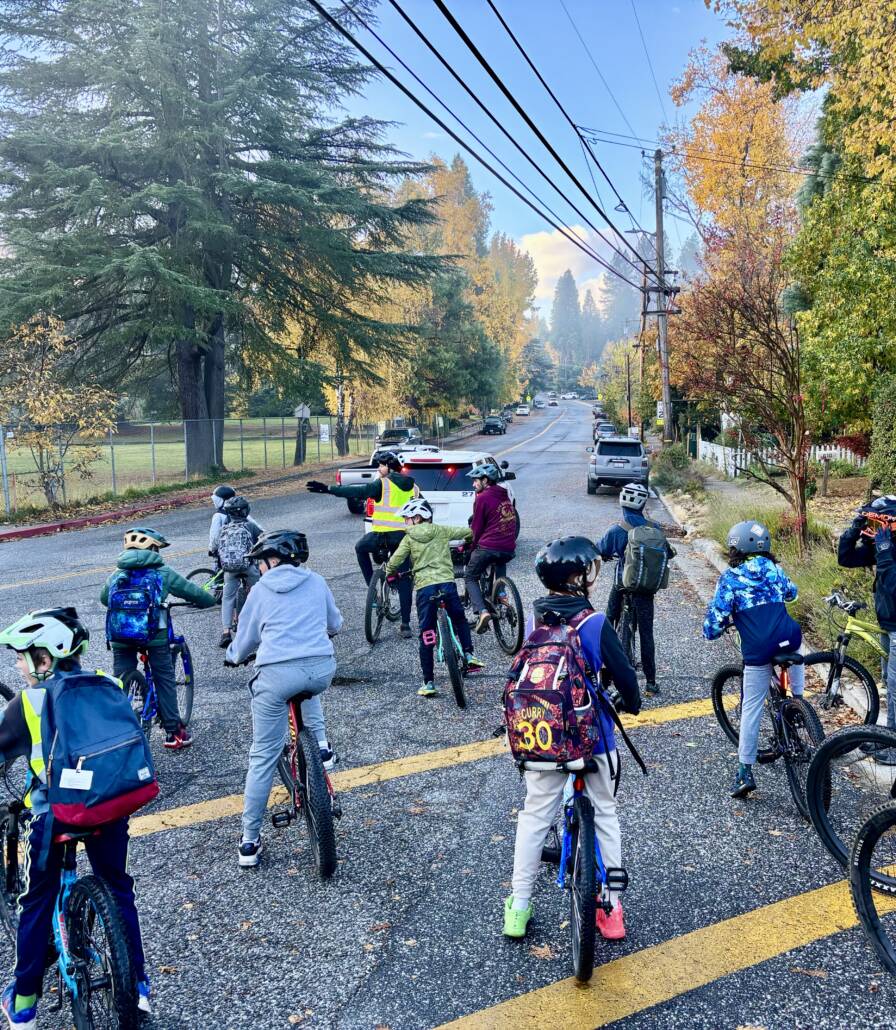
Adian Minty assists students making a left turn with the Nevada City Bike Bus.
The Conditions for Saying Yes
What bike buses surface is something advocates have long understood but don’t always design for: people don’t need to be convinced to want safer, more human streets; they need a low-risk way in.
For families, especially families with young children, the barrier isn’t ideology. It’s uncertainty, and a dozen nagging questions. Is this safe? Is my child ready? Am I the only one thinking about this? A bike bus answers those questions in the most persuasive way possible: by simply existing. As one parent organizing a bike bus in Piedmont put it, “It wasn’t about convincing anyone. It was just, come ride with us. Your kid will be with their friends. We’ll figure the rest out together.”
Once families experience that shift, participation shifts into advocacy. Parents who show up to ride once soon start asking better questions: How could this work more often? What would make this easier? Why isn’t the street already designed for this?
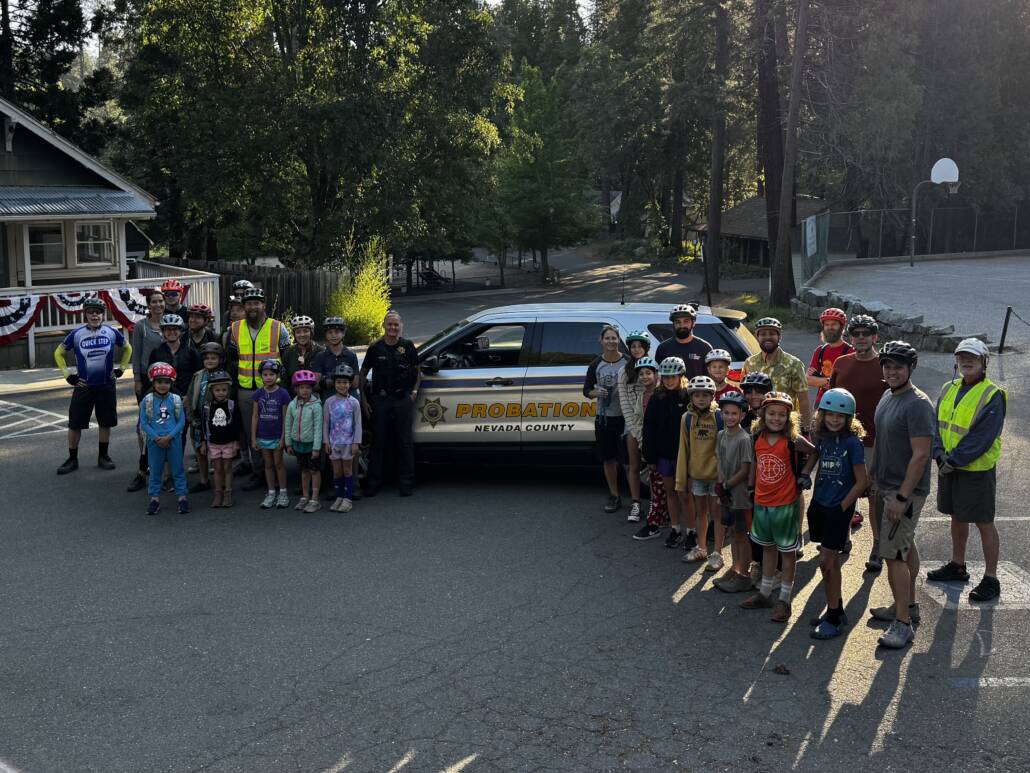
From the Nevada City Bike Bus leaders: Special thanks to the Nevada County Probation Officer Steph Olson for always being there to support our kiddos and provide an extra layer of safety.
Social Infrastructure Matters as Much as Concrete
A recurring theme from families involved in bike buses is how quickly informal efforts generate institutional support. Once the rides begin, school administrators help coordinate and provide time and space on campus. Police departments assist with major crossings or escorts. Local organizations offer safety checks, classes, or logistics. What starts as a handful of families riding together becomes something the community recognizes as legitimate and worth supporting.
In Nevada City, a weekly bike bus began with no sign-ups, no rules, and no formal structure; just the same place, the same time, every Friday. Kids joined along the route. Adult volunteers rotated in. Before long, county staff and CHP officers were showing up on bikes or following along to help keep the group safe.
The ride now happens rain or shine, because the expectation has been set: this is just how Fridays work. As one organizer put it, “Once it was happening, the question stopped being ‘should this exist?’ and became ‘how do we support it?’”
How Independence Builds Momentum for Bikes
Bike buses flip the usual question from “Is this safe?” to “How do we make this safe for kids?”
They treat children not as fragile passengers, but as capable participants; young fellow citizens learning to move through their communities with support. The focus shifts to lowering the barrier to entry so families can try it once without overcommitting, and to letting kids ride with friends, building independence together.
One parent shared a small moment that says everything: a child rushing through chores early so they wouldn’t miss the morning ride. When kids feel proud of themselves, navigating their neighborhood, arriving at school energized, and doing it alongside peers, the effects ripple outward and everyone’s day gets 10% better.
Growing the Definition of Advocacy
Not everyone is going to show up to a city council meeting or read a transportation plan. But as we say, ‘all biking is local’ and plenty of people will show up for their kids, they’ll volunteer once a month or help a family feel comfortable trying something new. They’ll support changes that make what they’re already doing safer and easier alongside their neighbors.
In some communities, bike buses are reinforced by hands-on education, like in Nevada City at Seven Hills Middle School where school-based bike repair programs teach every student how to fix and maintain a bicycle, embedding skills, confidence, and ownership early on. When kids know how their bikes work, and when riding is normalized as part of the school day, biking to school stops feeling like a special event and starts feeling like the most reasonable, approachable choice.
Mode Shift Inspires Mode Shift
Bike buses don’t replace the need for protected infrastructure, they strengthen the necessity to implement it. When people are given a small, supported opening to use bicycles, demand reveals itself quickly. Bike buses elegantly demonstrate that families are ready for mode shift, not someday, but now, if we meet them where they are.
Most importantly, they remind us that safer streets aren’t just an engineering problem.They reveal the gaps in trust and confidence that can undermine communities from joyfully living their lives to the fullest. Bike buses solve those problems together, one ride at a time. And once that momentum starts, it becomes very hard to argue against making it permanent.

